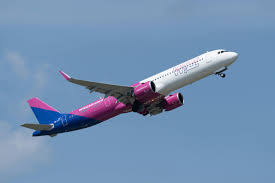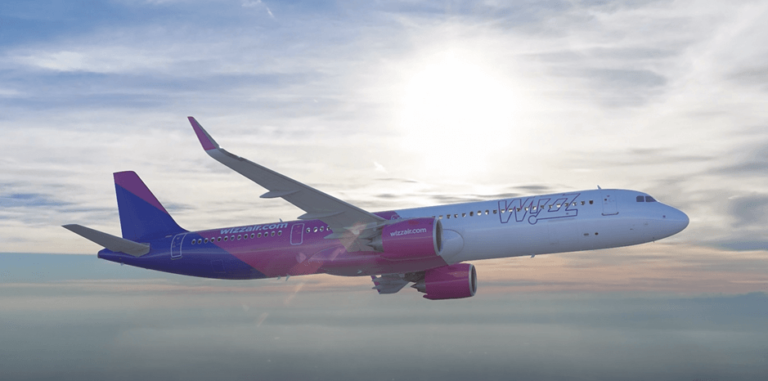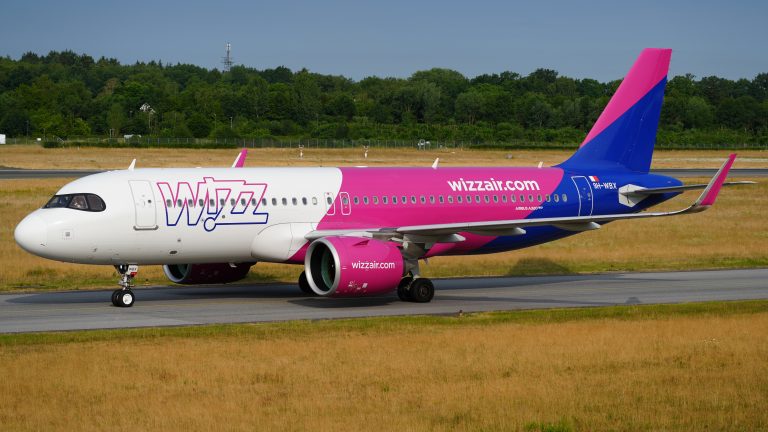
Wizz Air Holdings Plc (LON:WIZZ), Europe’s most emissions-efficient airline1, has issued unaudited results for the six months to 30 September 2025.
This Interim Financial Report does not include all the notes of the type normally included in an annual financial report. Accordingly, this report should be read in conjunction with the 2025 Annual Report and Accounts, and any public announcements made by Wizz Air Holdings Plc during the interim reporting period.
FINANCIAL RESULTS (unaudited)
| Six months to 30 September | 2025 | 2024 | Change |
| Period-end fleet size 1 | 243 | 224 | 8.5% |
| ASKs (million km) | 67,062 | 61,608 | 8.9% |
| Load factor (%) | 92.4 | 92.4 | (0.1) ppt |
| Passengers carried (million) | 36.5 | 33.3 | 9.8% |
| Total revenue (€ million) | 3,342.1 | 3,066.1 | 9.0% |
| EBITDA (€ million) 2 | 981.3 | 826.0 | 18.8% |
| EBITDA margin (%) 2 | 29.4 | 26.9 | 2.4 ppt |
| Operating profit for the period (€ million) | 439.2 | 349.2 | 25.8% |
| Net profit for the period (€ million) | 323.5 | 315.2 | 2.6% |
| RASK (€ cent) | 4.98 | 4.98 | 0.1% |
| Total CASK (€ cent) | 4.46 | 4.54 | (1.8)% |
| Fuel CASK (€ cent) | 1.38 | 1.54 | (10.4)% |
| Ex-fuel CASK (€ cent) | 3.08 | 3.00 | 2.7% |
| Total cash (€ million) 2,3 | 1,984.8 | 1,736.0 | 14.3% |
| Net debt (€ million) 2,4 | 4,832.8 | 4,956.3 | (2.5)% |
1 Aircraft at end of period includes 3 aircraft in Ukraine, but excludes wet-leased aircraft.
2 For further definition of measures presented refer to “Alternative performance measures (APMs)” section of this document. In addition to marked APMs, other measures presented above incorporate certain non-financial information that management believes is useful when assessing the performance of the Group. For further details refer to “Glossary of terms” section of this document.
3 Comparative figure is total cash balance as at 31 March 2025. Total cash is a non-statutory financial performance measure and comprises cash and cash equivalents (30 September 2025: €983.4 million; 31 March 2025: €597.5 million), short-term cash deposits (30 September 2025: €915.5 million; 31 March 2025: €1,060.2 million) and total current and non-current restricted cash (30 September 2025: €85.9 million; 31 March 2025: €78.3 million).
4 Comparative figure is net debt balance as at 31 March 2025.
HIGHLIGHTS
▶ASK capacity was 8.9 per cent higher in H1 F26 vs last year, with Q2 slightly lower than planned due to cancelled flights to Tel Aviv and the discontinuation of Abu Dhabi-based flights from September.
▶Passengers carried increased to 36.5 million in H1 F26 (vs 33.3 million in H1 F25), with a load factor of 92.4 per cent.
▶Total unit revenue (RASK) was up 0.1 per cent to €4.98 cents, while ticket RASK increased 0.1 per cent to €2.87 cents, and ancillary RASK increased 0.1 per cent to €2.11 cents. Q1 RASK was 4.41 cents while Q2 increased to 5.52 cents (+25.3 per cent QoQ).
▶Ex-fuel CASK increased by 2.7 per cent to €3.08 cents. In Q1 it was up 14.2 per cent year-on-year, while in Q2 it reduced to €3.05 cents (-6.3 per cent YoY).
▶EBITDA increased to €981.3 million in H1 F26 (vs €826.0 million in H1 F25), reflecting stable revenue, lower fuel and flight disruption charges and the absence of one-off wet lease costs that impacted H1 F25.
▶Departure punctuality improved by 11.1 percentage points moving from 58.2 per cent to 69.3 per cent.
1 According to Cirium, an independent aviation analytics company, which benchmarks global airline emissions intensity data and positions Wizz Air as the airline with the lowest CO2 per RPK compared to other global airlines.
▶Operating profit increased by 25.8 per cent to €439.2 million, due to improved EBITDA.
▶Net profit was €323.5 million, up 2.6 per cent year-over-year, with a net margin of 9.7 per cent. Q1 net profit was €38.4 million with a net margin of 2.7 per cent, while Q2 net profit was €285.1 million with margin at 14.9 per cent.
▶Total cash increased by 14.3 per cent versus 31 March 2025 to €1,984.8 million, and net debt decreased by 2.5 per cent to €4,832.8 million.
▶Wizz Air finalised the amendment of its aircraft purchase agreement with Airbus, which enables a mid-term annual 10 – 12 per cent seat growth and converts 36 of its A321XLR aircraft variant order commitment to A321neo.
▶GTF engine inspections: 35 aircraft on ground as of 30 September 2025 down from 41 at the end of June 2025.
József Váradi, Wizz Air Chief Executive, commented on business developments in the period:
“Our first half financial results reflect the increased capacity year-on-year deployed over the summer season. During the period both operational and commercial improvements were made, with further actions planned in the months ahead.
We made a number of significant business decisions supporting our longer-term strategic objectives. Notably, closing our Abu Dhabi base on the first of September, and initiating the closure of our Vienna base, which will be completed by March 2026. These actions reflect our pivot away from high cost locations to the opening of new bases at lower cost airports, including at Bratislava, Tuzla, Podgorica, Yerevan and Warsaw (Modlin), which will deliver operational cost savings going forward.”
On current trading and the outlook, Mr Váradi said:
“Most importantly, since the period closed, we have completed our objective of optimizing our aircraft delivery stream in order to target medium-term capacity growth at a more sustainable 10-12 per cent per annum. This encompasses the deferment of 88 Airbus deliveries from this decade to the next, while we have also sold 3 A321neos this year. Our order book, which now extends to 2033, remains a strategic asset, differentiating Wizz Air by securing stable and competitively-priced capacity growth for years to come.
We will see the most significant changes to our delivery profile in around 12 months time (given near-term orders and financing commitments). As such, we are actively managing this winter season’s capacity to deliver circa mid-teens H2 seat capacity growth YoY. In terms of pricing, looking at the current ninety-day booking curve, we are seeing unit revenue (RASK) approximately down low single digits percentage-wise year on year while the load factor, conversely, is up by a similar level in terms of a percentage points gain.
For the next fiscal year, we expect GTF engine-related aircraft groundings to reduce to a range of 25-30 aircraft.”
NEAR-TERM AND FULL-YEAR OUTLOOK
▶Capacity (ASKs): F26 H2 up around 10 per cent YoY (mid teens percent increase in terms of seat capacity); F26 full year up +10% YoY (up low teens percent increase in terms of seat capacity);
▶Load factor: F26 H2 up low single digit percentage points YoY; F26 up around 1 per cent YoY;
▶Revenue: Both F26 H2 and F26 full year RASK down low single digits percent YoY;
▶Costs: F26 H2 Total CASK up low single digits YoY; F26 full year broadly flat YoY;
▶Ex-fuel CASK: F26 H2 high single digit percent increase YoY; F26 full year mid-single digits higher YoY, in line with previous expectations associated with the changes made to the business and the timing of certain maintenance and “Other Expense” cost items YoY;
▶Fuel CASK: F26 H2 down mid to high single digits; F26 full year down high single digits.
COMMERCIAL AND NETWORK UPDATE
Wizz Air has continued its strategic realignment, with a renewed focus on core CEE markets, which included the discontinuation of its Abu Dhabi base and joint venture and the closure of its five aircraft base in Vienna.
Wizz Air has announced several new Central & Eastern Europe base openings. Warsaw (Modlin), Tuzla, Yerevan and Bratislava will commence operations with two aircraft each and will contribute to airport and handling cost savings partially from H2 F26, but more meaningfully from F27.
The core markets continued to be strengthened with the allocation of additional aircraft to Skopje, Sofia, Katowice, Wroclaw, Krakow, Gdansk, Tirana and Chisinau.
Wizz Air has entered into partnership with TravelFusion Limited, a travel content aggregator, enabling it to further expand its offerings to the corporate travel market.
During the period it rolled out a revised airport fee collection mechanism, while it continues to expand machine learning technologies in pricing, for both tickets and ancillaries.
GTF ENGINE UPDATE
As of 30 September 2025, Wizz Air had 35 aircraft grounded due to GTF engine-related inspections; an improvement over this summer when the grounded fleet was comprised of 41 aircraft. The average groundings expected through to the end of F26 are in the range of 30-35 aircraft with this figure reducing to 25-30 in F27, using a forecast based on 300-day engine turnaround time. The company continues to invest in stable operations and is expecting a further 16 spare engines to be delivered in H2, providing a total spare engine fleet of around 100 engines to support operations for the start of summer 2026.
FLEET UPDATE
▶Wizz Air has finalised the agreement to reschedule its order book delivery positions going out to 2033. The agreement also includes the conversion of 36 A321XLRs to A321neos, leaving the Company with a total A321XLR sub-fleet of 11 extended range aircraft from F27. The changes in the schedule start from January 2026. As part of the agreement, the Company has utilised its deferral rights within its aircraft purchase agreement.
▶In November 2025, the Company has also taken delivery of and immediately sold three A321neo aircraft to an aircraft lessor for onwards leasing to a related airline, further modulating its near term fleet growth in line with its objectives.
▶In the six months ended 30 September 2025 Wizz Air took delivery of 16x new A321neo aircraft, 3x new A321neo XLRs and redelivered 7x A320ceo aircraft, ending the period with a total fleet of 243 aircraft: 30x A320ceo, 41x A321ceo, 6x A320neo, 163x A321neo and 3x A321neo XLR.
▶The average age of the fleet currently stands at 4.6 years, and remains the youngest fleet of any major European airline, while the average number of seats per aircraft has climbed to 229 as at September 2025.
▶The share of new “neo” technology aircraft within Wizz Air’s fleet has increased to 71 per cent.
▶As at 30 September 2025, Wizz Air’s delivery backlog comprised a firm order for 237x A321neo and 44x A321XLR aircraft, a total of 281 aircraft. Since then, we have agreed a significant adjustment to our delivery schedule, with 88 Airbus A321s being deferred out of this decade and now extended to F33. As part of the agreement, the number of XLRs to be delivered has fallen from an original commitment to take 47 down to 11, with the difference taken up by conversions to A321neos.
▶The table below shows our fleet plan development according to the revised delivery schedule:
| F26 | F27 | F28 | F29 | F30 | F31 | F32 | F33 | |
| A320 CEO (180 seats) | 20 | 12 | 2 | 2 | 2 | 2 | 2 | – |
| A321 CEO (230 seats) | 40 | 29 | 14 | – | – | – | – | – |
| A320 NEO (186 seats) | 6 | 6 | 6 | 6 | 6 | 6 | 6 | – |
| A321 NEO (239 seats) | 182 | 213 | 240 | 280 | 315 | 342 | 365 | 368 |
| A321 XLR (239 seats) | 8 | 11 | 11 | 11 | 11 | 11 | 11 | 11 |
| Fleet total | 256 | 271 | 273 | 299 | 334 | 361 | 384 | 379 |
FINANCIAL UPDATE
▶The Company enjoyed profitable summer trading and recorded strong cash position of €1,984.8 million on 30 September 2025, a 14.3% per cent increase vs 31 March 2025. Wizz Air anticipates it will repay from its own cash its €500 million bond that matures in January 2026, though it will maintain its EMTN programme to support future capital expenditure requirements, similar to its practices over the last three years.
▶As of 22 October 2025, using jet fuel zero-cost collars, Wizz Air has accumulated hedge coverage of 82 per cent of its jet fuel needs for F26 at a price of 691/762 $/mT. For F27 the coverage is 50 per cent at a price of 652/718 $/mT. The jet fuel-related EUR/USD FX coverage stands at 88 per cent for F26 at 1.10/1.15, while the coverage for F27 stands at 47 per cent at 1.13/1.18 rates.
▶The Group’s credit rating was downgraded by Moody’s Investor Services on 17 June 2025 from Ba2 to Ba1 keeping outlook negative. Fitch downgraded Wizz Air’s credit rating on 9th July 2025 from BB+ to BB with stable outlook.
▶The balance of the EU emissions trading scheme credits repurchase agreement as at end of September 2025 was €278.6 million (vs €271.9 million at the end of F25). This repurchase agreement was rolled over in November 2025 with a new balance of €325.3 million, further enhancing the Company’s liquidity levels. The inventory must be repurchased from the counterparty by September 2027.
▶Wizz Air continued to receive OEM compensation from Pratt & Whitney related to the GTF engine issues.
ESG UPDATE
▶As of 30 September 2025, the 12 months rolling CO2 emissions per passenger kilometre was at 51.2g (vs 52.6g in the preceding 12 months), the lowest among peers in the industry.
▶During H1 F26 Wizz Air introduced a voluntary pension program to help employees save for retirement.
▶It also paid out an all-employee bonus equivalent to 13th month salary based on a set goal in the year before.
▶LinkedIn learning access has been expanded to crew members.
▶Wizz Air launched the third term of its Sustainability Ambassador Programme, after successfully concluding the second term during the summer.
▶Wizz Air continued to be recognized for its leading efficiency and was awarded Most Sustainable Low-Cost Airline for the fifth consecutive year at the World Finance Sustainability Awards 2025.
▶As of 15 October 2025 the share of Wizz Air issued share capital held by Qualifying Nationals (i.e. European Economic Area nationals), was 31 per cent, which, based on the disenfranchisement policy that Wizz Air Board last applied during July ’25 AGM, would entitle them to 55 per cent of total voting rights, leaving Non-Qualifying Nationals with the remaining 45 per cent of total voting rights.