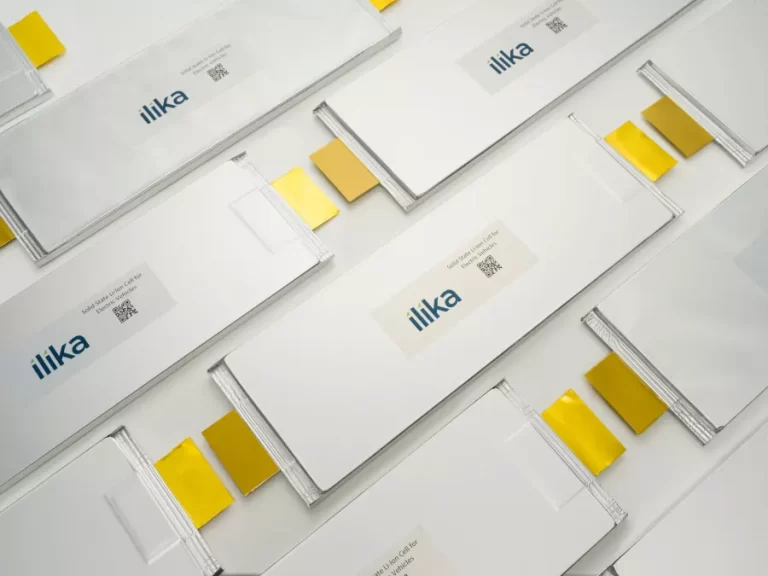
Ilika plc (LON:IKA) Chief Executive Officer Graeme Purdy caught up with DirectorsTalk to discuss the new 10Ah Goliath solid-state battery prototypes, the role of its automated pilot line, manufacturing yields, and future 50Ah development plans.
Q1: Graeme, what have Ilika had to optimise in order to scale your batteries from 2Ah to 10Ah?
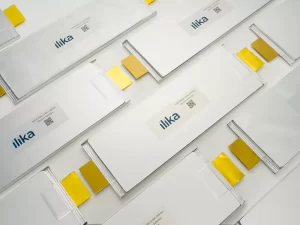
A1: Well, that’s a mighty five times increase in capacity, and these cells are actually physically bigger, if you saw them.
So, we are having to put down the components, the electrodes, and the electrolyte, over a larger area so there is some printing expertise involved, some coating expertise. Obviously, they have a higher energy density so in terms of their performance on a per kilogram basis, so the gravimetric energy density, that has gone up by at least 50%.
In order to do that, we have had to use higher energy materials, higher energy electrodes and there is some process expertise in being able to do that efficiently. So, quite a lot of work has gone into this scale up.
Q2: How useful has your automated pilot line been in producing these prototypes?
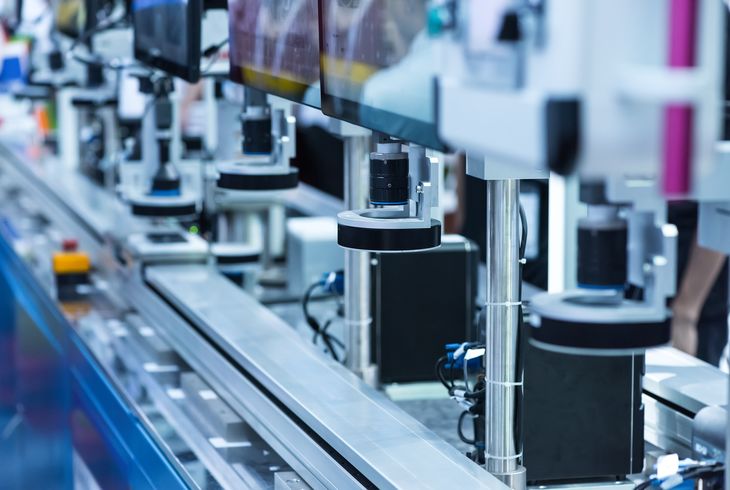
A2: Well, to be honest, we could not have made these cells without that pilot line. The engineering team has done a great job in preparing that over the last few months, together with our suppliers.
The key thing actually, when you make these batteries for sampling to customers, is that you need to cluster their performance, so you need to make sure that you have got a reproducible performance from all of the cells that you send. When you have an automated approach, it just makes it more straightforward to achieve those target specifications.
Q3: Now, you mentioned a manufacturing yield of 93%. How does that compare to the level achieved in industry?
A3: The rule of thumb is that when you are operating a pilot line, you should be able to do that in order to deliver a yield of about 80% and then by the time that gets scaled up and applied at gigafactory level, you want at least 90%.
So, I think it is absolutely fantastic that we have got a yield of 93% for our process, which shows how robust it is, and how ready that now is for deployment on a larger scale.
Q4: What sort of applications could be powered by a 10Ah hour battery?
A4: A 10Ah battery starts to become useful for quite a few different applications. Actually, some EVs, for instance, if you have got a Tesla 3 or a Tesla Model Y, you have got cylindrical cells that make up the battery pack in those vehicles that are actually lower in capacity than these 10Ah pouch cells that we have made. Although it is probably fair to say that Tesla is now using larger cylindrical cells with a higher overall capacity for some of their newer models. It’s on the cusp of being relevant for pack design for EVs, although we will be moving on to 50Ah in due course.
There are other lateral applications in other addressable markets that the 10Ah hour battery is really interesting for. So, in domestic appliances like your robotic lawnmower or beauty products like hair dryers and hair straighteners, and some of the domestic appliances like handheld vacuum cleaners, but also in the defence industry, which is very topical at the moment, where people are building battery packs for UAVs, etc. So, quite a wide range of applications starts to come into the frame there.
Q5: So, that being the case, why bother developing 50-amp hour batteries?
A5: In the automotive industry, they are using larger pouch cells than 10Ah hours, as I was hinting at, and so ultimately, we are being led by the needs of our customers. We are interacting with them to optimise the size of the pouch designs that we can offer as our generic A sample. So, that’s the trajectory we are on. If customer appetite changes, and we see an early monetisation opportunity, of course, we will flex Ilika’s development roadmap in order to accommodate that.