Ferro-Alloy Resources Limited (LON:FAR), the vanadium producer and developer of the large Balasausqandiq vanadium deposit in Southern Kazakhstan, has announced an update on the progress of the expanded feasibility study for the large Balasausqandiq vanadium deposit.
Overview
FAR is currently well advanced in the workstreams necessary to produce a Bankable Feasibility Study (‘BFS’). Following the investments by Vision Blue Resources during 2021, the decision has been taken to expand the scope of the Study to include not only the finalisation of the BFS for the first phase of development, known as Phase 1, but also to include Phase 2. Phase 1 envisages the treatment of 1 million tonnes of ore per year to produce 5,600 tonnes of vanadium pentoxide, and Phase 2 envisages an expansion to 4 million tonnes per year with production rising to 22,400 tonnes of vanadium pentoxide.
The Company has commissioned SRK Consulting (Kazakhstan) Limited to produce the overall Feasibility Study, with the metallurgy and process plant being covered by Tetra Tech Inc. The results of the BFS are expected during the last quarter of 2022.
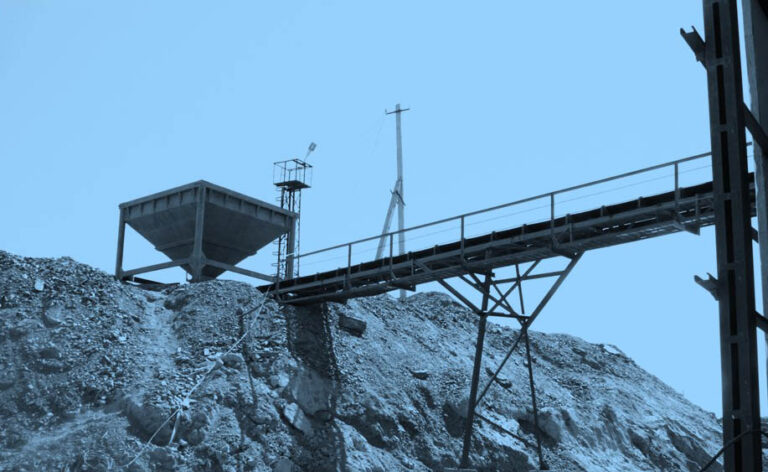
A considerable body of work has been undertaken in previous studies, including the assessment of the reserves of just one (of five) ore-bodies on a JORC 2012 basis at 23 million tonnes, and the operation of a test plant at which the proposed process was developed and tested at pilot and commercial scales. Balasausqandiq is unusual in being a sedimentary deposit comprised of black shales which are capable of a far lower-cost treatment route, in terms of both capital and operating costs, than the more plentiful vanadium ores comprising titano-magnetite which require pre-concentration and roasting at high temperatures.
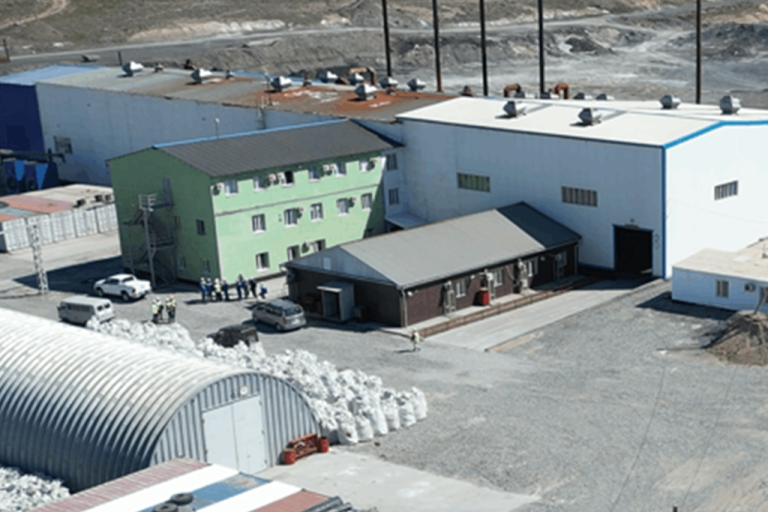
The former test-plant is currently operating on a commercial basis to produce vanadium, molybdenum and nickel concentrates from bought-in secondary raw-materials.
Drilling
At Balasausqandiq, there are five currently known ore-bodies. The first, OB1, has been explored sufficiently for a reserve of 23 million tonnes of ore to be announced under the JORC 2012 standard, providing enough ore to feed Phase 1 of the development of Balasausqandiq. Ore bodies two to five have been explored and a reserve announced under the former Kazakhstan system of reserve classification. In line with the decision to upgrade the scope of the feasibility study, the decision has been taken to carry out further drilling of OB1 to further understand the underground geometry and to use this information to tailor a drilling programme to be carried out on ore-bodies two to five with the intention of being able to define a reserve under JORC 2012 sufficient for Phase 2.
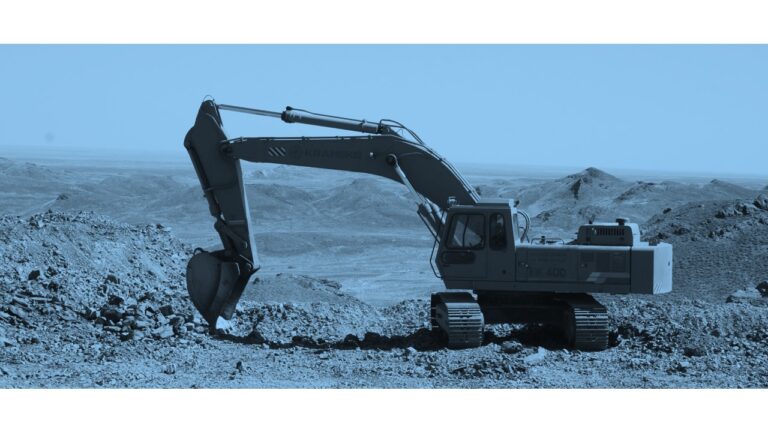
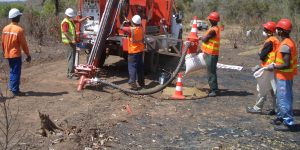
Contracts have been signed with two drilling companies. The first will complete a programme of diamond core-drilling and the second, a programme of the faster Reverse Circulation (‘RC’) drilling where the core is recovered as the drill chippings rather than as whole core.
The core-drilling rigs have now arrived on site and first drilling started on 23 November 2021. An initial programme of 6,000 metres will be carried out after which the requirements for the remainder of the programme, likely to be between 2,000 and 4,000 metres, can be re-assessed.
The RC contract provides for an expected start-date of 1 February 2022. The initial programme is for 9,000 metres. After assessment, a decision will be taken on how much further drilling of up to around 5,000 metres is required. It is currently expected that the RC drilling will be completed towards the end of the first quarter 2022.
Metallurgy
The FAR process utilises pressure acid leaching (‘PAL’) for the extraction of vanadium and associated uranium, molybdenum, aluminium, potassium and rare earth elements. The process was developed by the Company at its Shieli operation in Kazakhstan and has been tested at both pilot and semi-commercial scales. As part of the Feasibility Study, a comprehensive metallurgical test work program has been implemented at SGS – Canada (Lakefield) to validate the process and confirm critical process parameters tested in the pilot plant such as leach extraction, extraction kinetics, effect of recycle streams, solid/liquid separation requirements, reagent consumptions and final vanadium pentoxide product quality. To further de-risk the project a separate leach and comminution variability programme is also being implemented at SGS.
Initial batch testing has been completed and the results were in line with historical data from the Company. The next stage, “locked-cycle” testing where the leaching process is carried out multiple times to simulate actual ongoing operations, has commenced and will provide more definitive results, expected in early 2022.
By-products
As part of the process of leaching the vanadium, uranium, molybdenum, aluminium, potassium and rare-earth elements are also recovered into solution. Recovery from the leach solution is carried out by a three-stage sorption process in which uranium and molybdenum are recovered in the first, vanadium in the second and rare-earth elements can possibly be recovered in the third. The aluminium and potassium can be precipitated from the solutions as potassium alum. The recovery of these by-products will be confirmed within the test-programme discussed above.
Potentially a key by-product, carbon, is contained in the tailings and comprises a form of carbon similar in physical and chemical form to carbon black which is usually made by burning oil or gas. The Company has previously successfully tested two potential uses for this product; the first as a filler for making rubber and the second for smelting to make ferro-silicon. Two test-programmes have now been started to examine these options in more depth. A contract has been signed with professors from the Kazakhstan National University, Al Farabi, to examine the use as a filler in making rubber, with further testing by Belarusian State Technological University in Minsk, and a contract with the National Centre for Complex Processing of Mineral Raw Materials of the Republic of Kazakhstan has been commissioned to test the production of briquettes and use for smelting. Results of both contracts are expected during H1 of 2022.
Nick Bridgen, Ferro-Alloy Resources CEO, commented: “Balasausqandiq benefits from a combination of low capital and operating costs, access to infrastructure, an advantageous location and huge scale.
“World demand for vanadium is growing as more vanadium flow-batteries to store renewable energy are being built and vanadium in its traditional use as an alloy of steel is needed to cut down on CO2 used in steel production.
“Through its ability to supply large quantities of vanadium at low cost, Balasausqandiq is destined to play an essential part in the reversal of global warming.”