Great Western Mining Corporation PLC (LON:GWMO), a strategic minerals exploration and development company, has announced the results of an IP geophysical survey and the assay results of a reverse circulation drilling programme at Rhyolite Dome, a previously undrilled prospect, which forms part of its Olympic Gold epithermal precious metals project in the Walker Lane trend of Nevada.
HIGHLIGHTS
· Six IP survey lines completed, identifying a near-surface resistivity anomaly associated with a fault and a deeper untested chargeable feature at more than 300 m depth.
· Four shallow RC holes totalling 2,315 ft (706 m) intersected silicified, hydrothermally altered volcanic rocks consistent with an epithermal system.
· Low-grade gold and more significant silver mineralisation returned, including 70 ft (21.3 m) at 1.64 g/t Ag.
· Elevated pathfinder elements (Ba, As, Mn, Li, Sb) indicate shallow levels of a hydrothermal system.
· Geological model to be refined for better targeting of the deeper chargeable IP anomaly.
Great Western Chairman Brian Hall commented: “We have already extensively drilled at the Olympic Gold Project in the region of the prolific but now worked-out OMCO Mine vein, intercepting gold at an extension of the mine and at the Trafalgar Hill prospect on the western side of the claims area. The Great Western team regards Rhyolite Dome, one of the eight currently identified prospects across the 800 acre (324 ha) claims area, to be a prospect that merits further assessment and, in the second half of 2025, four initial shallow holes were drilled following an IP survey to launch a maiden exploration programme. While this first-pass drilling didn’t return significant precious-metal intercepts, it has materially advanced our geological understanding. Combined with the high-quality geophysical dataset, these results provide a strong technical foundation to refine targeting and design the next phase of exploration at this highly prospective epithermal gold prospect.”
DETAILS
The Olympic Gold Project lies in a historically prolific low-sulphidation epithermal gold district within the Walker Lane Trend, centred around the past-producing OMCO Mine, which delivered exceptionally high grades of 25-30 g/t Au between the two world wars. This is an area of gold-quartz veining and brecciation associated with silica flooding.
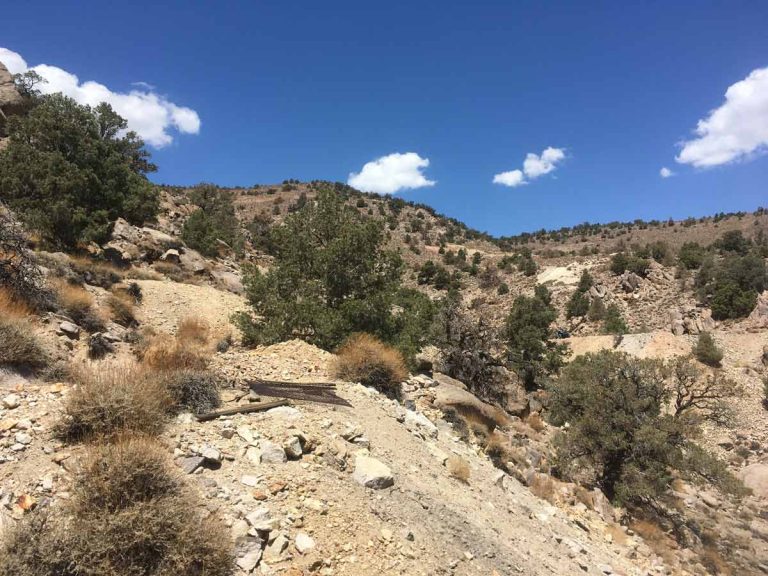
Rhyolite Dome is located along the Olympic Gold fault zone, approximately 1.5km southeast of the OMCO Mine. The area shows coincident geophysics (IP survey) and soil geochemistry anomalies, together with outcropping indications of geological and structural prospectivity indicators, as previously reported in 27 March 2024.
Six IP geophysical survey lines were successfully completed at Rhyolite Dome (Figures 1 and 2). Data inversions identified a near-surface zone of anomalous resistivity that coincides with a mapped fault zone, as well as a chargeable feature at depth of approximately 25mrad located more than 300 m below surface.
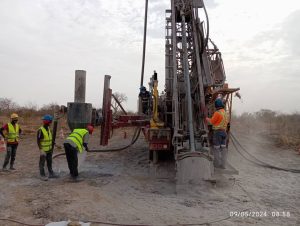
Four shallow RC drill holes were completed at Rhyolite Dome in November 2025 totalling 2,315 ft (706 m) (Figure 1). Drilling primarily targeted the near-surface resistivity anomaly defined by the IP survey, while the deeper chargeable feature was ultimately beyond the effective reach of the contracted RC rig from the permitted drill pads. Drilling intercepted several intervals of silicified rhyolite with locally common pyrite, together with hydrothermally altered volcanic rocks. Low concentrations of gold were encountered, with maximum intercepts of 5 ft (1.5 m) at 0.12 g/t Au and 5 ft (1.5 m) at 0.11 g/t Au in hole RDRC005 (Table 1). More significant silver intercepts were returned, including 70 ft (21.3 m) at 1.64 g/t Ag and 0.03 g/t Au in hole RDRC004, as well as 15 ft (4.6 m) at 1.13 g/t Ag and 0.05 g/t Au (Table 1).
Elevated concentrations of pathfinder elements were recorded across the drill hole assays, including barium (Ba, consistently greater than 1,000 ppm), arsenic (As, consistently greater than 200 ppm and up to 3,820 ppm), manganese (Mn, with several intervals exceeding 1,000 ppm), lithium (Li, consistently greater than 50 ppm) and antimony (Sb, with various intervals above 100 ppm). These geochemical signatures are consistent with the shallow levels of a hydrothermal system.
On the basis of these results, the geological framework for the Olympic Gold Project will now be revisited to refine future exploration targeting, particularly with respect to the chargeable feature that remains untested by this shallow RC drilling programme.
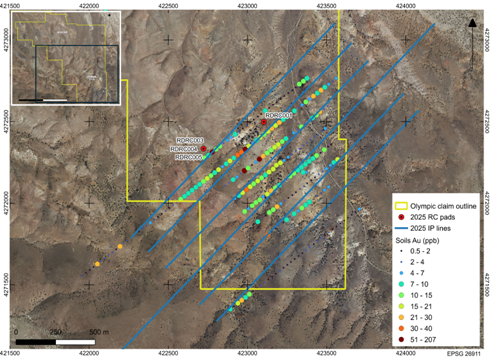
Figure 1: Map showing the location of the IP geophysical survey lines and drill collars and previously reported soil sampling survey. Coordinates in EPSG 26911.
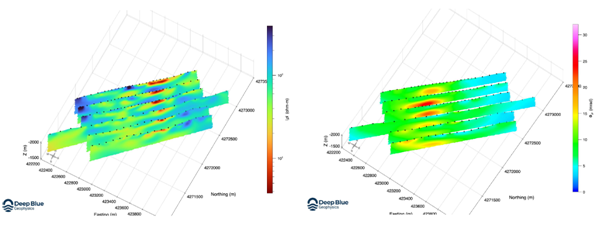
Figure 2: Inversions of the IP geophysical survey data (Left = resistivity, right = chargeability).
| Hole | X | Y | Azi/Dip | From (ft) | To (Ft) | Interval (ft) | Au (g/t) | Ag (g/t) | ||
| RDRC005 | 422722 | 4272332 | 135/-70 | 90 | 95 | 5 | 0.12 | 1.21 | ||
| 125 | 130 | 5 | 0.11 | 0.29 | ||||||
| RDRC004 | 422722 | 4272332 | 270/-45 | 240 | 310 | 70 | 0.03 | 1.64 | ||
| RDRC001 | 423093 | 4272498 | 200/-60 | 445 | 460 | 15 | 0.05 | 1.13 |
Table 1: Highlight drill hole assay intervals. Coordinates in EPSG 26911.
Additional Information
RC chip samples were logged and collected at 5ft (1.5 m) intervals and submitted to ALS laboratories, Reno, Nevada. Samples were analysed by methods ME-MS61 and Au-AA25. Quality control samples (duplicates, blanks and certified reference materials) were inserted by the Company and results reviewed prior to release. Down hole surveys were completed for every hole.