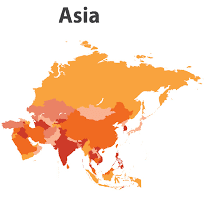
Fidelity Asian Values Plc (LON:FAS) has around one-third of its investment trust assets invested in China. Catherine Yeung, Fidelity Investment Director, explains what she is seeing in China today and why it is a good time to invest in the world’s largest economy.
“From an economic health perspective, the long-term structural growth drivers for China remain in place – such as the rise of the domestic consumer and investor. By 2030, China is predicted to be home to about 400 million households with upper-middle and higher incomes, approximately as many as in Europe and the United States combined . This creates a strong backdrop for companies to grow their earnings and profitability.”
Contrarian investing is supposed to feel a little uncomfortable and investing in China certainly feels uncomfortable today. The country continues to wrestle with Covid lockdowns, slowing growth and geopolitical tensions. Yet, the Fidelity Asian Values investment trust now has around one-third of its assets invested there.
We are not naïve about the problems China is facing. It has been a difficult place to invest over the past two years and sentiment has been against it. The country’s zero Covid policy continues to interrupt economic activity, with no immediate signs of a change of heart from the government. The property sector has been in crisis, with developers defaulting on loans and sales slumping. The property market is an important part of the Chinese economy and its weakness is significant.
However, the Chinese market has fallen a long way and is now back to levels last seen in late 20191. Sentiment towards the Chinese stock market remains poor. One indication is the discounts to net asset value for China-specialist investment trusts, which are at multi-year highs. As contrarians, this is the type of environment that draws our attention because it may offer opportunities to find good companies at lower prices.
It is clear that many of the risks have been priced into stock market valuations already. Chinese companies look cheap relative to their history and relative to developed markets, particularly in unloved areas such as property. They may get cheaper, but it provides a margin of safety for investors.
From an economic health perspective, the long-term structural growth drivers for China remain in place – such as the rise of the domestic consumer and investor. By 2030, China is predicted to be home to about 400 million households with upper-middle and higher incomes, approximately as many as in Europe and the United States combined . This creates a strong backdrop for companies to grow their earnings and profitability.
Equally, China does not face many of the problems currently experienced by Western markets. Households are in good shape with the household savings rate at over 30%, the exact opposite of the situation in many developed markets where household savings are falling and resilience is low because of rising interest rates and utility bills.
China is not beset by the same inflationary challenges. China’s CPI shows an increase of 2.5% year on year , marginally behind the Central Bank target of 3%. This puts policymakers in a strong position to support the economy, either through falling interest rates or through government spending initiatives. This is already happening. It is a notable contrast to central banks around the world who are tightening monetary policy to curb inflation.
In the meantime, growth remains relatively robust. The IMF is forecasting growth of 3.3% in 2022 and 4.6% in 20234 . There should be an improvement in the Covid situation over the next 12 months, as new vaccines and treatments come on stream. This could give the economy a short-term boost.
Against this backdrop of an improving economic picture and poor sentiment, we believe it is a good moment to be revisiting China. Nevertheless, as contrarians, we are very careful on quality, recognising that there are still plenty of risks in the Chinese market. We look for businesses with good management teams, that are rewarding minority shareholders, where valuations give a strong margin of safety.
At the moment, we are hunting in the property sector, where valuations of some large state-owned enterprises (SOEs) are very low due to the broad sell-off of the sector, but where yields are high. There are likely to be some defaults in the property sector, but they will be managed. More importantly, there will be consolidation, with a ‘flight to safety’ towards these SOEs. In selecting the higher quality companies in a difficult sector, we can pick up a high dividend and should benefit as sentiment improves.
We are also looking at other areas likely to benefit from an improving economy. Outdoor advertising company Focus Media should be a beneficiary of the recovery. Even though we are still seeing a weak consumption environment, the company has demonstrated strong new customer acquisition and retention of existing customer. They also are the leader in this part of the advertising world, with new entrants entering the market over the years but Focus maintaining its leadership position.
To our mind, the best opportunities are seldom found where sentiment is universally bullish. We believe the ability to grow capital is far greater in those parts of the market that are unfashionable, where there is the chance for a recovery in operational performance and sentiment. This is what we see in China today.
(Sources: Fidelity, MSCI, McKinsey, Reuters and IMF)
Fidelity Asian Values Plc (LON:FAS) provides shareholders with a differentiated equity exposure to Asian Markets. Asia is the world’s fastest-growing economic region and the trust looks to capitalise on this by finding good businesses, run by good people and buying them at a good price.