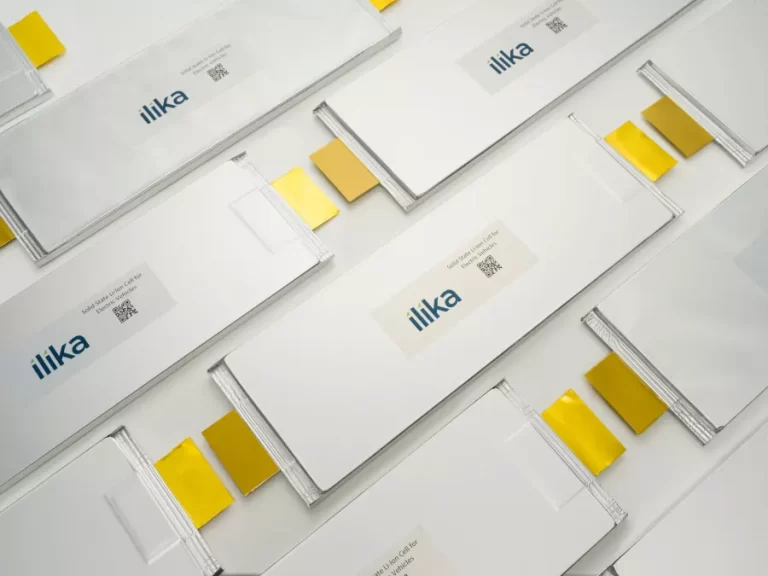
Ilika plc (LON:IKA) Chief Executive Officer Graeme Purdy caught up with DirectorsTalk for an exclusive interview to discuss the levels of energy density achieved for Stereax, wireless edge node and the first commercial deployment.
Q1: You provided an update to the market on the energy density of your Stereax solid state batteries in which you mentioned a perpetual power pack. Graeme, can you describe for us what you mean by this?
A1: A perpetual power pack is a combination of an energy harvester, such as a small photovoltaic panel, and a means of storing that energy and then supplying it at a rate, a power, that is useful to the device you’re trying to supply power to.
So, the concept of a perpetual power pack is effectively that the power pack takes its original energy from the environment, harvests it and then it stores it until its ready so that you can use it usually to power something like a sensor or a small electronic device.
Q2: What are people using at the moment?
A2: At the minute, people either run a wire or a cable to the device or they use a disposable battery.
So, the disadvantage of having to run a wire is that it’s actually quite expensive, particularly if you’re trying to over long distances.
The disadvantages of using a disposable battery is that at some point you have to replace it, it’s not so much the cost of the replacement cell, it’s more to do with the fact that actually you have to deploy a labour crew to do it. So, in an industrial environment you need a team to go out and replace those cells and so that’s got quite a high operating cost associates with it.
The other downside of using disposable cells is that they’ve got an environmental impact and that’s becoming increasingly important as the number of batteries that we deploy starts to increase.
Q3: Just coming back to today’s headline, how has it been possible to increase the energy density so dramatically?
A3: Like many technologies, Ilika have been gradually improving the performance of our technology along the lines of the Japanese concept of ‘kaizen’ so continuous improvement. So, there’s been a number of small improvements to the process and the way that we make our material but also the architecture of the cells that when added up have amounted to this significant step forward.
Q4: You also mentioned a wireless edge node, for those of us that are no so technical, could you just explain what that is?
A4: There’s quite a lot of jargon associated with the Internet of Things and an edge note is what is often referred to as really the sensors at the edge of a data network. So, you imagine that you’re trying to monitor process parameters in say a chemical plant or a refinery, you’re gathering data from different pipes and compressors and pumps and valves around the refinery and the point in which you acquire that data is referred to as an edge note.
That data is generally relayed back to a telemetry point where the data is then consolidated and transferred back to a control room. So, the edge note is really the perimeter of your data acquisition network.
Q5: Just looking at the bigger picture, what do you think will be the first commercial deployment of this and could you give any timing around that?
A5: Industrial IoT is very important for Ilika plc, we’ve got quite a large pipeline of interactions with companies that are assessing this technology at the moment. I’ve talked to the market about this regularly over the past couple of years and demonstrated how that pipeline is growing and continues to have significant momentum.
Also, we’re seeing interest in asset tracking, so not necessarily throughout the whole supply chain although that is important but more specifically in complex environments where you’ve got scarce resources. So, expensive equipment or people that are distributed throughout that establishment, you need to track where they are, so you can deploy those scarce resources.
So, a hospital would be a good example of that where you may have some mobile equipment such as ECT equipment and you may need that on different wards, you haven’t got a replica set of equipment for every ward in the hospital and you want to be able to know exactly where that is very quickly.
So, you can monitor the locations of that equipment using asset tracking concepts that you can power using power packs that we’ve been talking about today.