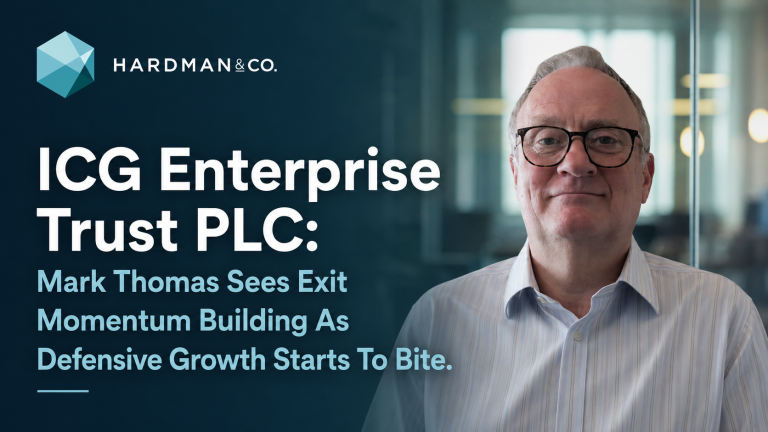
ICG Enterprise Trust plc (LON:ICGT) is the topic of conversation when Hardman & Co’s Analyst Mark Thomas caught up with DirectorsTalk for an exclusive interview.
Q1: Your recent report sits behind a disclaimer. What can you tell us about that?
A1: It is just the standard disclaimer that many investment companies have. In essence, for regulatory reasons, there are some countries (like the US) where the report should not be read. In the UK, because private equity (PE) is not a simple asset class, it should only be looked at by professional/qualified investors. Page 2 of the report gives all the details.
Q2: Can you give us a brief summary of your report ‘FY’24: portfolio companies performing strongly’?
A2: The key message from ICG Enterprise Trust’s FY’24 results, to January, is the continued strength of the operating companies, which continue to deliver mid-teen EBITDA growth.
Despite challenging markets, margins have widened, which should help allay some concerns over the impact of the higher-rate environment. Target returns are “broadly unchanged”. FY’24 saw about half the usual investment and realisation activity (and fewer realisations saw less NAV uplift on exit). A degree of volatility is to be expected, and the five- and 10-year total annualised NAV per share return (14.6% and 13.2%, respectively) are a better reflection of what investors are getting from the defensive growth strategy.
The trust has a balanced capital return policy.
Q3: So, your key themes were value creation from their defensive growth strategy and particularly how this works in a higher-rate environment. What can you tell us about that?
A3: Their focus is on growing, profitable businesses and well-established managers. This has seen investee companies deliver mid-teens’ EBITDA growth over the long term.
Crucially, there has been great consistency of performance, which materially enhances compounding, and we estimate its EBITDA growth since 2010 has been over 4x the UK market. FY’24 results prove both resilient and well-diversified investments.
In terms of the higher-rate environment, the bottom line is that its partner GPs’ target returns are unchanged. We detail in the note how both organic and inorganic EBITDA growth opportunities combine to offset the pressure of higher rates. It is worth remembering that over the long-term investment horizon of PE, financing costs are just one of many variables the managers face.
Q4: In previous interviews, you have commented on why you believe the NAV to be realistic and resilient, can you just give us the key reasons?
A4: After having conducted extensive due diligence, the fact that buyers are still willing to pay substantial premiums to carrying value is evidence of the conservative accounting. In FY’24, this was close to a 30% premium, continuing a long-term trend. Further, continued delivery of this should mitigate concerns about the credibility of the current NAV.
In terms of resilience, ICGT’s strategy is defensive growth. Our note explores what defensive growth means in practice. The key factors are a focus on growing, profitable businesses, in secular growth sectors, with multiple options to generate growth, and well-established managers.
Q5 The company announced an opportunistic buyback programme in addition to the long-term progressive dividend and share buyback programme. What can you tell us about that?
A5: ICG Enterprise Trust has a balanced approach to capital allocation, including making new investments to generate long-term growth, a progressive dividend policy (it was up 10% in FY’24), a long-term buyback programme (£23m bought back to date) and, with these results, it announced a tactical buyback programme of up to £25m to take advantage of the unusually high level of discount. This will run alongside the long-term programme, with the opportunistic programme, typically, involving larger single transactions but active less frequently.
We believe this reflects the board’s willingness to take market opportunities as they are presented but, with a strong balance, continue to make investments and new commitments.
Q5: What could change in terms of the perceptions driving the discount?
A5: We see two elements at work here. There is a sector-wide discount and then trust-specific issues. In essence, what may change the former is macro drivers, such as expectations of an interest rate fall, the current green shoots of increased PE activity converting into higher sustained deal activity, and improved communication by all the participants. The trust’s own discount is likely to be driven by continued delivery of returns and uplifts on exits. More of the same convincing investors that their concerns are misplaced.
ICG Enterprise Trust is a leading listed private equity investor focused on creating long-term growth by delivering consistently strong returns through selectively investing in profitable private companies, primarily in Europe and the US.