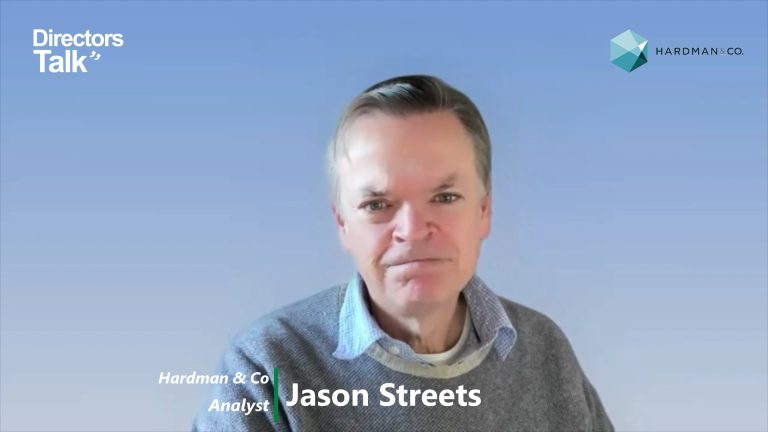
Cavendish plc (LON:CAV) is the topic of conversation when Hardman & Co’s Financial Analyst Jason Streets caught up with DirectorsTalk for an exclusive interview.
Q1: Jason, perhaps before we look at the interim results, you could just remind us who Cavendish is and what it does?
A1: Cavendish are a UK investment bank focusing on the smaller end of the market capitalisation spectrum, a billion pounds and less, and sometimes quite a bit smaller and it was the result of the merger of two businesses, finnCap and Cenkos in 2023.
Now, it has more clients than anyone else on AIM, but it also has a very thriving private companies business where it advises on deals and capital raisings for unlisted companies.
It has essentially three revenue streams: transaction advisory fees, retainers, and old-fashioned trading and research. The retainers provide very steady income every month, every quarter, their clients are paying them a retainer, and the trading is obviously dependent on market conditions and other factors. The advisory business, which is around 70% of the total and is split reasonably evenly between public and private companies, is lumpy but reasonably consistent, by which I mean the number of transactions is reasonably consistent, but the scale of them and hence the fees can be quite lumpy.
Certainly, what doesn’t help, though, is uncertainty and the delayed budget, the speculation around all sorts of tax increases, plus the harm done to the corporates in the last budget. None of this has helped the market. PwC commented that in the first half of 2025, M&A volumes were down by more than 19% and the third quarter, frankly, was no better.
Q2: Can we take a look at the interim results then?
A2: Cavendish reported interims to the end of September, right at the end of October. Revenues were up 3%, with the trading business up substantially, and both retainers and transaction revenue down slightly. But with non-employee costs down 10% and total costs down altogether, pre-tax profit rose marginally and adjusted for share-based payments and a few other small distorting factors, pre-tax came in at £2 million. So, cash was 15% higher than last year at £20 million and the interim dividend was maintained at 0.3p.
We’ve left our overall forecast for this year and next pretty much unchanged. Slightly lower revenue, but also lower costs, leading to almost identical profit numbers. Consequently, our valuation, which comes out with a central value of around 18p per share, compared with the current price of around 10p, is also virtually unchanged.
Q3: So, all pretty much as expected then?
A: Yes, well, arguably. I would say the results were a bit disappointing because the year started off very well with two IPOs in April, which generated not only advisory fees, but in the normal course of events, and certainly in this case, did some decent trading revenues too. While the stock market has been reaching new highs, this has largely been driven by overseas investors. Domestic funds continue to see outflows from UK equity funds, but the problem is overseas investors tend to stick to the larger companies. So, this boost has not really fed through to Cavendish’s sweet spot.
I think it’s fair to say that conditions have continued to be very tough for operators in Cavendish’s field, which is, I guess, a long way around saying that we had hoped that our forecasts would prove conservative and we would have been upgrading them at this stage. Obviously, there’s still plenty of time to surprise on the upside in the rest of the year. Let’s get this budget out of the way and assuming there’s nothing too appalling in it, plans which have been put on hold can be put back into gear and transactions resume.
Q4: You alluded to valuation earlier. How did you get to your number and what are comparable companies trading at?
A4: Well, when we first published on Cavendish in January, there was no useful comparator out there at all. Since then, Peel Hunt, which is the only listed company and remotely similar to Cavendish, has produced some results and there are now some forecasts of some reasonably normalised profits. Previously it was only losses or just above breakeven.
Peel Hunt is now trading on a P/E of around 17.7 for March ‘26 and 14.7 for March ’27, that’s at a share price of 105. There’s only one public estimate, I should add. Peel Hunt differs in that it has a much larger trading business, and the market size of its 4.5 base is substantially higher. So, the market conditions in the first half, as I was explaining, favouring large companies, were kinder to it than to Cavendish.
So, at Cavendish’s current share price, I’m using 10.5p. It’s trading on 12.7 times to March ‘26 and just 7 to ‘March 27 so a very, very substantial discount to Peel Hunt. At our valuation, at 18p, that would put it on 22 times, falling to 12 times March ‘27.
Q5: Could you remind us how you got to your 18 pence value?
A5: First of all, I should say that the 18p is near the bottom of our range calculated from our DCF with various assumptions. On our central assumptions, the equity value comes to £68 million, including £22 million of cash, that’s at the year end of March ‘26. Our range extends all the way from £67 million up to £112 million.
Now, the way our DCF works is that we take our forecast for the next two years. We then have a growth rate for the third year, which is a path to vary the value, depending on what number you want to put in. The crucial point is we use a range of discount rates. Our perpetual growth rate, which is fixed, is nominal 4% and the tax rate is struck at 20%.
Now, we at Hardman, or at least I, are not fans of CAPM and generally use a 10% equity discount rate for most of our DCFs. We make exceptions when you have businesses which are either much more or less predictable than average. I’m not sure I’ve ever had one on the more predictable end. We have put Cavendish on a 15% discount rate, and this is the most sensitive assumption underlying the outcomes.
So, our range is derived from lowering the 15% down to 10%. The third-year growth rate is actually not that sensitive and we have used 6% in our central number. Now, I go through all this in some detail in the published report and it’s worth looking at the sensitivities tables in there. Or if you’re really keen, you can email me, and I’ll send you the model.
The key is, I think, with all DCFs of equities, it’s the assumptions that are more interesting than the outcomes. You can basically get any value you want. The question is, are the assumptions we’ve used reasonable? Do they look sensible? Do they come up with a number that is credible? We think our central valuation is reasonably conservative.
Q6: So how would you sum it all up?
A6: Well, I think I would sum it up by saying that the company has made OK profits in a very tricky market and that’s very, very predictable performance.
They’ve produced the cost savings they promised from the merger. That doesn’t always happen. They’ve got a very strong balance sheet, more than £20 million of net cash at the interim and that will climb by the year end. It’s got a current dividend yield of over 7.5% so with the following breeze, this business can be much more profitable. You’re being paid pretty well to wait for the winter to.