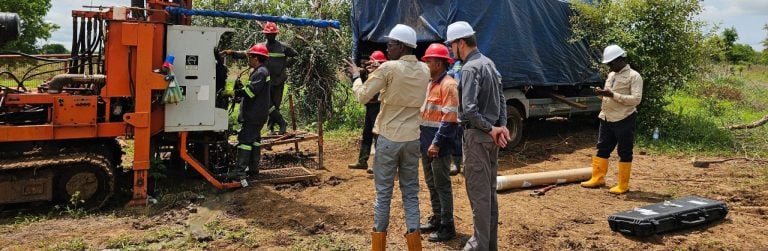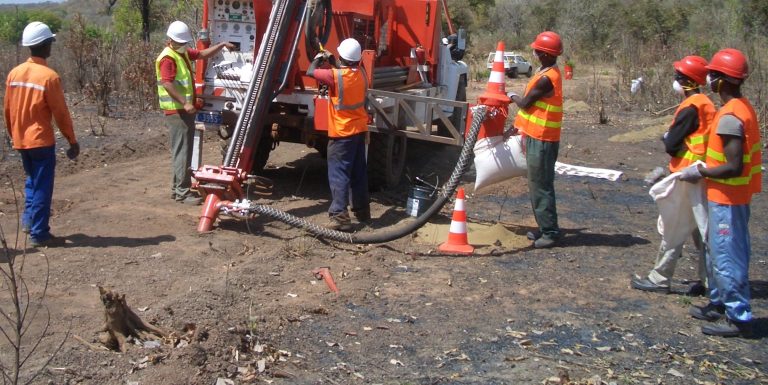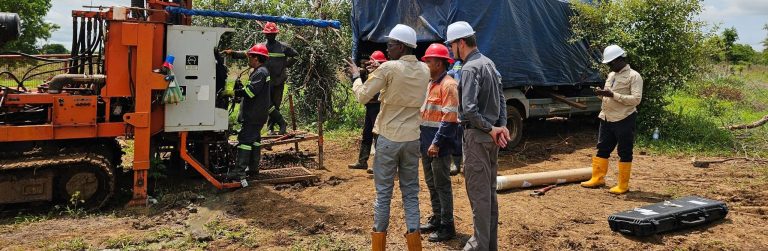
Oriole Resources PLC (LON:ORR), the AIM quoted gold exploration company focused on Central and West Africa, has provided an update on its 90%[1] owned Mbe gold project in Cameroon, where it has received further results from the ongoing 2,950m maiden diamond drilling programme at the MB01-N target.
Highlights
o Results from holes MBDD031 to MBDD033 have returned further gold intersections, including:
MBDD031
o 7.00m at 1.02g/t Au from 49.50m, including 1.00m at 3.99g/t Au
o 1.00m at 4.42g/t Au from 17.50m
o 1.00m at 2.63g/t Au from 37.40m
o 2.00m at 1.51g/t Au from 113.70m, including 1.00m at 2.67g/t Au
MBDD033
o 1.10m at 4.39g/t Au from 177.20m
o 1.00m at 2.03g/t Au from 154.90m
o 1.10m at 1.47g/t Au from 108.50m
o 4.20m at 0.49g/t Au from 14.90m
o 2.00m at 0.79g/t Au from 47.00m
MBDD032
o 4.00m at 0.35g/t Au from 212.50m
o All three holes returned gold bearing intersections and have extended the limits of the system, which is now confirmed over at least 300m width, 550m in length, and to 185m vertical depth. It remains open in all directions. Additional sampling in hole MBDD028 returned two low grade intervals, as outlined in Table 1.
o The fully funded MB01-N drilling programme is now around 90% complete, with approximately 2,650m drilled in thirteen holes and two holes left in the programme.
o The programme is expected to complete by early Q2-2026, after which the Company’s consultant will prepare a maiden JORC Resource for the MB01-N target to add to the existing 870,000oz JORC Resource at the nearby MB01-S deposit, where a fully funded step-out drilling programme will commence in Q2-2026.
Chief Executive Officer of Oriole Resources, Martin Rosser, said: “The latest set of drilling results has significantly extended the mineralised system dimensions, yet it remains open in all directions. We look forward to the conclusion of the programme and reporting the remaining drill hole results and the revised MRE.”
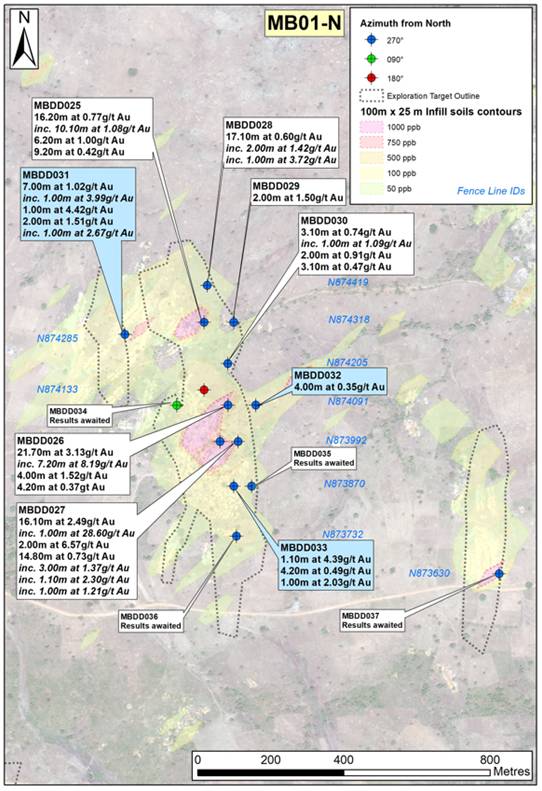
Figure 1. Diamond drilling progress at the MB01-N target with selected best results to date. Results published today are in blue boxes (MBDD031 to MBDD033), and previously reported results are in white boxes (MBDD025 to MBDD030). All holes are planned to be drilled at an inclination of -50˚.
Further Details
The Programme, which commenced in November 2025, has been planned to test the MB01-N target, which is located 700m to the northeast of the MB01-S deposit, where Oriole Resources has previously reported a maiden JORC Inferred Mineral Resource Estimate of 24.8Mt at a grade of 1.09g/t Au for 870,000oz contained gold (see announcement dated 21 October 2025). MB01-N has a JORC Exploration Target of 15Mt to 20Mt at 0.77 to 0.94g/t Au for 370,000oz to 605,000oz contained gold, and offers significant upside to the total JORC Resource potential of the Mbe project. The Programme has been designed to maximise conversion from an Exploration Target to a JORC Resource.
The Programme is progressing well and is over 90% complete, with thirteen holes (MBDD025-037) drilled and two holes left in the programme. The Company today reports the results from MBDD031 to MBDD033, which include a total of 23 mineralised intersections (Table 1; using a 0.20g/t Au cut-off grade).
An intersection grading 1.02g/t Au over 7.00m, including 1.00m at 3.99g/t Au was returned from hole MBDD031, further showing higher grading individual intervals within wider envelopes of lower grading material. This relationship has been observed at a larger scale elsewhere both in MB01-N, within the main core of the prospect (i.e. MBDD025 – MBDD028), and at MB01-S.
The results reported today have extended the strike length and width of the system at MB01-N by 100m and approximately 150m respectively. The system at MB01-N is now confirmed over a width of 300m, a length of 550m, and to 185m vertical depth from surface; it remains open in all directions.
A review of the QAQC samples has confirmed that the data falls within acceptable limits of error. Results from additional samples collected from MBDD028 (see announcement date 26 January 2026), returned a further two gold bearing intersections, which are presented in Table 1 along with the results from MBDD031 to MBDD033.
Table 1. Selected intersections from holes MBDD031 to MBDD033, and from additional sampling completed in MBDD028, using a 0.20g/t Au lower cut-off grade. Results > 1.00g/t Au are highlighted in bold.
| Hole ID | From (m) | To (m) | Grade (g/t Au) | Intersection |
| MBDD028 | 125.30 | 126.30 | 0.35 | 1.00m at 0.35g/t Au |
| and | 167.10 | 168.20 | 0.25 | 1.10m at 0.25g/t Au |
| MBDD031 | 17.50 | 18.50 | 4.42 | 1.00m at 4.42g/t Au |
| and | 32.70 | 33.90 | 0.47 | 1.20m at 0.47g/t Au |
| and | 37.40 | 38.40 | 2.63 | 1.00m at 2.63g/t Au |
| and | 43.50 | 45.50 | 0.39 | 2.00m at 0.39g/t Au |
| and | 49.50 | 56.50 | 1.02 | 7.00m at 1.02g/t Au |
| including | 55.50 | 56.50 | 3.99 | 1.00m at 3.99g/t Au |
| and | 60.50 | 61.50 | 0.41 | 1.00m at 0.41g/t Au |
| and | 99.30 | 100.30 | 0.23 | 1.00m at 0.23g/t Au |
| and | 113.70 | 115.70 | 1.51 | 2.00m at 1.51g/t Au |
| including | 113.70 | 114.70 | 2.67 | 1.00m at 2.67g/t Au |
| MBDD032 | 135.10 | 136.30 | 0.45 | 1.20m at 0.45g/t Au |
| and | 159.00 | 160.10 | 0.28 | 1.10m at 0.28g/t Au |
| and | 212.50 | 216.50 | 0.35 | 4.00m at 0.35g/t Au |
| and | 241.40 | 242.50 | 0.21 | 1.10m at 0.21g/t Au |
| MBDD033 | 14.90 | 19.10 | 0.49 | 4.20m at 0.49g/t Au |
| and | 32.60 | 36.60 | 0.33 | 4.00m at 0.33g/t Au |
| and | 47.00 | 49.00 | 0.79 | 2.00m at 0.79g/t Au |
| and | 54.00 | 55.10 | 0.30 | 1.10m at 0.30g/t Au |
| and | 104.10 | 105.20 | 0.35 | 1.10m at 0.35g/t Au |
| and | 108.50 | 109.60 | 1.47 | 1.10m at 1.47g/t Au |
| and | 111.70 | 113.90 | 0.50 | 2.20m at 0.50g/t Au |
| and | 154.90 | 155.90 | 2.03 | 1.00m at 2.03g/t Au |
| and | 177.20 | 178.30 | 4.39 | 1.10m at 4.39g/t Au |
The geological setting at MB01-N is broadly similar to MB01-S, with the dominant lithologies consisting of the orthogneiss-amphibolite basement rock, which in turn has been intruded by numerous shear-hosted granitic felsic dykes and late mafic dykes. The mineralisation is structurally controlled, predominantly hosted by veins and breccias within shear-hosted felsic intrusions. The mineralisation typically occurs within steeply dipping shear corridors, with mineralisation enhanced by brittle failure (brecciation) of the felsic intrusions.
However, MB01-N appears to be structurally more complex than MB01-S and assessment of this is ongoing. The previously reported scissor hole MBDD034, drilled towards 090 degrees to assess core parallel (down-dip) structures identified in holes MBDD026 and MBDD032 (orientated towards 270 degrees; see announcement dated 26 January 2026) has also intersected localised core-parallel mineralised structures. Whilst the 270 degree orientation is still deemed the optimal orientation to intersect the NNW-SSE trending breccia zones, it will not be possible to fully resolve these downdip structures, which trend ENE-WSW and ESE-WNW, by drilling the holes in an E-W direction. Accordingly, the programme has been modified to relocate one of the holes planned to test the system north of MBDD037, to instead drill a single 180 degree (south) orientated hole that aims to intersect previously reported mineralisation in hole MBDD026 (Figure 1). This will help provide further context on this second high-grade population at MB01-N and thus the geological model, prior to the generation of the Resource estimation in Q2-2026.
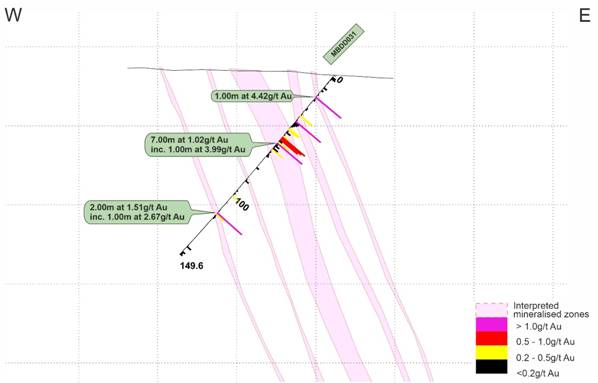
Figure 2. Simplified cross section of fence line N874285 with results from MBDD031 and interpreted mineralised zones.
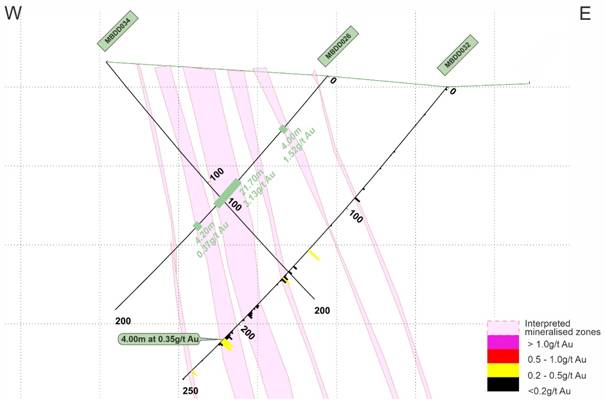
Figure 3. Simplified cross section of fence line N874091 with new results from MBDD032, previously reported results from MBDD026, the drill trace of scissor hole MBDD034 (results pending) and interpreted mineralised zones.
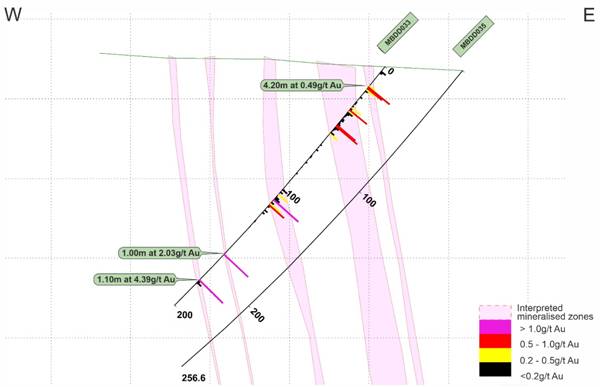
Figure 4. Simplified cross section of fence line N873870 with results from MBDD033, the drill trace for MBDD035 (results awaited) and interpreted mineralised zones.
Upon completion of the Programme, by early Q2-2026, the Company’s partner BCM International Limited will acquire a 50% interest in Mbe.