Longer-lasting manufacturing hardware could help semiconductor manufacturers reduce material use, maintenance requirements and component replacement, according to Hardide.
The company argues that sustainability in semiconductor manufacturing needs to consider the full lifecycle of production equipment, rather than focusing only on electricity, water and process gases. Extending the useful life of chamber components, vacuum hardware and gas delivery systems can reduce the need for replacement parts and the resources required to manufacture, transport and install them.
The issue is relevant because semiconductor manufacturing has an environmental impact beyond the operation of production equipment. Hardide cites estimates from SEMI and the Semiconductor Climate Consortium showing that semiconductor manufacturing accounted for 21% of the approximately 500 million tonnes of CO2 equivalent associated with the lifecycle of semiconductor devices produced in 2021. The upstream supply chain accounted for a further 16%.
Component replacement can also involve additional processes before production resumes. Opening a chamber, removing and installing components, cleaning, conditioning and requalifying equipment can all add to the resources required to maintain manufacturing operations.
Surface degradation is one factor that can shorten component life. Semiconductor equipment can be exposed to plasma erosion, corrosion, wear and other conditions that gradually change the surface of components. This can result in dimensional changes, particle generation, contamination or variations in manufacturing processes before the underlying component suffers structural failure.
Hardide argues that protecting the surface of a component can therefore extend its useful operating life where degradation, rather than structural failure, is the reason for replacement.
The company says longer component life should not be pursued at the expense of manufacturing performance. A component that remains physically intact but causes contamination, dimensional inaccuracies or reduced wafer yields does not necessarily provide a sustainability benefit. Instead, the objective is to maintain components in a condition where they continue to meet the required manufacturing and process standards.
This places component durability alongside other semiconductor sustainability measures, including energy efficiency, process-gas management and water use.
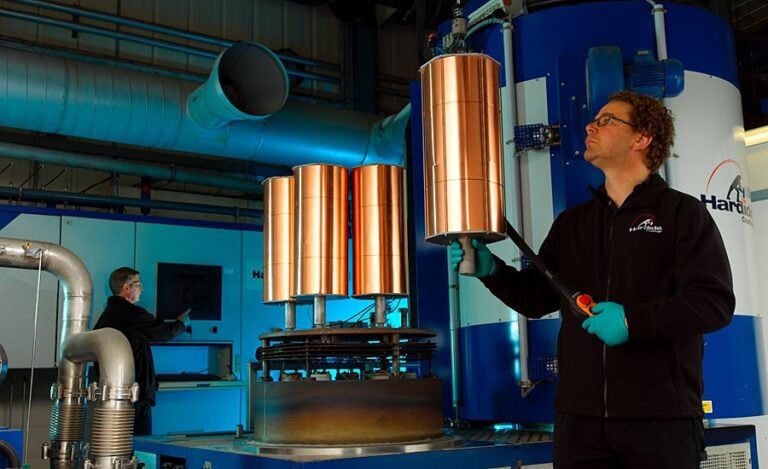
Hardide plc (LON:HDD) is a pioneer in advanced tungsten/tungsten carbide CVD coatings. They showcase unmatched capabilities to greatly extend the life of complex geometry components facing extreme wear, erosion and corrosion.