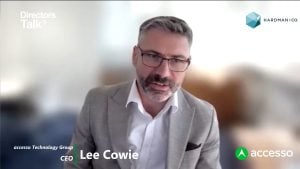
accesso Technology Group plc (LON:ACSO) Chief Executive Officer Lee Cowie caught up with DirectorsTalk to discuss the company’s software ecosystem strategy, AI, payments processing, customer relationships, and commercial growth opportunities.
Q1: Lee, what attracted you to accesso Technology Group?
A1: So accesso is a company that I have known for maybe a decade or so. I was previously Chief Technology Officer at Merlin Entertainments, who of course are a customer of accesso and that’s when I first became introduced to them.
I love this sector. What we do, the way we do it, how we do it. Whenever you walk into an attraction and you step over that threshold and you think, I helped make that happen. It’s an immense privilege to be involved with some of the world’s leading attractions, to be able to offer the solutions that we do.
This is a company that has such tremendous opportunity ahead of us. It was too good an opportunity for me to turn down. It was a dream come true to be able to work with accesso.
Q2: Could you add some colour on your new software ecosystem strategy?
A2: We have a range of best-in-breed software solutions that have been purpose-built for the sectors that they operate in and the problems that they solve for. We have at our disposal a set of capabilities that, when mapped to a typical journey that a consumer would take through an attraction, is a very compelling prospect.
We sell ticketing through our ticketing solution, but we also can curate the journey through an attraction. We have food and beverage solutions for your burgers and your fries. We have retail solutions for buying in the gift shop. We have queuing solutions that allow venues to monetise their queue. We have in-attraction marketing capabilities through our mobile app platforms and our direct-to-consumer messaging, and we can facilitate and help with post-purchase follow-ups such as membership and renewals and that communication.
The ecosystem as we look at it is a set of capabilities that our customers can choose to deploy one or all of those capabilities. Of course, the more they take from us, the better the solution is for them because we can deliver better pricing and we can help them with more of their problems.
There’s a couple of things we’ve done recently that really brought that power and made it even more compelling. One is the payments processing that we’ve now built into our products with a partnership with Adyen. The other one is the intelligence platform that we’ve put over the top that allows all of the data that we generate to be presented back to a venue and gives them AI capabilities to query their data and derive really powerful insights into how the venue is operating.
So, these suite of systems really help a venue monetise every single interaction between a guest and that venue and we do it in more places than any of our competitors can do.
Q3: Given the advances in technology, including AI, why can’t venues do it themselves?
A3: It’s quite tempting, isn’t it, when people look at things like ChatGPT and strike up a conversation with it and get some really compelling information back expressed with absolute confidence. But it doesn’t take much more of a conversation for that confidence to materially unwind.
As you have a conversation with ChatGPT or something like that, it will be very definitive about an answer and then you’ll challenge it and go, I’ve got that completely wrong, and then you’ll end up in a completely different place.
AI is a powerful tool, but it requires deep context. It requires a lot of operational experience to get the best out of it and a venue on their own will find that they’re missing an awful lot of context.
We’ve got over 600 customers spread out across the globe. We manage services for 1,100 different venues. We bring to this 20 years of deep operational experience of context, of a semantic understanding of what matters to a venue. That rich foundation is what allows us to deliver AI solutions that have very high fidelity and have limited the chance for them hallucinating.
A venue facing a similar task will have a very tiny amount of context that they can bring into this. It will be substantially more expensive than they might assume it would be to do all the data normalisation, to get that context right, to build the machinery that’s necessary.
With us, we’ve got this pre-built platform, this pre-built capability. It’s been enhanced by our 20 years of operational experience. It’s been tested across the globe and comes ready to deploy.
So, it is a materially easier journey to adopt that technology with us than it would be to go alone.
Q4: So, what feedback are you getting from customers on the new accesso Intelligence business?
A4: It’s been amazing. We’ve loved working with our customers, seeing how they’re using it, and we’ve seen a huge array of different use cases.
We’ve had one customer using it to identify fraud patterns, where they’ve been able to analyse the data that they’re generating through systems to identify areas where staff might be being a little less honest than they really should be in doing refunds and fraud on the tills.
We’ve seen some customers use it to get really precise marketing capabilities, where they’ve matched their attendance data with publicly available census information to do a segmentation analysis of potential customers that live within a 90-minute commute of the venue. And then work out specific marketing techniques to be able to target those demographics.
We’ve seen people predict attendance months in advance so that they can then use that to adjust pricing, or adjust staffing, or to predict how much coffee they’re going to spend on any particular day and then adjust their stock accordingly.
So, we’ve seen a huge range of use cases. Feedback has been really easy to deploy, the insight is really powerful, and we’re really excited about the direction of the products going with the customers providing their feedback to us.
Q5: How are your AI plans progressing across the organisation?
A5: Very well. We’ve got a very strong roadmap on that intelligence platform that I talked about. We will be making some announcements about some of the agentic capabilities that we’ve got in IAAPA next week in London and we’ve got a very long roadmap and our ambition with that platform is almost limitless at this point in time.
We’ve also been looking hard at where we deploy AI capabilities into how our teams work and how they operate with our development and our product teams. We’ve seen a material increase in the pace at which we can deliver new features to market. Some cases we’re about six months ahead of where we thought we would be and that’s all because of the investment we’ve made in agentic tooling for our development teams.
Q6: Could you please discuss the opportunity in payments?
A6: Payments is another really exciting one for us and that’s the layer in our ecosystem that allows us to really simplify the pricing that we’re offering to our customers.
The partnership that we have with Adyen is based off the fact that our platforms today process £5 billion in revenue and we’ve been able to therefore negotiate really compelling prices with Adyen as the technology partner.
We can now take those wholesale prices and make them available to venues that on their own would be unable to negotiate as compelling a deal as we’ve been able to negotiate.
That shows up in a number of ways. One, it allows us to really simplify our pricing so we can go to a venue with a very simple-to-understand price for our products that includes payments.
It is also almost certainly going to save money for our venues and our operators as we bring global scale to a relatively small venue. We will almost certainly be able to save the money on what they’re currently paying their payment processor.
Q7: You’ve had some challenges with two major customers. How are these relationships evolving?
A7: I’m not so sure that I would class them as challenges.
We are very privileged to have long-term contracts with our customers that span in some cases 20 years and there’s always ups and downs and ebbs and flows in any relationship that lasts that long.
We have very strong and positive relationships with our customers as we navigate technical change and adjust our offering to match their evolving business strategy.
For both those customers in question, we remain deeply engaged in working with them. We’re actively discussing ways in which we can add more value and bring new opportunities to them. Both relationships are strong as we kind of work through where they want to go next.
Q8: Could you talk about the commercial momentum and where you see the greatest opportunities for growth?
A8: We’ve got a really healthy product pipeline, pretty really healthy sales pipeline.
I mentioned earlier the product ecosystem vision that we have. That means that we will deploy multiple solutions into a customer venue and as we look at the pipeline ahead of us, we see a near doubling of opportunities that are where we’re talking about multiple products to customers.
We have some large opportunities in the pipeline where we are selling the entirety of the ecosystem, all of our capabilities, to one venue and we’re really positive about that.
We’ve got some really exciting new features that we’re bringing into the ski market towards the end of this year that I think will be really interesting for that sector and so I’m positive about the ski market as well.
I think on the whole, we have a set of capabilities that are really unique in our sector and with the way we’re now able to wrap that with the AI intelligence and the simplification from the payments, we have got a really compelling offering.
So, I’m optimistic and positive about our future pipeline.