Low-alloy steel is widely used because it combines strength, machinability and cost-effectiveness. Its main limitation is corrosion resistance. In harsh industrial environments, moisture, salts, acids, process chemicals and sour-service conditions can attack the surface of components well before the underlying steel loses its structural integrity.
Corrosion can trigger other forms of damage. Surface pitting creates stress concentrations, increased roughness can accelerate wear and seal degradation, and material loss can reduce dimensional accuracy. Hydrogen ingress can also increase cracking risk in sour-service applications, while corrosion combined with cyclic loading can contribute to fatigue failure.
Stainless steel, duplex stainless steel and nickel alloys can provide greater corrosion resistance, but they can also increase material costs, lead times, machining difficulty and supply-chain complexity. Hardide’s proposition is that manufacturers may instead be able to retain low-alloy steel and improve the surface where degradation starts.
This creates a clear role for coatings, although conventional technologies have limitations. Hard chrome plating can contain networks of micro-cracks that allow corrosive substances to reach the steel beneath the coating. It also relies on hexavalent chromium, which faces increasing restrictions under REACH regulations.
Thermal spray coatings provide high hardness but can contain porosity and binder phases that create pathways for corrosive ingress. Binder degradation can also reduce protection in aggressive environments. Line-of-sight coating processes can have further limitations when components include internal bores, threads, recesses or complex flow paths.
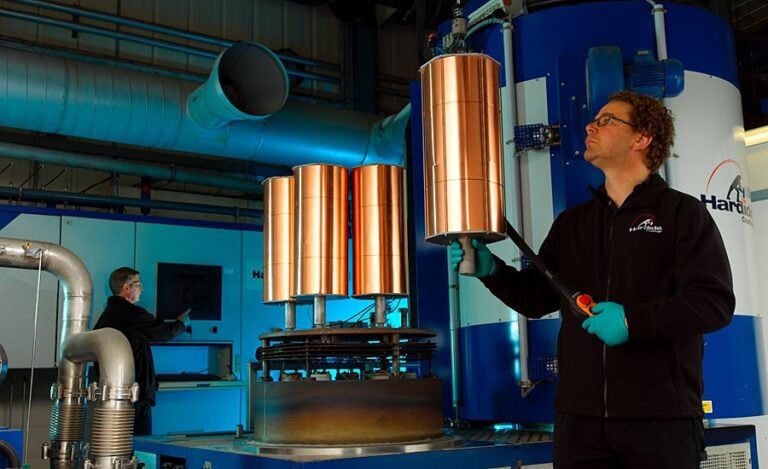
Hardide’s CVD process is designed to address these weaknesses by creating a dense and effectively pore-free tungsten carbide coating. Rather than spraying or plating material onto a surface, CVD crystallises the coating from a gas phase, creating a metallurgically bonded layer.
The resulting coating is intended to prevent corrosive media from reaching the underlying steel while also providing strong adhesion, crack resistance and resistance to aggressive chemicals, acids and hydrogen sulphide environments. Because the process is not limited to direct line-of-sight application, it can also coat internal and difficult-to-reach surfaces.
Hardide plc (LON:HDD) is a pioneer in advanced tungsten/tungsten carbide CVD coatings. They showcase unmatched capabilities to greatly extend the life of complex geometry components facing extreme wear, erosion and corrosion.