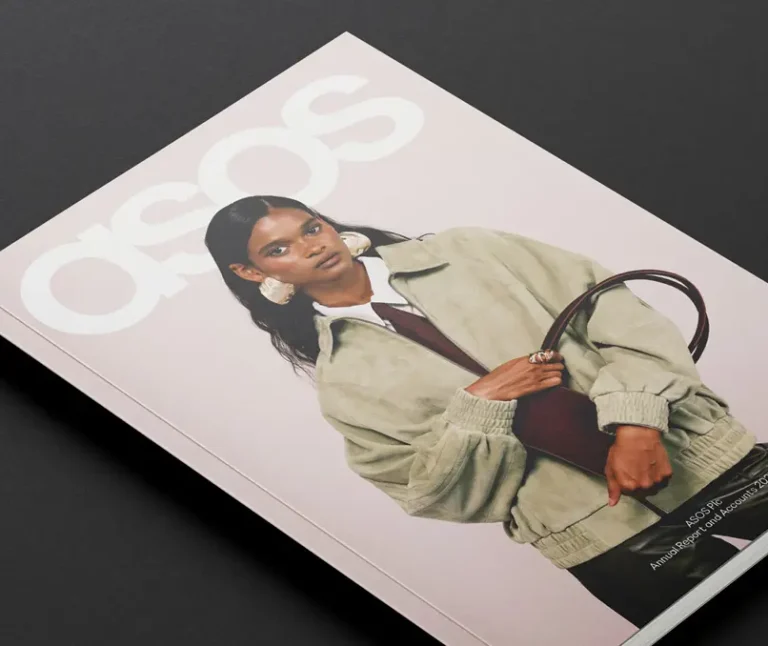
ASOS Plc (LON:ASC) has announced its final results for the 52 weeks to 30 August 2026
Return to growth: Strong operational and profit delivery
Summary financial results
| £m1 | 52 weeks to 30 August 2026(FY26) | 52 weeks to 31 August 2025(FY25) | Change | Adjusted LFL change2 |
| Headline adjusted numbers3 | ||||
| Gross Merchandise Value (GMV)4 | 2,349.0 | 2,456.3 | (5)% | |
| Adjusted group revenue | 2,240.3 | 2,464.8 | (9)% | |
| Adjusted gross margin | 50.5% | 47.1% | 340bps | |
| Adjusted cost to serve5 | 43.2% | 42.0% | (120)bps | |
| Adjusted EBITDA | 170.3 | 131.6 | 38.7 | |
| Adjusted EBIT | 18.8 | (32.2) | 51.0 | |
| Adjusted loss before tax | (46.4) | (98.2) | 51.8 | |
| Net debt | (109.3) | (184.7) | 75.4 | |
| Free cash flow | (16.4) | 14.1 | (30.5) | |
| Statutory Measures | ||||
| Group revenue | 2,245.6 | 2,477.8 | (9)% | |
| Gross margin | 50.6% | 47.1% | 350bps | |
| Operating profit/(loss) | 93.5 | (212.3) | 305.8 | |
| Profit/(loss) before tax | 24.4 | (281.6) | 306.0 |
FY26 highlights
| • | Delivered YoY growth in Q4: GMV returned to YoY growth in Q4 for the first time since FY22, marking an important milestone in the transformation and providing momentum entering FY27. |
| • | GMV –5% YoY, with growth rate improving every quarter: YoY GMV trends improved sequentially throughout FY26, accelerating to -1% in H2, supported by stronger product relevance, an enhanced customer experience, greater product availability through flexible fulfilment and increased marketing investment. |
| • | Customer database delivers QoQ growth: Customer database returned to quarter-on-quarter growth (Q4 FY26) for the first time since Q2 FY22, reflecting strength across new, reactivated and existing customers, marking a clear inflection point. |
| • | Gross margin exceeds medium term target: Adjusted gross margin increased by 340bps to 50.5%, surpassing our medium-term target and delivering a second successive year of more than 300bps expansion. This has been driven by better buying and sourcing, expansion of Flexible Fulfilment models and a focus on full-price sales through disciplined inventory management. |
| • | Strong AEBITDA improvement with step-up in investment for growth: Adjusted EBITDA increased by +29% YoY to the upper end of our guidance range, reflecting the combined benefits of strong gross margin progression, supply chain efficiencies and disciplined cost control. The result demonstrates our ability to drive profitable growth while investing in marketing, the customer experience and future growth opportunities. |
| • | Further strengthening financial flexibility: Net debt reduced by more than 40% to £109.3m due to strong operational execution, a successful refinancing in November 2025 and the disposal of two non-core assets for £115.5m, leaving ASOS in a significantly stronger financial position. |
| • | Sharper, more relevant product: Improved FY26 12-week full-price sell-through by 70bps YoY through more efficient inventory management, and increased flexible fulfilment penetration across Partner Brands to 21% of GMV, up more than 10ppts YoY |
| • | Inspiring and personalised fashion discovery: Delivered more than 100 app enhancements and accelerated AI-powered personalisation, driving higher conversion, engagement and revenue per customer for users exposed to the updated app features growing c.10ppts faster than the wider iOS customer base. |
| • | Resilient and efficient supply chain: Supply chain cost-to-serve reduced by 130bps YoY, reflecting productivity and efficiency improvements across our fulfilment network, despite the disruption arising from the transition of US fulfilment operations and geopolitical challenges in the Middle East. |
Cyber Incident
Following the cyber incident on 6 October, we took immediate steps to contain the incident and protect our customers. We also launched a full investigation, supported by external cyber experts, which has now concluded. As we previously disclosed, the investigation found that the unauthorised party accessed some basic customer data. It confirmed no payment information or account passwords were impacted. Our website and app remained operational and safe to use throughout. The Group has since implemented further measures to strengthen security across the business.
As a precaution, the Group temporarily paused certain marketing and CRM activity immediately following the incident, returning to planned activity within two days. This has resulted in some short-term disruption to trading, most notably in the UK, with the latest impact since 6 October estimated at c.2–4% of Group GMV6. The Group has remained resilient with broadly flat GMV growth and our customer base continuing to grow, giving us confidence that this impact will be temporary.
Outlook & current trading
| • | Trading in the opening weeks of FY27 has been encouraging, with Group GMV growth broadly flat YoY despite the temporary impact of the cyber incident. |
| • | Customer trends also remain encouraging, with the active database growing month-on-month in September and October. |
| • | Following the reduction in net debt to £109.3m at year-end, we continue to assess opportunities to optimise our capital structure. |
| • | Reflecting the progress made during FY26 and the momentum with which we entered the new financial year, the Board remains confident in the Group’s outlook and provides the following guidance for FY27: |
| • Low-single digit GMV growth | |
| • Adjusted EBITDA of £180-200m | |
| • Capex of c.4% of revenue | |
| • Positive free cash flow generation | |
| • | FY26 has delivered against the majority of our medium-term targets, and as we enter the sustained growth phase of our transformation, we see further opportunity to enhance both our gross margin and cost to serve in the mid-term. |
| • | We intend to host a Capital Markets Event during FY27, providing investors with a deeper insight into the next chapter of ASOS’s growth strategy, including the evolution of our role as ‘The Stylist’, our key growth drivers and an updated medium-term financial framework. |
CEO Review
As I reflect on FY26, I am proud of what our teams have achieved. This was another year of consistent delivery and, above all, the year ASOS returned to growth. Building strong foundations and getting back to growth are important milestones, but they were never our end destination, we have a more ambitious goal.
A consistent track record of delivery
Over the past four years, ASOS has been transformed in three deliberate waves. We have consistently delivered against the priorities we set at each stage of the journey. First, we dealt with the most critical issues facing the business: stock and debt. We took decisive action to reduce intake, clear excess inventory and strengthen the balance sheet, reducing inventory from £1.1bn to less than £400m and net debt to AEBITDA from 2.6x at the end of FY23 to c.0.6x at the end of FY26. Having delivered against those initial priorities, we were able to turn our focus to rebuilding the underlying economics of the business.
Second, we fundamentally reinvented our business model around gross margin, stock turn and speed to market. Over successive years, we have embedded better buying and sourcing, tighter stock management and greater operational flexibility, while building new capabilities such as Test & React, simplifying our operations and launching new partner models through ASOS Fulfilment Services and Partner Fulfils. The benefits have built consistently over time: gross margin has improved by 630bps to over 50% and AEBITDA margin by 410bps to 7.6%. Together, these changes have created a more profitable, flexible and efficient ASOS, and with those foundations in place, we entered the third wave: returning ASOS to sustainable, profitable growth.
As those foundations strengthened, we progressively increased our focus and investment behind growth, while continuing to deliver against the financial and operational disciplines established through the first two waves. FY26 was the clearest demonstration of that progression to date, with investment stepped up in product, marketing and the customer experience alongside continued margin expansion, disciplined inventory management and further supply chain efficiencies. At the same time, trading momentum improved through the year, giving us increasing evidence that the actions taken across the transformation are translating into improved customer and commercial performance.
This consistent execution has taken ASOS from stabilising the business through rebuilding its economics, to the third wave of the transformation: returning ASOS to sustainable, profitable growth. We have delivered against a number of the medium-term targets set in FY23 and are fast approaching achievement of the remainder, while continuing to invest behind the areas that can support the next phase of our development.
We are back to growth, and it is spreading
The most important message of this year is a simple one: ASOS is growing again, and that growth is broadening across the Group. The growth started with our customers. New customer acquisition improved through the year, from -5% in H1 to +4% in H2 and +6% in Q4, clear evidence that our renewed proposition is resonating with a new generation of fashion lovers. Importantly, the quality of our new customer cohorts is also improving, purchasing a higher mix of full-price YoY. In H2, we also saw customers shopping across more categories, alongside a higher proportion of new customers returning to site and saving an item within 90 days, encouraging signs of engagement and future retention.
At the same time, we are keeping more of the customers we have, with churn down 270bps and reactivated customers up 3%. The result is a turning point in our customer base, which returned to quarter-on-quarter growth in Q4 for the first time since Q2 FY22. The UK has grown its active customer base for 4 consecutive months, fuelled not only by new customers but by a significant improvement in retention. Similarly, Germany has also returned to active customer growth versus H1.
These leading indicators converted to sales. At our interim results, we highlighted the outperformance of the UK versus the Group and Womenswear being in growth6 for March. Both were the result of deliberate actions to focus on our core, and we said at the time that we would apply those learnings more broadly across the Group. That is exactly what has happened. In H2, GMV growth gained ground in the UK +2% and in Womenswear6 +8%, while growth broadened to Germany, +8% YoY. The US followed in Q4 and the Group delivered GMV growth for the first time since 2022.
Not everything is working yet, and there remain areas where we have more work to do. Menswear is still in recovery phase back to GMV growth6. Performance strengthened in H2, giving us good momentum, but there is significant scope for improvement. We are applying the playbook that has transformed Womenswear and have strengthened the team, hiring a new Menswear Product Director for ASOS Design in August. There remains substantial headroom across Womenswear, Face + Body and Sportswear, and in our core markets of the UK, Germany and US. Menswear, along with France, represents further upside to our plans rather than a prerequisite for growth, and we have conviction in what can be achieved.
Operational excellence is driving our growth
Our return to growth is the cumulative result of continuously improving the fundamentals of our business: fresher stock, faster time to market, more flexible business models, better merchandise management, more reliable execution, more effective marketing and a stickier customer experience. We can see the results across the business: GMV growth6 in some of our key Own Brands and Partner Brands; in our performance marketing and in The Heart, where product and marketing now work as one; and in our app and our loyalty programme. Today, ASOS is operating with greater pace, discipline and consistency than at any point in the last four years.
Financial review
GMV was down -5% for the year, improving to -1% in H2 and returning to low-single-digit growth in Q4. Adjusted gross margin improved 340bps and adjusted EBITDA margin rose 230bps, as operational efficiencies more than offset a planned increase in marketing investment, driving a 28% increase in profit per order. Inventory was down 9% against GMV down 5%, with further improvements in stock turn. Capex was 3.4% of revenue, within our 3-4% guidance range, and free cash flow was negative £16m, primarily reflecting working capital and financing payment timing. More detail can be found in the CFO Review.
The next phase
We enter FY27 encouraged by our progress. Our priority is to consolidate our return to growth and make sustained, profitable growth the new normal for ASOS. Our expectation is that FY27 will mark our first full year of growth since completing the transformation of our business model.
We see this growth powered by two different and distinct engines. The first, and most immediate, is operational excellence: through FY27, we will go deeper on the initiatives already working across our three strategic pillars and further embed AI to make every process faster, smarter and more efficient.
The second is about our longer-term ambition, which goes far beyond just returning to growth. We believe that online fashion shopping experience is about to be transformed, from a more transactional into a more inspirational shopping experience, and ASOS can champion this process.
Our research tells us that, in a world of almost limitless choice, customers are no longer looking for access to more fashion, but for help navigating it. Our response is ‘The Stylist’. It is our ambition to use AI to transform how people buy fashion online: from transactional to inspirational, from generic to deeply personal, from individual to social, from flat to immersive, and from single items to complete outfits. Imagine a store that is different for every customer, every time they visit, built around their own wardrobe and style, and shared with the friends, stylists and creators they love. We want shopping at ASOS to be a moment of pleasure, something you would never want anyone else to do for you, rather than the mechanical experience customers too often endure today. We believe this will bring a new wave of growth to online fashion, and we are determined to lead it, making ASOS the most exciting online fashion destination for young fashion lovers and disrupting this industry once again. We will set out this next chapter, together with a new medium-term financial framework, at a Capital Markets Event during FY27.
I would like to thank all our ASOSers for their commitment, resilience and ambition throughout the year, and our customers, brand partners, shareholders and other stakeholders for their continued support. There is much to celebrate, and much still to do. We enter this next phase with confidence in the platform we have built, energy from the progress we have made and real excitement about the opportunity ahead.
Strategic Review: A return to growth through disciplined execution
FY26 marked a strategic pivot towards growth, building on the progress made through our transformation to date. The structural improvements of the last three years are now embedded in how we operate, and while we will keep refining our processes, our primary focus has shifted to growth.
That growth has come from the cumulative impact of continuously improving the fundamentals of our business, from product creation and sourcing through to marketing, fulfilment and customer experience. Put simply, our formula is better product, a more engaging shopping experience and a more efficient operating model. Some examples of how far we have come over the last four years (FY23-FY26) include:
Product
We have built a faster, fresher and more flexible product model. New and current stock mix has increased +6ppts, lead times have reduced by c.30%, Test & React has scaled to more than 20% of Own Brand sales and flexible fulfilment now represents more than 20% of Partner Brand GMV. Together, greater speed and stronger inventory discipline have helped drive 12-week sell-through +240bps to record levels since the launch of the New Commercial Model.
Customer Experience
We have transformed how customers experience ASOS, making shopping more reliable, engaging and increasingly personalised. Missed Customer Delivery Promise has reduced by c.5ppts and the proportion of iOS visits resulting in Add to Bag has increased by 240bps. Beyond the transaction, we have built a loyalty proposition from the ground up, now offering exclusive benefits including more than 20 early-access product launches and Sale moments in FY26. We have also stepped up the ASOS experience through pop-ups and events across London, New York and Aspen (more than 10 delivered in FY26).
Efficiency
At the same time, we have materially lowered the cost and complexity of running ASOS. Total fixed costs have reduced by c.£90m, the underlying returns rate has improved by 420bps and supply chain cost to serve has reduced by 410bps, creating a leaner operating model from which to grow.
FY26 showed the impact of these changes coming together at greater scale across the business, with progress across each of our three strategic pillars increasingly translating into better customer and financial outcomes. The remainder of this Strategic Review outlines how we brought these improvements together more effectively across our three strategic pillars and the foundations they are creating for the next phase of ASOS’s growth journey as we develop ‘The Stylist’.
RELEVANT FASHION PRODUCT: the product model driving growth
Product sits at the heart of the ASOS proposition and is the most important lever in our return to growth. Over the last two years, we have worked hard to improve relevance, buying precision, speed, flexibility, quality and curation across both our Own Brands and Partner Brands. At the start of FY26, many of these foundations were in place. This year, the focus was on scaling them, so that more customers experienced a better ASOS.
Faster, and more in control
Speed remains a critical advantage, and we continued to build a structurally faster and more responsive product model. More than 20% of Own Brand sales are now generated through Test & React, allowing us to respond quickly to emerging trends and customer demand while reducing inventory risk. We are now using AI-supported forecasting to grow it further and make capability improvements. Combined with our other fast routes, including Speed to Market, c.40% of our Own Brand mix now runs on lead times of less than six weeks, while lead times on our longer-lead routes are down by around 30%, giving customers faster access to newness and letting our teams react closer to real-time demand.
We are not only faster, but more in control. By combining real-time data, automated workflows and closer collaboration across buying, merchandising, supply chain and logistics, we have created a more connected critical path that enables earlier intervention and faster decisions. Missed Product Delivery Promise improved by c.40% YoY, with AI tools increasingly supporting the team. The right product is arriving at the right time, ready for our customers.
Scaling capital-light flexibility
One of the most important structural developments of FY26 was the scaling of our flexible models. Partner Fulfils and ASOS Fulfilment Services increased by 13ppts to 21% of Partner Brand GMV, with 16 net new brands added, giving customers broader choice and better availability while significantly reducing inventory risk.
We continued to expand Partner Fulfils, launching emerging brand Noughts & Kisses through the model and Levi’s across the UK and Europe, while our partnership with Abercrombie & Fitch marked the brand’s first marketplace integration of its kind in the UK and Europe. Following the move of Inditex onto AFS at the end of FY25, every one of its brands delivered growth6, benefiting from better availability and greater responsiveness to demand.
Raising the bar on quality
Quality is fundamental to customer confidence, and we raised the bar on fit, fabric and consistency. We increased upstream intervention across product development, strengthened supplier accountability and more than doubled our quality control coverage, alongside investment in sizing, grading and supplier capability. In Menswear, we introduced more consistent, proven fits across the range, with a c.20ppts increase in standardised blocks (i.e. a master template for clothing) to more than 90%, alongside targeted investment in better fabrics and garment construction. In Tailoring, for example, improvements including better linings, internal construction, pockets and trims contributed to a 280bps reduction in returns. Similarly, in Womenswear, we almost tripled the proportion of our range using blocks. ASOS DESIGN and Topshop were two of the key beneficiaries from this, reducing returns by 140bps and 200bps respectively with improvements across the majority of categories. This is early evidence that prevention upstream is improving the customer outcome, and it is building the foundations for long-term loyalty and repeat purchase.
Sharper buying, smarter stock management
Lower intake, fewer options and tighter stock management delivered the best 12-week full-price sell-through since our transformation journey began with the New Commercial Model: +70bps YoY with an acceleration through H2, +300bps YoY. Driving part of this improvement was offering our customers a fresher assortment, with the mix of new and current stock (<3 months old) up c.100bps. We have rebuilt the tools and ways of working behind this, including the migration of our product ERP, upgrades to core product systems and the integration of AI across the product lifecycle, removing c.500 hours of manual work every week. Around 20% of our buy is now AI-led and buyer-refined, helping us spot trends earlier, while AI-driven image recognition has cut product onboarding times by up to 99%. AI is augmenting our product expertise, freeing our teams to focus on the creativity, judgement and fashion instinct that make ASOS different.
Our best assortment yet
Womenswear is the most profound demonstration of our product transformation. We deliberately prioritised it given its importance in fashion, and Womenswear delivered GMV growth6 of 3% for the year and 8% in H2. Product relevance was the primary driver, with growth6 across multiple customer segments and aesthetics, and in key categories including Outerwear, Evening Dresses, Casual Bottoms and Tops.
Across Partner Brands, we launched 80 new brands, while exiting 50 weaker-performing brands, and more than halved onboarding times, bringing relevant brands to customers faster. New launches including NA-KD, Calzedonia and Ruched & Ready performed strongly, while our core partners, including Bestseller, Mango, Inditex, Gina Tricot, House of CB and Princess Polly, grew GMV6 supported by our more flexible models and more reliable operations.
Exclusives and collaborations are an increasingly important source of differentiation, with 32 exclusive brands, 8 exclusive collections and 20 collaboration-led initiatives, built on deeper relationships with our partners. ASOS x adidas goes from strength to strength. Drop 3 delivered a sell-through of c.80% within the first week of launch, generated a 40% halo effect for the Adidas brand and took the collaboration into the US as well as physical retail for the first time. The collection resonated strongly in the US, accounting for c.20% of sales with 50% from new and reactivated customers. Drop 4 added Menswear for the first time and achieved c.90% sell-through in its opening weekend, with the US representing c.30% of sales and more than 10% conversion in the first few hours. We also launched our first Barbour Re-loved collaboration, selling out within minutes and driving strong customer engagement and a positive halo across the wider Barbour assortment, ahead of a broader partnership in FY27.
Our newer and refreshed Own Brands are gaining momentum, with Topshop, 4505 and ARRANGE all delivering strong growth6 and demonstrating what is possible when relevance, speed and quality come together.
INSPIRATIONAL SHOPPING EXPERIENCE: engaging customers more effectively
In FY26, we changed how customers discover, engage and shop with ASOS, moving beyond transactional browsing towards an experience built around outfits, curation, community and individual style.
The first steps towards a superior shopping experience
We delivered the most significant upgrade to our app in recent years, with more than 100 customer-facing enhancements, including Follow Brands, Ways to Style and user-generated content (UGC), improving customer stickiness (daily average users to monthly active users rate) across all platforms, including iOS +c.80bps YoY. We significantly expanded our outfit-led proposition, moving beyond a single-item experience to provide customers with more styling inspiration and multiple ways to wear, with 90% of eligible products now featuring at least one outfit (FY25: 57%). These products now show a combination of studio curated and AI-powered outfit recommendations to showcase style versatility, enabling us to grow from showing hundreds of thousands of outfits throughout the year to over a million. We also strengthened our UGC capability through a new partnership, bringing authentic customer content into more touchpoints across the shopping journey. Early engagement is encouraging, with customers viewing UGC showing higher rates of Add to Bag, save for later and conversion. We extended personalisation across the journey, bringing our recommendation technology into search: personalised search alone lifted conversion by 140bps, equivalent to c.£31m of annualised revenue.
Behind all of this is a much stronger engine for innovation. With the support of AI, we more than doubled the number of experiments we run, the proportion delivering a positive outcome improved almost fivefold, and the rate of conclusive experiments rose by more than 15ppts, so we learn what customers love, and scale it, faster.
AI is also helping customers shop with more confidence. Testing of Virtual Try-On showed higher conversion and revenue per customer and a directional reduction in returns, with the strongest gains among newer customers, the cohort where fit uncertainty is highest. In October we extended testing to all UK Womenswear, approximately a third of our catalogue. We were also one of the first fashion retailers to launch on ChatGPT, where customers can discover products and receive personalised styling advice through conversation. Since launching in May, traffic is up 10% with an 4ppt improvement in bounce rate, and we have set up a dedicated agentic commerce team to make the most of this new way to shop.
Smarter, more effective marketing
We increased marketing investment by 120bps as a percentage of sales, and spent it with greater confidence, supported by better attribution, Marketing Mix Modelling and incrementality testing. Marketing Mix Modelling moved from an in-house pilot to a core decision-making tool, guiding more than 60% of performance marketing spend, and we will extend it across our four largest markets with a specialist partner in FY27. In H2, improvements to our bidding approach enabled us to increase spending capability by 11% while maintaining a broadly stable ROAS, helping to drive higher GMV. Broader targeting and new campaign structures also contributed to the sequential improvement in GMV through the year. CRM moved from broad-based messages to personalised, lifecycle-triggered journeys, with CRM-attributable visits up 30%, new customers through the channel up 12% and reactivated customer engagement up 28%.
We also sharpened our brand positioning. We appointed Baron & Baron to refresh the ASOS brand platform, we simplified our calendar from many campaigns to four clear moments and we moved from a high-volume influencer model to a curated network of genuinely relevant creators, with authentic content for every community and style. It worked: demand accelerated rapidly following organic influencer exposure, with weekly retail sales doubling post our collaboration with Farron Clark on one of our Test & React jackets with the total style surpassing £1m of sales. We also moved our in-real-life activity from purely experiential to commerce-led, with a series of shoppable pop-ups. Spontaneous awareness and first-choice consideration improved in key markets for the first time since FY23, particularly in the UK with some green shoots also appearing in Germany.
The Heart: where product meets marketing
The Heart brings together the most fashion-authoritative product from across ASOS and has grown from a monthly edit into a meaningful part of our offer. Backed with 50% more units per option, its contribution to sales of new and current stock doubled to 12%, with featured products selling 19% faster than comparable ‘New In’ ranges. In H2, we aligned our go-to-market plan with The Heart drops, connecting product, customer attention and demand more closely than ever. This drove a c.36% increase in reach and, in Q4, rate of sale for the Heart versus ‘New In’ accelerated to 40%.
Deepening loyalty and convenience
ASOS.WORLD expanded across the UK, US, Germany and Austria to reach 5.6m members, including 4.8m in the UK, or 74% of our UK active customers. Members receive exclusive access to launches, sales events, brand experiences and product co-creation, with testing demonstrating the programme’s ability to drive incremental customer value. After 12 months, Tier 3 members delivered 17% higher Net ACV and 16% higher average order frequency versus comparable controls, with Tier 4 members delivering increases of 6% and 7% respectively. This provides encouraging evidence that ASOS.WORLD can deepen engagement and increase the value of our most loyal customers.
We also enhanced our service proposition for customers. We extended our UK next day delivery cut-off to 11pm for all customers, introduced same day delivery in parts of London and reshaped our carrier mix, consistently delivering QoQ improvement in our Missed Customer Delivery Promise. Exchanges, launched in March, has already retained c.£5m of GMV across c.200k units, with exchanged orders returned at around half the rate of refunded orders and materially higher customer satisfaction. We have since extended it across the UK and key European markets.
EFFICIENT OPERATING MODEL: AI-enabled efficiency and cost discipline
Throughout the transformation programme, we have demonstrated tangible improvements in our operating model. In FY26, this continued as we further optimised our supply chain, logistics infrastructure and reduced fixed costs.
A more efficient network
FY26 was an important year for our fulfilment network. We reshaped our US operations, exiting the larger Atlanta site while opening a more flexible returns capability in Dallas. This enabled us to reduce the cost and complexity of our US network, while retaining in-market capability. Completing the sale of both our Atlanta and Lichfield fulfilment centres realising proceeds of £115.5m and c.£12m of prospective annual cash cost savings.
Improved picking, superior handling of returns and the introduction of twilight shifts, contributed to a reduction in supply chain cost to serve by 130bps, delivered another improvement in profit per order of +28% YoY and halved operational stock unavailable for sale. Notably, picking automation in Berlin improved the proportion of volume moving through goods-to-person processes by 11ppts as well as contributing to the overall increase in automation by 13ppts YoY, helping to reduce variable cost per unit. We achieved all of these supply chain benefits despite the transition of our US operations to fulfil from our UK facility and disruption in the Middle East.
Doing more with AI
We continued to expand the use of AI across ASOS in H2, both scaling capabilities highlighted at half year and applying the technology in new areas. This is improving the customer experience while changing how we create content, build technology and operate the business.
During FY26, Customer Care committed to an agentic care model, with the ASOS AI Assistant providing faster, more accurate resolutions directly to customers. It handled 4m customer conversations during the year and achieved a 24ppt uplift in the containment rate, meaning nearly two in three customers can now complete their journey without additional support from a human advisor. From refunds to replacement return labels, more queries can now be resolved seamlessly, improving the customer experience while reducing cost to serve.
AI Studios has also moved rapidly from concept to scaled deployment. First introduced as a proof of concept at the half year, the end-to-end AI content workflow moved into production in H2, scaling image production from tens to thousands and increasing throughput nine-fold. Since year-end, we have continued to expand the capability and it is now live across 25% of product volumes. As AI Studios becomes embedded within individual categories, first-time success rates are improving by c.30ppts compared with the initial trial and scaling phase, demonstrating the benefits as the technology and workflows mature.
We have also opened up new applications for AI across the business. Embedding AI agents into software development has transformed how we build. Across four major programmes, we delivered the same scope with almost half the originally planned engineers for this project, reducing estimated development effort by c.87% and delivering three times faster than anticipated.
Our in-house AI translation platform, supporting our ten language markets, is expected to reduce localisation costs by more than 90% once fully scaled, while giving us greater control over how we communicate with customers in each market. Alongside tight control of central costs, which is generating a c.17% annualised saving, these capabilities are helping ASOS absorb greater scale and complexity without a corresponding increase in cost.
Reducing returns
Returns remain one of our biggest opportunities, for customers and for our economics. During FY26, the underlying returns rate improved by 140bps, supported by better intrinsic product quality, product listing content, fit information and a 13ppt increase in customer review coverage. We are now building an AI-powered returns insight capability that combines reviews, return reasons and product feedback to spot fit and quality issues faster and act on them across buying and product development.
CONSOLIDATING OUR RETURN TO GROWTH
As we stated before, our ambition goes beyond just becoming a great fashion company, we want to turn ASOS into the most exciting destination for young fashion lovers, delivering sustainable growth over the course of the years. We see this growth being fuelled by two different engines.
In the more immediate future, we see significant opportunity simply by continuing to raise the bar on operational excellence. The progress we made in FY26 demonstrates what this can deliver, and there is much more opportunity throughout FY27. In parallel, we are embarking on new avenues of growth from reshaping the online fashion shopping experience. We expect this second growth engine to build over time and play an increasingly critical role in realising ASOS’s medium- and long-term potential.
FY27, OPERATIONAL EXCELLENCE WILL DRIVE OUR GROWTH
This FY27, we will go deeper on the initiatives already working across our three strategic pillars and further embedding AI to make every process faster, smarter and more efficient.
Relevant Fashion Product
Our ambition is the best assortment in online fashion, built on unbeatable speed, the most flexible partner models and a unique portfolio of brands, from household names to new discoveries. Fashion Frontier is our headline initiative. It is our programme to embed AI agents across the end-to-end product journey, from spotting trends and designing through to buying, merchandising and onboarding, so that we design, buy and sell product faster, more precisely and with increasing automation. FY27 will see the programme move from design into action, with the first agents deployed into our product processes and tested in live environments to demonstrate where they can have the greatest impact.
We are also bringing the Womenswear playbook to Menswear under its new leadership. We are extending our speed models, Test & React and Speed to Market, across more of the range, and bringing more partners onto our flexible models, including River Island onto AFS and Nike onto Partner Fulfils. As Nike’s latest new marketplace partner in the UK and Europe, this will enable us to offer customers a broader Nike range, improve availability and respond faster to demand and emerging trends.
Collaborations continue to set ASOS apart, and we are building a strong pipeline, including a broader partnership with Barbour. They are already delivering. Our latest ASOS x adidas drop, launched at the start of FY27, was one of our strongest yet. It delivered the highest opening-period sales of all five drops, with the US being our largest market. Sales were up 9% on the previous launch and product views almost doubled.
Efficient Operating Model
Our ambition is to become the most efficient and effective fashion company, and that takes a relentless willingness to question how we do things.
Continuing to reinvent how we are organised will be an important part of that, building on the changes already under way across our Engineering and Product teams. Having proven the benefits of AI across a wide range of use cases in FY26, the next step is to scale it: extending agentic workflows into Supply Chain, Finance and Commercial; deploying agents across our product critical path; extending AI-powered development across the technology lifecycle; and expanding our in-house translation platform into customer, marketing and commercial content.
Automation will play a greater role across our supply chain in FY27, with two significant programmes to automate inbound stock flows across our fulfilment network. The first is expected to go live in Barnsley in FY27, followed by our second programme at Berlin which will begin in FY27 ahead of implementation in FY28. As well as automating inbound activity, the Berlin investment will enable us to increase automation across outbound fulfilment, including a greater proportion of volume moving through automated picking.
Our next phase of supply chain improvement will increasingly harness AI, including agentic inbound volume forecasting to better predict when stock will arrive. This will help us identify potential issues earlier and materially reduce forecast variation. We will also use AI to optimise where inventory is held across our fulfilment network, reducing handling and fulfilment costs.
Finally, we will continue to invest in site reliability and explore opportunities to make our delivery promises more responsive in real time, further improving the efficiency and resilience of our supply chain.
Inspirational Shopping Experience
Our vision is to become the most inspirational destination for young fashion lovers. In FY27 we will continue working on two fronts, improving our core marketing skills, while we continue to build the foundations of an improved shopping experience through the continuous improvement of our customer proposition and the app.
An increased marketing investment will support this ambition, with greater emphasis on content, storytelling and style-led inspiration in the mid and upper funnel. At the same time, we will build on the progress made in product-centric marketing through The Heart, continue to improve performance marketing and CRM, and develop more targeted and personalised lifecycle activity to attract, retain and reactivate customers.
The underlying customer proposition will continue to strengthen too. This includes later next-day delivery cut-offs and same-day options; a more compelling ASOS.WORLD, with enhanced rewards and experiences; and a clearer role for Premier for our highest-value customers. Exchanges will continue to expand through more options and AI-powered recommendations, while faster testing across the app and wider shopping experience will help us keep innovating around what customers value most.
Revamping the app was a huge undertaking in FY26. Next steps include scaling and operationalising what we have built, connecting capabilities across the app to create a more joined-up, personalised and immersive shopping experience. There are three key elements to progress in FY27:
| • | Outfit-based: Building outfits will evolve to become more responsive to customer intent, helping customers move from an occasion, aesthetic, vibe or shopping mission to complete, shoppable looks. We will expand outfit discovery beyond individual product pages and make looks easier to understand, personalise and adapt, including helping customers find new ways to style products they already own. |
| • | Community: Having expanded UGC across the customer journey in FY26, the next step is to move from largely reacting to content customers create and tag us in, to proactively encouraging participation and bringing authentic customer content into more of the shopping journey. This will connect more closely with creator profiles, styling and personalised discovery, helping customers find inspiration from people they relate to. |
| • | Brands: Elaborating on our ‘Follow Brands’ capability, FY27 will evolve Brand Pages into richer shop-in-shop destinations, bringing together products with editorial content, UGC, ASOS Lives, outfits, campaigns, collections and launches. |
THE STYLIST: BUILDING OUR LONGER-TERM GROWTH ENGINE
Beyond FY27, ‘The Stylist’ is how we intend to lead the next reshaping of online fashion, as set out in the CEO Review. It is a long-term ambition, not a single product, and we believe it can unlock a new wave of growth for ASOS. We believe ASOS has the ingredients to lead this change:
| • | Our own product engine, which brings the most relevant product to customers at the right price and at the right time; |
| • | Our ability to offer the best brands in fashion through deep partner relationships; |
| • | Our position as a digital-native business that has embraced AI as the great enabler. |
Few others bring all three together.
Once we succeed, customers will come to ASOS not only when they know what they want to buy, but when they want to be inspired. They will come more often, stay longer and buy complete looks rather than single items. That is the growth opportunity we see from FY28 onwards.
While operational excellence leads our growth in FY27, customers will see ‘The Stylist’ emerge more clearly through the year. Existing initiatives, such as Virtual Try-On and AI Studios will begin to scale across more of our range, while AI Stylist will move from a standalone destination into the heart of the shopping journey. New initiatives, like Wardrobe, will introduce a new layer of personalisation, building suggestions around what customers already own and providing inspiration on what to shop next. Outfit building will bring discovery, styling and personalisation together, while customer and creator content will make shopping a more social experience.
Technology is only half of the story. We must also own the position of ‘The Stylist’ in the hearts and minds of our customers. That journey has begun with our new campaign, the appointment of Law Roach as Stylist-in-Residence and the relaunch of ASOS Magazine. It will continue through our creators, our Own Brands and our role as the home of discovery for new brands.
We will share more on ‘The Stylist’, and the financial framework that supports our growth ambitions, at our Capital Markets Event.
Current trading and guidance
We have been pleased with our trading in the first eight weeks of FY27 which has been broadly flat YoY, notwithstanding a temporary impact from the cyber incident reported on 6 October. Customer trends also remain encouraging, building on the return to quarter-on-quarter growth in the active customer base in Q4 FY26. At the end of October, the Group had 16.5m active customers, a c.1% increase versus FY26 year-end and growth versus H1 FY26.
For FY27, ASOS expects:
· Low-single-digit GMV growth YoY
· Adjusted EBITDA of £180m-£200m
· Capex of c.4% of revenue
· Positive free cash flow
Over the medium term, we see clear opportunities to take ASOS further on its journey to become the most exciting destination for young fashion lovers. We see a clear path to growth in our home market, with significant opportunities in the US and Germany as the improvements we have made to our proposition over the past four years continue to resonate with customers. Growth will be driven in the near term by our continued focus on operational excellence and, over the longer term, by our ambition to transform online shopping through ‘The Stylist’.
We expect to enhance gross margin over the medium term through continued improvements in intake margin, the development of flexible fulfilment models and higher full-price sales. We see opportunities from further efficiencies as well as the increased adoption of AI to support further improvements in our cost to serve. Combined, this will drive improvements in AEBITDA margin.
We have made substantial progress over the past three years, and we believe there remains significant opportunity to go further through the execution of our strategic plan. We will provide further detail at a Capital Markets Event later in the year.
While the consumer environment remains uncertain, the Board is confident that ASOS is well positioned to deliver further profitable growth and cash generation in the years ahead as the Group continues to execute its strategic plan.
Notes:
- Numbers throughout this section are subject to rounding.
- Like-for-like (LFL) GMV and adjusted revenue are adjusted for the impact of foreign exchange translation (constant currency sales) and adjusting items.
- The alternative performance measures used by ASOS are explained, defined and reconciled to statutory measures in the Alternative Performance Measures note at the end of the financial statements.
- Gross Merchandise Value (GMV) defined as adjusted retail sales plus revenue attributable to Flexible Fulfilment partners, net of returns and excluding sales tax – used throughout this section unless otherwise indicated.
- Adjusted cost to serve defined as operating costs (excluding depreciation, amortisation, impairments and adjusting items) as a percentage of adjusted revenue.
- GMV excluding tax on a billed basis.