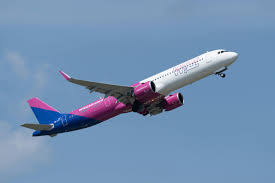
Wizz Air Holdings Plc (LON:WIZZ), Europe’s most emissions-efficient airline, has announced its results for the full year ended 31 March 2026 (F26).
|
|
|
|
|
|
Full year to 31 March |
2026 |
2025 |
Change |
|
Period-end fleet size 1 |
262 |
231 |
13.4% |
|
ASKs (million km) |
132,031 |
121,671 |
8.5% |
|
Load factor (%) |
90.7 |
91.2 |
(0.5)ppt |
|
Passengers carried (million) |
69.7 |
63.4 |
10.0% |
|
Total revenue (€ million) |
5,691.4 |
5,267.6 |
8.0% |
|
EBITDA (€ million) 2 |
1,318.3 |
1,134.3 |
16.2% |
|
EBITDA Margin (%) 2 |
23.2 |
21.5 |
1.6ppt |
|
Operating profit for the period (€ million) |
139.7 |
167.5 |
(16.6)% |
|
Net profit for the period (€ million) |
1.3 |
213.9 |
(99.4)% |
|
RASK (€ cent) |
4.31 |
4.33 |
(0.4)% |
|
Total CASK (€ cent) |
4.35 |
4.33 |
0.5% |
|
Fuel CASK (€ cent) |
1.34 |
1.48 |
(9.6)% |
|
Ex-fuel CASK (€ cent) |
3.02 |
2.85 |
5.8% |
|
Total cash (€ million) 2,3 |
2,126.4 |
1,736.0 |
22.5% |
|
Net debt (€ million) 2 |
4,941.5 |
4,956.3 |
(0.3)% |
1 Aircraft at end of period includes 3 aircraft in Ukraine.
2 For further definition of measures presented refer to the “Alternative performance measures (APMs)” section of this document. In addition to marked APMs, other measures presented above incorporate certain non-financial information that management believes is useful when assessing the performance of the Group. For further details refer to the “Glossary of terms” section of this document.
3 Total cash comprises cash and cash equivalents (31 March 2026: €1,085.9 million; 31 March 2025: €597.5 million), total current and non-current cash deposits (31 March 2026: €952.8 million; 31 March 2025: €1,060.2 million) and total current and non-current restricted cash (31 March 2026: €87.7 million; 31 March 2025: €78.3 million).
HIGHLIGHTS
▶ASK capacity was 8.5 per cent higher vs last year with seats at 10.5 per cent higher due to continuing effect of shorter stage length.
▶Carried a record 69.7 million passengers (vs 63.4 million last year), delivering revenue growth of 8.0 per cent with a load factor of 90.7 per cent (91.2 per cent last year).
▶Total unit revenue (RASK) decreased 0.4 per cent year-on-year, with ticket RASK flat at €2.39 cents and ancillary RASK down 0.8 per cent to €1.92 cents.
▶Ex-fuel CASK increased by 5.8 per cent due to higher depreciation, maintenance, navigation and crew cost. Q4 ex-fuel CASK was up 18.1 per cent at €2.96 cents due to absence of one-off maintenance cost adjustment recorded in F25.
▶Fuel CASK was down by 9.6 per cent to €1.34 cents supported by lower market prices during most of F26, offset in-part by the cost of SAF mandate and varying ETS costs.
▶Operating profit decreased to €139.7 million mainly due to previously guided higher maintenance and depreciation cost as older fleet of aircraft are exiting the fleet.
▶Total cash increased by 22.5 per cent to €2.1 billion, and net debt decreased by 0.3 per cent to €4.9 billion. In January 2026, the maturing €500 million bond was repaid from own cash.
▶On-time performance improved vs last year and disruption cost fell by circa €29.9 million.
▶GTF engine inspections: 30 aircraft-on-ground as of 31 March 2026, down from 42 at the end of last fiscal year. Currently, as of 5 June 2026, at 24 aircraft.
▶Wizz Air closed its Abu Dhabi base during Q2 and wound down base operations in Vienna.
▶CEE market share of 25.3 per cent grew by +1.1 percentage points vs prior year, maintaining its position as the largest CEE operator by seats.
▶Wizz Air delivered CO2 emissions at 50.6 grams per passenger/km for the rolling 12 months to 31 March 2026 (vs 52.2 grams for F25).
▶Wizz Air celebrated a significant milestone during F26 – it has flown 500 million passengers since the start of its operations.
József Váradi, Wizz Air Chief Executive Officer commented on the results:
“F26 has been a year of relentless focus on our strategy and aim to be the reliable travel partner of choice across Central and Eastern Europe, and key markets across the whole European continent.
We have continued to grow and serve an increasing number of customers. Equally, the defining feature of the year was the set of strategic decisions we made to position the business for long-term resilience and competitiveness. This has proven to be the right direction – working well in a balanced environment as well as at times of volatility, which the industry experienced towards the end of the financial year due to the Middle East crisis.
The actions taken during F26 have further strengthened our resilience and the foundations of our business. With a clear strategy, a highly efficient operating model, a young fleet and financial resilience we are well positioned to deliver sustainable growth and create value over the long term.
As we move into the next financial year, our priorities are clear. We will continue to focus on our core markets, restore full fleet utilisation as engine availability improves, maintain discipline in capacity growth and cost control, and further enhance the reliability and quality of our operations. In F27, we will continue to invest in our fleet, our people and our commercial capabilities to support the long-term growth of Wizz Air.“
NEAR TERM AND FULL YEAR OUTLOOK
We are not giving guidance for F27 at this time of the year given the lack of visibility across our trading seasons, uncertainty related to the ongoing conflict in Iran and the closure of the Strait of Hormuz:
▶Capacity (ASKs): Q1 F27 +15% YoY, Q2 F27 +20% YoY;
▶Capacity (Seats): Q1 F27 +25% YoY, Q2 F27 Up high twenties percent YoY;
▶Load factor: Flat YoY across H1;
▶RASK: Q1 F27 down mid-to-high single digit YoY, Q2 F27 flattish YoY;
▶Ex-Fuel CASK: H1 flat to up low single digit YoY.
SUMMARY OF F26 FINANCIAL RESULTS
Wizz Air reported a net profit of €1.3 million (F25: net profit of €213.9 million), with EBITDA improving to €1,318.3 million from €1,134.3 million in F25, showing the overall resilience of the business despite a number of significant one-off headwinds in F26 that included the forced cancellation of Tel Aviv and other Middle East routes during the 2025 peak summer period as well as the cancellation of Middle East and Cyprus routes in March 2026. Whilst the Iran conflict in March 2026 had the risk of negatively impacting earnings by an estimated €50m, this was largely mitigated by fuel hedges put in place prior to the conflict.
Total revenue increased by 8.0 per cent to €5,691.4 million (F25: €5,267.6 million) with seat capacity up by 10.5 per cent to 76.9 million seats and passengers reaching a record number of 69.7 million (F25: 63.4 million). Total fuel expenses decreased by 1.9 per cent to €1,764.0 million (F25: €1,797.6 million). Total operating expenses increased by 8.9 per cent to €5,551.7 million (F25: €5,100.1 million), resulting in a lower operating profit of €139.7 million (F25: €167.5 million) and an operating margin of 2.5 per cent (F25: 3.2 per cent). Net financing expense decreased to €112.7 million (F25: €147.8 million). Profit before income tax was €27.0 million (F25: €19.7 million), while the tax expense was €25.7 million (F25: tax credit €194.2 million) resulting in a net profit of €1.3 million (F25: profit after tax of €213.9 million).
REVENUE AND COST HIGHLIGHTS
Passenger ticket revenue increased by 8.4 per cent to €3,161.4 million (F25: €2,917.0 million) and ancillary revenue grew by 7.6 per cent to €2,530.0 million (F25: €2,350.6 million). The load factor declined by 0.5 percentage points to 90.7 per cent (F25: 91.2 per cent) due largely to the aftermath of the war with Iran. Ancillary revenue was partly impacted by the closure of the Abu Dhabi base in September 2025 and the reduction of flight volumes to the Middle East, as those longer flights generated higher than average ancillary revenues per pax. At the same time, the Company saw higher demand year-on-year for its reserved seating product and new ancillary initiatives like ‘All You Can Fly’.
While total fuel expenses decreased year-on-year, spending on Carbon Emission schemes such as EU and UK ETS and CORSIA increased by 27.2 per cent to €273.3 million (F25: €214.8 million) and the Company spent €56.5 million on SAF (sustainable aviation fuel) uplift in the first year of the EU mandate. Fuel consumption per block hour, however, was reduced by 1.5 per cent to 2.2 metric tonnes, showing improved fuel efficiency due to a greater share of the flying fleet comprising NEO aircraft.
Other major cost lines increased broadly in tandem with capacity growth and inflation. Certain unit costs remained stable as the powder metal affected grounded fleet was systematically released back to service. Airport, handling and en-route costs were higher, increasing by 13.0 per cent to €1,527.6 million (F25: €1,351.8 million) due to rising Eurocontrol sector fees introduced at the start of 2025 and a larger volume of flights. Crew costs were 16.1 per cent higher at €655.9 million (F25: €564.9 million) due to a greater number of operated flights as well as salary and cost-of-living adjustments. Depreciation and amortisation rose 21.9 per cent to €1,178.6 million (F25: €966.8 million), while maintenance, materials and repairs increased to €462.8 million (F25: €330.4 million), up 40.1 per cent, as we maintained more aircraft and spare engines during the year. Flight disruption costs fell to €136.7 million (F25: €166.5 million) owing to the significantly improved operational stability and performance.
Income tax charged increased to €25.7 million (F25: €194.2 million credit) as F25 included a one-off credit arising on the recognition of deferred tax assets that started to unwind as new aircraft are delivered.
FLEET UPDATE
▶In the twelve months ending on 31 March 2026, Wizz Air took delivery of 39x new A321neo aircraft (including 3x which were immediately sold to an aircraft lessor for onwards leasing to a related airline), and 7x new A321neo XLRs. During the same period 11x A320ceo and 1x A321ceo aircraft were redelivered, ending the period with a total fleet of 262 aircraft: 26x A320ceo, 40x A321ceo, 6x A320neo, 183x A321neo and 7x A321neo XLRs.
▶New aircraft deliveries were financed using a combination of sale and leaseback, JOLCO (Japanese Operating Lease with Call Option) and financial lease transactions, with lease terms averaging ten years, before lease extension options.
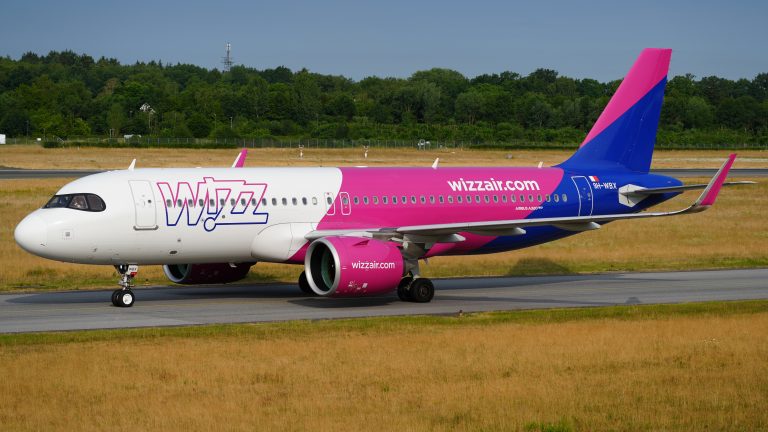
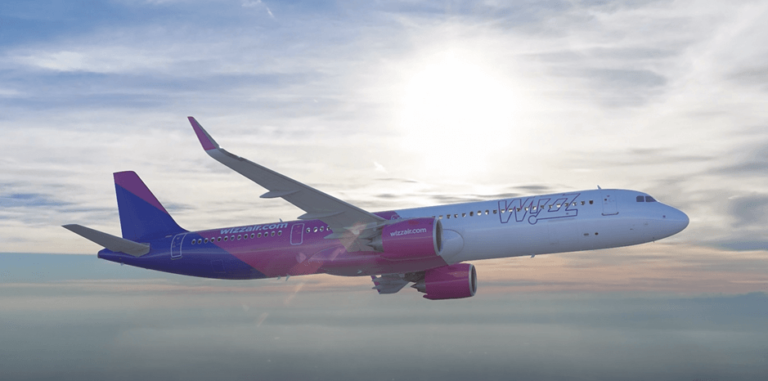
▶The average age of the fleet as of 31 March 2026 stood at 4.5 years, making it the youngest fleet of any major European airline, while the average number of seats per aircraft climbed to 231.
▶The share of new “neo” aircraft within Wizz Air’s fleet has increased to 75 per cent.
▶As of 31 March 2026, Wizz Air’s delivery backlog comprised a firm order for 250x A321neo and 4x A321XLR aircraft, a total of 254x aircraft. The Company discontinued discussions with partners to transfer remaining A321XLR aircraft to other operators and plans to ultimately use all 11x aircraft on longer range routes within its network.
▶Earlier in the year we made a significant adjustment to our delivery schedule, with 88x A321neos being deferred out of this decade and now extended to F33.
▶The table below shows our fleet plan development according to the revised delivery schedule:
|
|
|
|
|
|
|
|
|
|
|
|
|
|
|
|
|
|
|
|
|
|
F26 |
F27 |
F28 |
F29 |
F30 |
F31 |
F32 |
F33 |
|
A320 CEO (180 seats) |
26 |
13 |
3 |
3 |
3 |
3 |
3 |
1 |
|
A321 CEO (230 seats) |
40 |
29 |
14 |
– |
– |
– |
– |
– |
|
A320 NEO (186 seats) |
6 |
6 |
6 |
6 |
6 |
6 |
6 |
3 |
|
A321 NEO (239 seats) |
183 |
211 |
238 |
280 |
315 |
342 |
365 |
368 |
|
A321 XLR (239 seats) |
7 |
11 |
11 |
11 |
11 |
11 |
11 |
11 |
|
Fleet total |
262 |
270 |
272 |
300 |
335 |
362 |
385 |
383 |
COMMERCIAL AND NETWORK UPDATE
At the start of the year, we set out a clear strategic direction: to focus our operations on markets where we can achieve meaningful scale in more cost-efficient, operationally stable environments.
We exited our Abu Dhabi joint venture, initiated the closure of our Vienna base, and accelerated the reallocation of capacity towards Central and Eastern Europe (CEE) and other core markets where we see stronger structural advantages. Additional aircraft were allocated to Skopje, Sofia, Varna, Warsaw, Katowice, Wroclaw, Gdansk, Tirana, Budapest, Bucharest and Chisinau. The non-CEE bases in London, Rome, Milan, Venice, Naples and Catania were also adding aircraft as we record growing yield performance in these markets.
We opened a number of lower-cost bases, including in Bucharest (Baneasa), Bratislava, Podgorica, Suceava, Targu Mures, Tuzla, Warsaw Modlin and Yerevan, strengthening our footprint where we believe we can deliver superior returns over time. Our CEE market share reached 25.3 per cent in the year, maintaining our position as the largest CEE operator by seats. More recently we announced the opening of the new Palermo and Turin bases in Italy.
We continue to monitor the geopolitical situation carefully, to be able to restore our network when the security situation permits. We have plans in place to resume operations in Ukraine within weeks of any ceasefire and opening of the airspace. We also remain committed to Israel, and are keen to develop the market further to meet the growing demand for Wizz Air’s routes.
GTF ENGINE UPDATE
As of 31 March 2026, Wizz Air had 30 aircraft grounded due to GTF engine-related inspections; showing an improvement compared with the end of F25 when the grounded fleet comprised 42 aircraft. GTF engine-related groundings expected at the end of F27 are in the range of 15-20 aircraft with this figure reducing to 0 by the end of calendar year 2027.
GEOPOLITICAL CRISES IN OUR REGIONS
After the war in Iran broke out on 28 February we suspended our Middle East capacity, accounting for circa five per cent of total seats and ten per cent of total ASKs. Having exited the Abu Dhabi base in September of 2025 our exposure in the region was mostly focused on Israel and Tel Aviv. Most of this capacity was immediately redeployed to our core CEE markets, improving the existing summer season products to destinations in Spain, Italy, Croatia, Albania and others. We continue to monitor closely the situation on the ground in the Middle East and in Ukraine. On 28 of May we resumed flights to Tel Aviv from most of our CEE bases.
FINANCIAL UPDATE
▶The Company’s cash position at the end of March 2026 was €2,126.4 million, a 22.5 per cent increase vs 31 March 2025. In January 2026 the Company repaid its maturing €500 million bond, while renewing its €3.0 billion EMTN programme for another three years.
▶Net debt at 31 March 2026 was €4,941.5 million vs €4,956.3 million at 31 March 2025, while the Company’s leverage ratio (net debt to EBITDA) decreased to 3.7x compared to 4.4x at F25 year-end. Over the same period, liquidity ratio increased to 35.8 per cent from 31.5 per cent.
▶As of 29 May 2026, using jet fuel zero-cost collars, Wizz Air has accumulated hedge coverage of 84 per cent of its jet fuel needs for H1 F27 at a price of $826/ 757 per metric tonne and 71 per cent for H2 F27 at a price of $819/747 per metric tonne. For F28 the coverage is 17 per cent at a price of $861/ 773 per metric tonne. The EUR/ USD FX coverage stands at 81 per cent for H1 F27 at $1.1701/ $1.1340 rates and 72 per cent for H2 at $1.2048/ $1.1683 rates; for F28 it is at 17 per cent at $1.2033/ $1.1788 rates. From beginning of F26 the Company has been hedging USD currency exposure on its lease liabilities. As of 31 March 2026, Wizz Air had 83 per cent of $4.5 billion USD lease liability hedged using a blend of USD cash deposits, and cross currency swaps (average EUR/ USD rate of 1.12).
▶The balance of the EU emissions trade scheme credits repurchase agreement as at the end of March 2026 was €308.1 million.
▶Wizz Air continued to receive OEM compensation from Pratt & Whitney related to the GTF engine issues.
ESG UPDATE
In F26 Wizz Air achieved further progress on the sustainability agenda:
▶As of 31 March 2026, the 12 months rolling CO2 emissions per passenger kilometre was at 50.6 grams in F26 (F25: 52.2 grams), the lowest among peers in the industry.
▶Wizz Air maintained a ‘B’ score in 2025 climate ranking CDP, reaching ‘management level’.
▶Wizz Air continued to be recognized for its leading efficiency and was awarded Most Sustainable Low-Cost Airline for the fifth consecutive year at the World Finance Sustainability Awards 2025.
▶It has also been ranked the world’s second best ultra‑low‑cost airline and placed among the top 10 global low‑cost carriers for 2026 by Airline Ratings, the global authority on airline safety, product quality and passenger reviews.
▶In the first half of F26 it introduced a voluntary pension program and paid out all-employee bonus equivalent to 13th month salary.
▶During Q3 Wizz Air updated its All-Employee Bonus Scheme, aligning it more closely with Company’s performance objectives.
▶In November, an employee engagement survey was conducted with highest recorded number of participants and an overall employee engagement score increased to 7.5 (+0.5 points compared to previous year).
▶In December, Wizz Air created a new Financial Performance Committee, with an oversight of the Company’s operational and financial planning, asset financing, capital structure and performance related financial and productivity metrics.
▶As of 31 March 2026 the share of Wizz Air issued share capital held by Qualifying Nationals (i.e. European Economic Area nationals), was 43 per cent, which, based on the disenfranchisement policy that Wizz Air Board last applied during July ’25 AGM, would entitle them to 55 per cent of total voting rights, leaving Non-Qualifying Nationals with the remaining 45 per cent of total voting rights.
DETAILS OF RESULTS MEETING
Wizz Air’s management will host an in-person presentation for analysts and institutional investors at 09:30 GMT (10:30 CET) at MHP Group’s offices, 60 Great Portland Street, London, W1W 7RT, on the day. For those who are unable to attend the presentation in person, a live webcast will also be available.
Participants can register for the webcast here: https://sparklive.lseg.com/WizzAirHoldings/events/fe061844-aaeb-4802-8115-9aa44cf77ee6/wizz-air-f26-results