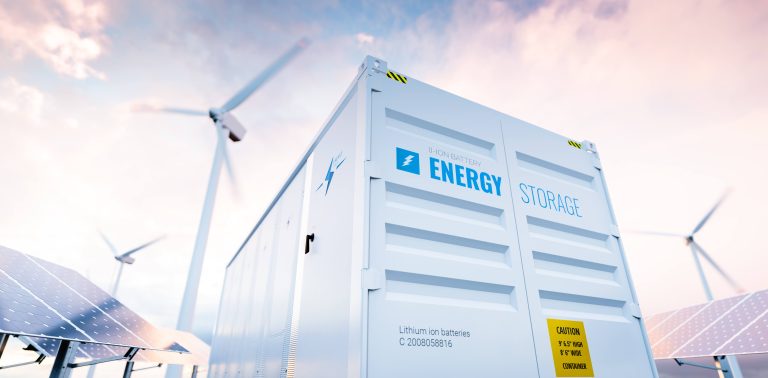
Commercial battery energy storage is increasingly being used as a practical tool for managing power costs, improving resilience and supporting renewable energy use. Battery storage can help businesses reduce exposure to peak electricity pricing, keep operations running during disruptions and make energy use more predictable.
A battery energy storage system, or BESS, stores electricity and releases it when it is needed. In a commercial setting, that stored power can be used during periods of high demand, during outages or when renewable generation is not available.
A complete BESS is more than a bank of batteries. It usually includes a grid connection, switchgear, a transformer, a power conversion system, battery containers, an energy management system and communications equipment. These parts allow the system to connect safely to the site and the grid, convert power when required and control when energy is stored or discharged.
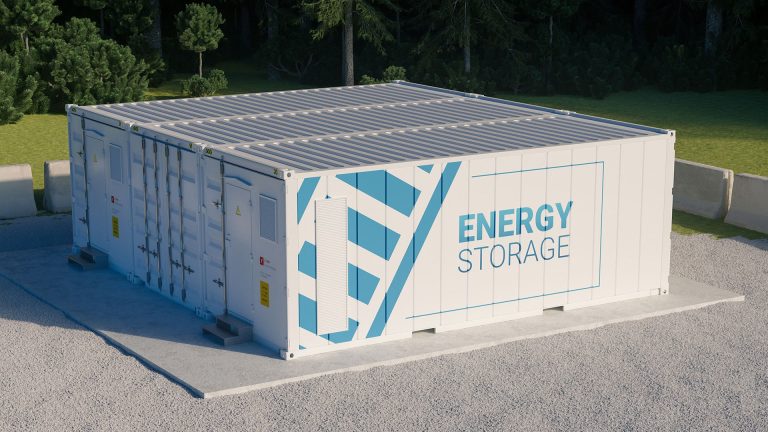
The container itself is also a managed system. It can include battery racks, thermal controls, fire suppression, control panels, emergency disconnects, sensors, wiring and busbars. These components are important because battery storage needs to be monitored and protected at every level.
At a deeper level, the battery rack and module structure show where reliability is built. Racks hold the battery modules and include busbars, fuses, contactors, current sensors, temperature sensors and monitoring units. Modules contain cell groups, compression plates, voltage sensing wires, thermal interface materials, a battery management board and fuse links. The cell is the core storage unit, with its case, cathode, anode, separator, electrolyte, current collectors, safety vent and terminals.
This layered structure helps explain why commercial storage is not just a hardware purchase. It is an integrated energy asset that depends on safety systems, software control and correct sizing. A system that is well matched to a site can help manage demand charges, support backup power needs and improve the use of onsite generation. A system that is poorly specified may fail to deliver the expected operational value.
Ampeak Energy Limited (LON:AMP) a developer, owner and operator of sustainable energy projects. Transitioning to become a major Independent Power Producer (IPP) with a project development arm specialising in Battery Storage and Tidal Stream generation.