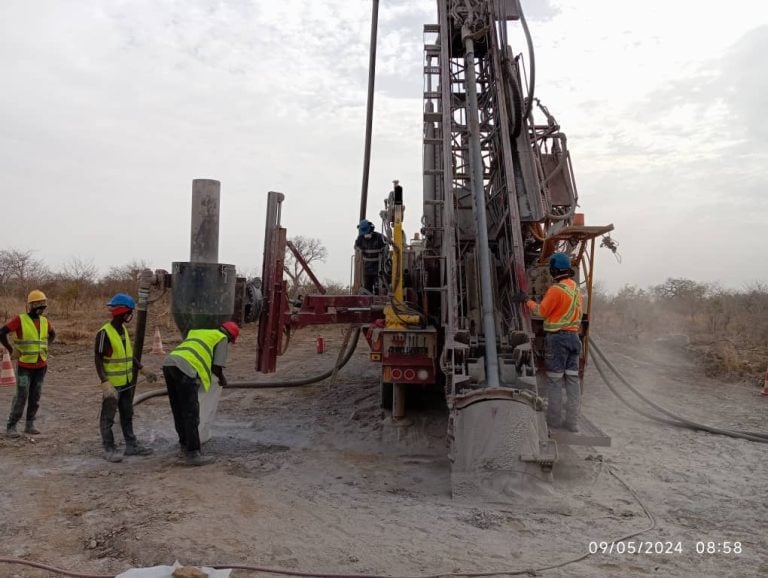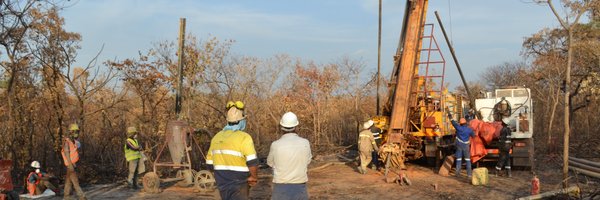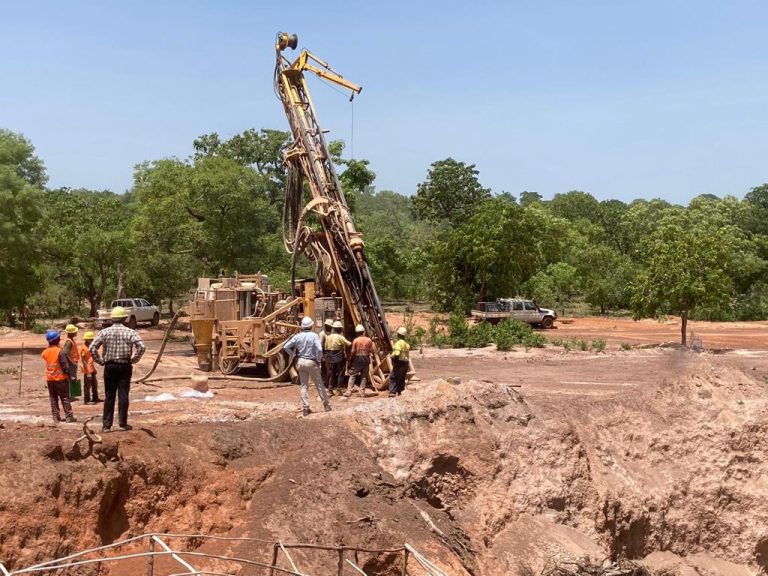
Cora Gold Limited (LON:CORA), the West African focused gold company, has provided an update on recent drilling results being conducted at the Company’s Sanankoro Gold Project in southern Mali. The 2026 drill programme is targeting both extensions to existing deposits and a number of highly prospective near-mine greenfield targets, offering the potential for rapid conversion into future mine plan feed.
The first batch of assay results have been received from drilling at Zone B, which is a major focus of the 2026 mineral resource estimate (‘MRE’) update drilling programme. Zone B was prioritised due to the extensive strike length (>2 km, excluding the additional 1.7 km Zone B North trend), broad mineralised widths, limited deeper drilling, and significant potential to improve continuity within the existing resource area as part of a targeted drilling campaign aimed at extending Inferred mineralisation beyond the current model.
2026 Drilling Highlights
● Best intercepts from initial assays at Zone B (central) include:
o 22m @ 2.24 g/t gold (‘Au’) from 12m in hole SC0712
o 34m @ 6.78 g/t Au from 117m in hole SC0716
▪ Includes 9m @ 23.91 g/t Au from 128m
o 54m @ 1.06 g/t Au from 144m in hole SC0718
▪ Includes 8m @ 5.68 g/t Au from 153m
o 7m @ 1.05 g/t Au from 37m in hole SC0709
● Results to date demonstrate broad intervals of mineralisation outside of the 2024 MRE model, including higher-grade zones.
● The higher-grade zones may present future mining plan optionality to pursue these zones from underground mining.
● These results provide further confidence in the potential to materially expand the Project’s current MRE inventory of 1.044 Moz and life of mine of 10.2 years.
● The drill programme remains ongoing, with assays pending from Selin, Dakounkoura South, Zone A and Zone C with drilling continuing at TRA07, Kary (Zone B south) and the remaining drill holes at Zone B.
● All drilling areas and their resources are within short trucking distance of Sanankoro’s proposed gold processing plant currently undergoing Front-End Engineering Design (‘FEED’) work programmes.
● 10,656 metres drilled to date of planned 12,000 metres total, 1,272 metres released today in first set of assays.
Bert Monro, Chief Executive Officer of Cora, commented, “34m @ 6.78 g/t Au is a fantastic drill hole. To encounter this, alongside several other very strong intercepts outside the existing MRE pit shell, in our first holes is extremely encouraging both for the rest of the results and also the future resource growth.
“These results continue to demonstrate the broad nature of the mineralisation that we come to expect from Zone B, and importantly it is the higher-grade core of these mineralised zones in the fresh rock that start to demonstrate the possibility of a much greater extended mine life, beyond the oxide mining and processing. As often is the case with start-up oxide operations, they morph into much longer life projects with a mixture of open pit and underground operations. Our current resource expansion drill programme is beginning to unlock further value of the Project, as we keep one eye on the future mine life extensions.”
Sanankoro Gold Project Map
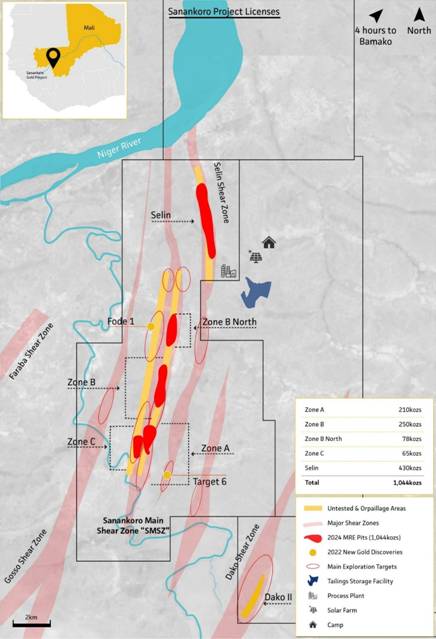
Figure 1: Map showing the locations of the deposits, and future mineral resource growth zones at the Sanankoro Gold Project
Drill Programme Overview
In early June, the Company announced plans of its proposed 2026 MRE growth drilling programme, which comprises more than 12,000m of drilling, both diamond drilling but predominantly reverse circulation (‘RC’) drilling, to be carried out at four of the five existing deposits at Sanankoro. Zone B is planned to receive the largest allocation of metres due to its significant growth potential resulting from the current MRE model being predominantly constrained by a lack of drill coverage along strike and at depth.
The Company believes that whilst not a primary focus of the drill programme, portions of the drilling will also convert some of the additional mineral resources into the Indicated category, supporting future ore reserve and mine life growth. This drill programme is part of a broader long-term resource growth strategy across the Sanankoro Project Area, incorporating resource extension and green fields drilling, both of which are designed to enhance the current mine life and reserves of 10.2 years and 531 koz respectively. The exploration and resource definition at Sanankoro is still regarded as being in its infancy with many more drill programmes and greenfield targets to be tested for their resource potential. The exploration potential of Sanankoro is evidenced by an Independent JORC Compliant Exploration Target Report, announced September 2022, of between 26.0 Mt and 35.2 Mt with a grade range of 0.58-1.21 g/t Au for a potential content of 490 koz Au to 1.37 Moz Au, which was in addition to the MRE at the time of 24.9 Mt at 1.15 g/t Au for 920 koz, announced on 29 July 2022.
Zone B Drilling Results Summary
To date, during the current campaign at Zone B (central pit area), the Company has drilled 10 holes for 1,272m.
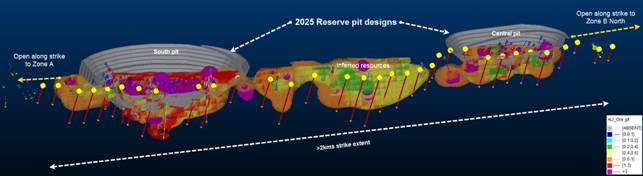
Figure 2. Zone B MRE model, coloured by gold grades (g/t) with planned drill holes layout and reserve pit designs for Zone B South and Central.
The reported drill results are from the northern end of the Zone B Central pit area (far right end in Figure 2). Zone B comprises three separate deposits: Zone B South, Zone B Central and Zone B North (not shown on the above graphic); these are all hosted along the same mineralised structural corridor associated with the hanging wall of the Sanankoro Main Shear Zone (‘SMSZ’). Collectively, the three deposits extend over approximately 3.7 km of strike length.
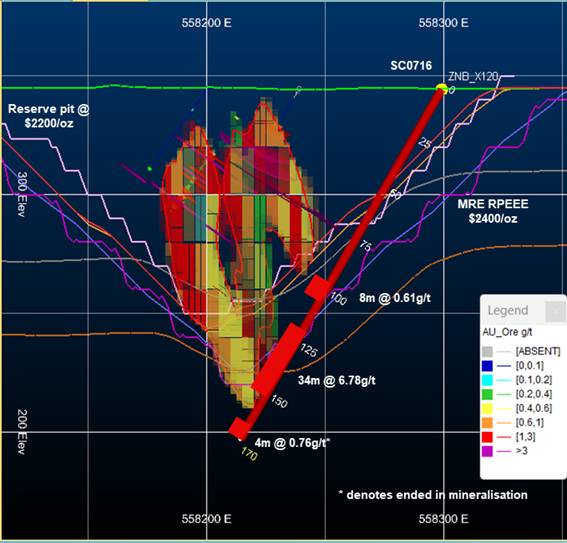
Figure 3: Zone B Central deposit drill section looking north, planned hole ZNB_X120 = drilled hole SC0716, which ended in mineralisation.
Drill hole SC0716 intersected a mineralised zone of 34m @ 6.78 g/t Au, with the hole drilled beneath the reported 2025 MRE Reasonable Prospects for Eventual Economic Extraction (‘RPEEE’) pit shell of US$2,400/oz and outside the MRE mineralised grade shell. The hole also intersected other zones of mineralisation which represents the wider mineralised structure associated with the hanging wall of the SMSZ. Further deeper drilling in the future could be carried out to test for down dip extensions of the higher-grade core of 9m @ 23.91 g/t Au.
Below in Table 1 is the full summary of the drill intervals for the Zone B Central pit area drill results, where reporting criteria is cut-off Au≥0.1 g/t Au, minimum 3m interval & ≥6m waste included (where all drill holes dip is -60 degrees and drill hole azimuth = 270 degrees).
| Hole ID | From | To | Intercept |
| SC0709 | 21 | 55 | 34m @ 0.34 ppm (includes 7m @ 1.05ppm from 37m) |
| SC0710 | 4 | 7 | 3m @ 0.24 ppm |
| SC0712 | 12 | 34 | 22m @ 2.24 ppm |
| SC0712 | 46 | 64 | 18m @ 0.19 ppm |
| SC0712 | 94 | 106 | 12m @ 0.31 ppm |
| SC0712 | 119 | 126 | 7m @ 0.23 ppm |
| SC0713 | 142 | 149 | 7m @ 0.63 ppm |
| SC0716 | 96 | 104 | 8m @ 0.61 ppm |
| SC0716 | 117 | 151 | 34m @ 6.78 ppm |
| SC0716 | 166 | 170 | 4m @ 0.76 ppm |
| SC0718 | 16 | 21 | 5m @ 0.13 ppm |
| SC0718 | 126 | 136 | 10m @ 0.68 ppm |
| SC0718 | 144 | 198 | 54m @ 1.06 ppm |
Table 1. Summary of the drill intervals for the Zone B Central pit area drill results.
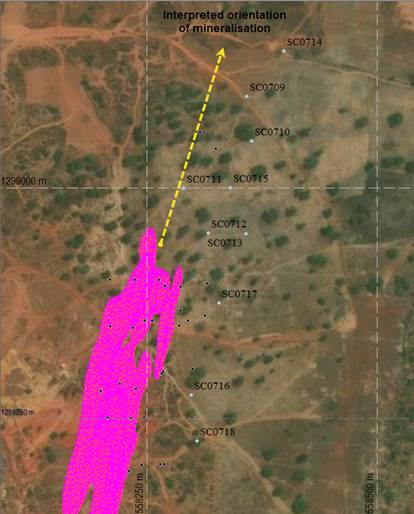
Figure 4: Zone B Central pit area 2026 drill programme map, displaying holes SC0709 – SC0718. Magenta shape is the 2022 MRE grade shell. Holes with no intercepts were SC0711, SC0714 and SC0715.