Cora Gold Limited (LON:CORA), the West African focused gold company, has provided further drill results from the ongoing 2026 mineral resource estimate (‘MRE’) growth drilling programme being conducted at the Company’s Sanankoro Gold Project in southern Mali. The drill programme aims to unlock the broader long-term potential of the Project through a targeted resource growth and exploration programme, focusing on both extensions to existing deposits and evaluating a number of highly prospective near-mine greenfield targets.
The latest assay results have been received from drilling at the Zone A and Zone C deposits, the two most southerly deposits at Sanankoro, located along the Sanankoro and Bokoro structures respectively. The Zone A drilling (13 reverse circulation holes for a total of 1,780m) was testing for possible extensions of the known mineralised zones and Zone C drilling (12 RC holes for a total of 1,550m) primarily tested the gap area between the north and south MRE pits at this deposit. All holes were designed to add new Inferred resources once the MRE update modelling has been completed. The drill programme at Zone A confirmed mineralisation is still open at both the northern and southern ends of the deposit, as well as at depth, while at Zone C drilling was successful at defining broad intercepts of mineralisation in the central area between the northern and southern MRE pits. Future oxide resources may be further defined once drilling can be programmed to continue drill testing the extremities of both deposits.
Zone A and Zone C Drilling Highlights
● Best intercepts from the drill programme include:
o Zone A
▪ 3m @ 21.24 g/t gold (‘Au’) from 160m in hole SC0757
▪ 13m @ 1.01 g/t Au from 148m in hole SC0759
▪ 14m @ 0.89 g/t Au from 56m in hole SC0764
▪ 22m @ 0.50 g/t Au from 22m in hole SC0735
o Zone C
▪ 19m @ 3.19 g/t Au from 123m in hole SC0774
▪ 49m @ 1.13 g/t Au from 87m in hole SC0767
▪ 40m @ 0.89 g/t Au from 85m in hole SC0768
▪ 69m @ 0.48 g/t Au from 66m in hole SC0769
● The Zone C drill results prove the continuity at depth of the mineralisation between the northern and southern MRE pits, approximately 250m of strike length. Mineralisation remains open at depth.
● The broad zones of mineralisation intersected in the central area of Zone C are expected to enable future MRE Reasonable Prospects for Eventual Economic Extraction (‘RPEEE’) pit optimisations to go deeper and generate one larger MRE RPEEE pit shell, rather than two separate smaller RPEEE pit shells, maximising the mineralised potential and improving the Project’s economics.
● The southern end of Zone A is directly open towards the >1.5km long Narakaboh target located along the Sanankoro structure, with hole SC0735 intersecting 22m @ 0.5 g/t Au from 22m depth.
● Drill results continue to build on the positive 2026 drill programme results reported from Zone B (central), Selin and Dakounkoura South, with assays still pending from Zone C (three holes outstanding), Zone B South (RC and diamond drilling), TRA07 and Kary (Zone B south/west).
● The diamond drill programme continues to test the deeper extensions to Zone B mineralisation.
● The consultants Environmental Resources Management Ltd (‘ERM’) have been engaged to complete the MRE update and technical reporting, once all assays have been received, as the Company aims to expand the Project’s current MRE inventory of 1.044 Moz and life of mine of 10.2 years.
Bert Monro, Chief Executive Officer of Cora, commented, “These latest drill results provide further validation of the exploration and resource potential of the Sanankoro and Bokoro structures. Not only is our relatively small targeted drill programme providing us with positive results and MRE growth opportunity, it is also continuing to produce new drill targets and further resource growth in the future.
“Historically Zone C, in particular along the Bokoro structure, has seen little to no drilling along its interpreted 8km of strike and certainly not at depth, so these assays, which are above the 0.3 g/t Au Reserve cut-off grade, are a great result, proving the continuity at depth and defining broad intercepts of mineralisation in the central area. Zone A has shown that the mineralised extensions continue north towards Zone B and encouragingly its southern extension is open to the Narakaboh target, an undrilled portion of the Sanankoro structure that could see us increase the strike length of the structure to over 10km. Given the success of the results to date, we are becoming increasingly confident that the more we drill along the Bokoro and Sanankoro mineralised structures, then the more we can turn Sanankoro into another long-life gold mining project in Mali.”
Sanankoro Gold Project Map
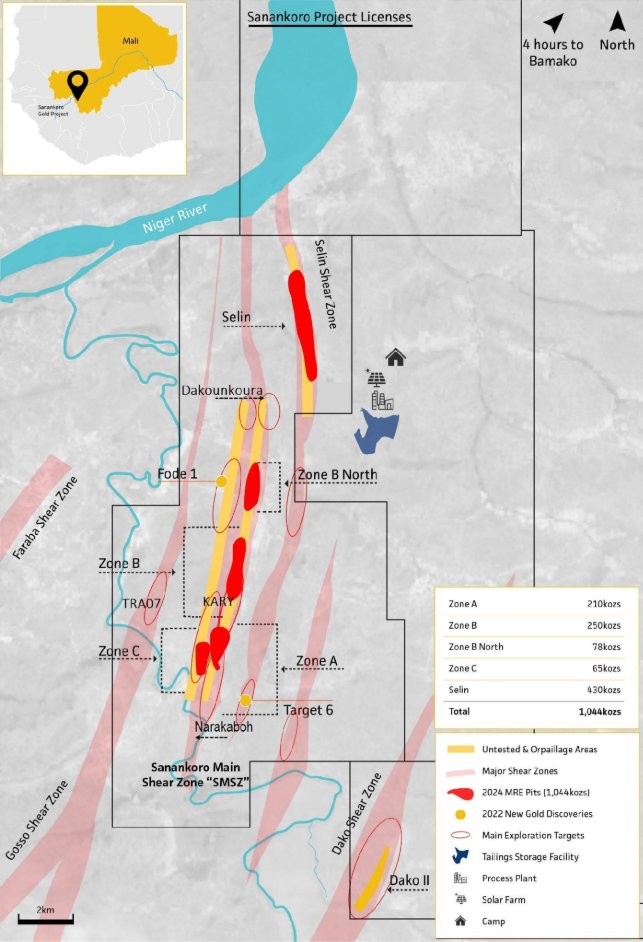
Figure 1: Map showing the locations of the MRE deposits, and future mineral resource growth zones at the Sanankoro Gold Project.
Zone A and Zone C Drill Programme Overview
The 2026 MRE growth drill programme at Zone A and Zone C comprised 13 RC holes (1,780m) and 12 RC holes (1,550m) respectively. The Zone A drill programme was testing for possible extensions to known mineralisation at the extremities and below the MRE. The Zone C drill programme primarily tested the central area between the north and south MRE RPEEE pits. All holes at both deposits were designed to add new Inferred resources once the MRE update modelling has been completed.
Figure 2 below shows the southern portions of the Zone A and Zone C deposits, located along the Sanankoro and Bokoro structures (respectively) that form the hangingwall and footwall contacts of the Sanankoro Main Shear Zone (‘SMSZ’), one of five main gold bearing structures known to host mineralisation within the Project’s extensive exploration permits.
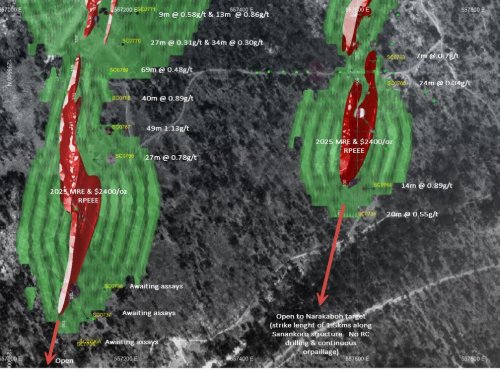
Figure 2. Southern end of the Zone A (right) & Zone C (left) deposits showing the completed 2026 MRE drill holes with their drill intercepts, MRE grade shell (red shaded outlines) and the 2025 MRE RPEEE pit shells (green)
Figure 3 below shows the northern portions of the Zone A and Zone C deposits – both deposits lack reconnaissance drilling to the north to test for grade continuity. Artisanal miner activity between Zone A and Zone B (approximately 1km apart) suggests that the two deposits may link together once drilled systematically in the future. The Bokoro structure currently hosts Zone C in the south, Fode01 towards the central portion and Dakounkoro at the northern end, with approximately 8km in strike length. The Company has not at this point in time been able to give the structure the same exploration focus as the Sanankoro structure but intends to do so in the future.
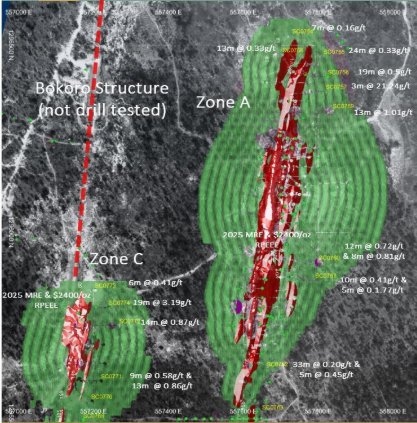
Figure 3. Northern end of the Zone A (right) & Zone C (left) deposits showing the completed 2026 MRE drill holes with their drill intercepts, MRE grade shell (red shaded outlines) and the 2025 MRE RPEEE pit shells (green).
Zone C Drilling Results Summary
Below in Table 1 is the full summary of the drill intervals for Zone C, where the reporting criteria cut-off is ≥0.1 g/t Au, minimum 3m interval and ≥6m waste included (where all drill holes dip is -60 degrees and drill hole azimuth = 270 degrees).
| Hole_ID | From | Intercept | Gram x Metre |
| SC0766 | 11 | 4.00m @ 1.03 ppm | 4.1 |
| SC0766 | 106 | 27.00m @ 0.78 ppm | 21.1 |
| SC0767 | 9 | 9.00m @ 0.61 ppm | 5.5 |
| SC0767 | 87 | 49.00m @ 1.13 ppm | 55.4 |
| SC0768 | 9 | 13.00m @ 0.77 ppm | 10 |
| SC0768 | 85 | 40.00m @ 0.89 ppm | 35.6 |
| SC0769 | 7 | 21.00m @ 0.12 ppm | 2.5 |
| SC0769 | 66 | 69.00m @ 0.48 ppm | 33.1 |
| SC0770 | 82 | 27.00m @ 0.31 ppm | 8.4 |
| SC0770 | 119 | 34.00m @ 0.30 ppm | 10.2 |
| SC0771 | 19 | 8.00m @ 0.16 ppm | 1.3 |
| SC0771 | 108 | 9.00m @ 0.58 ppm | 5.2 |
| SC0771 | 130 | 13.00m @ 0.86 ppm | 11.2 |
| SC0772 | 31 | 15.00m @ 0.43 ppm | 6.5 |
| SC0772 | 140 | 3.00m @ 0.31 ppm | 0.9 |
| SC0772 | 187 | 14.00m @ 0.87 ppm | 12.2 |
| SC0773 | 7 | 25.00m @ 0.12 ppm | 3 |
| SC0773 | 72 | 6.00m @ 0.41 ppm | 2.5 |
| SC0774 | 123 | 19.00m @ 3.19 ppm | 60.6 |
| SC0774 | 153 | 5.00m @ 0.23 ppm | 1.2 |
Table 1. Summary of the drill intervals from Zone C.
Zone A Drilling Results Summary
Below in Table 2 is the full summary of the drill intervals for Zone A, where the reporting criteria cut-off is ≥0.1 g/t Au, minimum 3m interval and ≥6m waste included (where all drill holes dip is -60 degrees and drill hole azimuth = 270 degrees).
| Hole_ID | From | Intercept | Grade x Metre |
| SC0735 | 22 | 22.00m @ 0.50 ppm | 11 |
| SC0754 | 47 | 10.00m @ 0.09 ppm | 0.9 |
| SC0754 | 74 | 7.00m @ 0.16 ppm | 1.1 |
| SC0755 | 60 | 24.00m @ 0.33 ppm | 7.9 |
| SC0755 | 141 | 8.00m @ 0.09 ppm | 0.7 |
| SC0756 | 35 | 13.00m @ 0.33 ppm | 4.3 |
| SC0757 | 121 | 8.00m @ 0.20 ppm | 1.6 |
| SC0757 | 160 | 3.00m @ 21.24 ppm | 63.7 |
| SC0758 | 66 | 6.00m @ 0.33 ppm | 2 |
| SC0758 | 116 | 4.00m @ 0.21 ppm | 0.8 |
| SC0758 | 135 | 19.00m @ 0.50 ppm | 9.5 |
| SC0758 | 186 | 3.00m @ 0.34 ppm | 1 |
| SC0759 | 21 | 4.00m @ 1.45 ppm | 5.8 |
| SC0759 | 39 | 4.00m @ 0.29 ppm | 1.2 |
| SC0759 | 59 | 12.00m @ 0.12 ppm | 1.4 |
| SC0759 | 78 | 3.00m @ 0.15 ppm | 0.4 |
| SC0759 | 148 | 13.00m @ 1.01 ppm | 13.1 |
| SC0760 | 19 | 4.00m @ 0.18 ppm | 0.7 |
| SC0760 | 60 | 5.00m @ 0.13 ppm | 0.7 |
| SC0760 | 99 | 5.00m @ 0.21 ppm | 1.1 |
| SC0760 | 150 | 12.00m @ 0.72 ppm | 8.6 |
| SC0760 | 183 | 8.00m @ 0.81 ppm | 6.5 |
| SC0760 | 216 | 6.00m @ 0.24 ppm | 1.4 |
| SC0760 | 229 | 5.00m @ 0.14 ppm | 0.7 |
| SC0761 | 39 | 10.00m @ 0.41 ppm | 4.1 |
| SC0761 | 58 | 5.00m @ 0.38 ppm | 1.9 |
| SC0761 | 111 | 4.00m @ 0.16 ppm | 0.6 |
| SC0761 | 155 | 5.00m @ 1.77 ppm | 8.8 |
| SC0761 | 177 | 14.00m @ 0.26 ppm | 3.6 |
| SC0762 | 56 | 33.00m @ 0.20 ppm | 6.6 |
| SC0762 | 97 | 5.00m @ 0.45 ppm | 2.3 |
| SC0763 | 69 | 7.00m @ 0.70 ppm | 4.9 |
| SC0764 | 35 | 14.00m @ 0.24 ppm | 3.4 |
| SC0764 | 56 | 14.00m @ 0.89 ppm | 12.5 |
| SC0765 | 71 | 3.00m @ 0.17 ppm | 0.5 |
| SC0765 | 81 | 24.00m @ 0.34 ppm | 8.2 |
Table 2. Summary of the drill intervals from Zone A.
Selected drill sections from Zone A and Zone C drill programme
In Figure 4 below drill hole SC0735, the southernmost hole at Zone A, tested the southern extension of the Sanankoro structure at Zone A (see Figure 2). The drill hole was collared outside the MRE RPEEE pit shell (at US$2,400/oz) and 50m beyond the 2025 MRE grade shell. Once re-modelled, this hole is expected to add new resources to the next MRE update in addition to providing the confidence to continue exploring and testing south of Zone A at the Narakaboh target, an untested portion of the Sanankoro structure, >1.5km long.
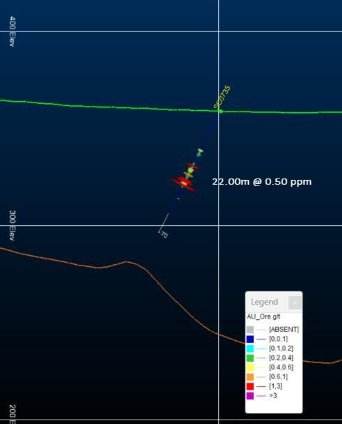
Figure 4: Zone A southern end, hole SC0735 coloured by gold grades (g/t Au), intersected mineralisation outside of the MRE model (not shown). Mineralisation open to south and down dip along Sanankoro structure.
Figure 5 below shows the RC drill chips (below left) for hole SC0735, mineralised and oxidised quartz veins visible from 22m depth to 44m, and a photo of the surface ground condition looking south towards the Narakaboh target area showing extensive historic artisanal mining activity.
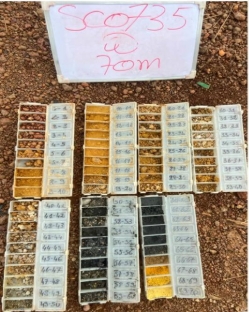
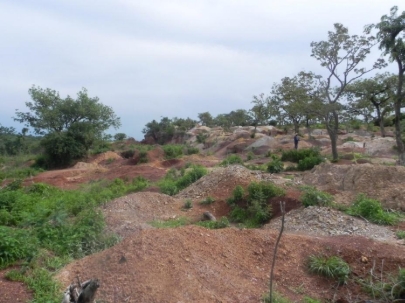
Figure 5: Drill hole SC0725 RC drill chips (left) and artisanal miners surface workings following the Sanankoro structure south towards Narakaboh target.
Below in Figure 6 drill section from Zone C, drill hole SC0767, drilled into the central area between the two previously defined north and south mineralised zones along the Bokoro structure.
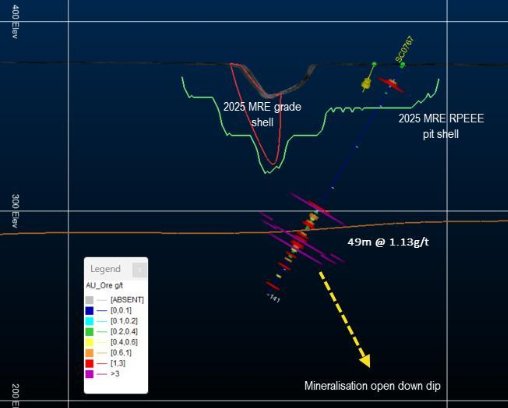
Figure 6: Zone C, drill hole SC0767 (coloured by gold grades (g/t Au)), showing MRE grade shell outline (red polygon) & 2025 MRE RPEEE pit shell (at US$2,400/oz) – green line.
Figure 7 below is an oblique 3D long section of Zone C displaying the MRE grade shell with new 2026 drill holes showing the extensions to mineralisation in the central area of the Zone C deposit, which was not previously drill tested. The future MRE update modelling will likely join the north and south mineralised zones into one larger continuous zone as a result of the 2026 MRE growth drilling, which will improve the MRE RPEEE pit optimisation economics resulting in a larger single pit shell for reporting mineral resources. Assay results are still outstanding for the three most southern holes at Zone C and, if successful, may add additional resources, and confirm the open extension of the deposit and structure to the south, as no previous drilling has been carried out to test for its continuation and exploration prospectivity.
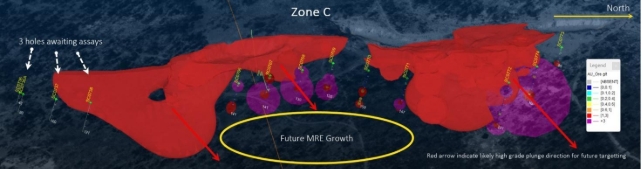
Figure 7: Zone C deposit, oblique 3D long section displaying the 2026 drill programme intercepts, coloured by gold grades (g/t Au) – see legend, 2025 MRE grade shell (red shaded object).