Meren Energy plc (MER.TO) Chief Executive Officer Dr Oliver Quinn caught up with DirectorsTalk to discuss latest results, increased full-year earnings guidance, its Nigerian drilling programme, investment opportunities, and the progress of its offshore Namibia projects.
Q1: Oliver, first off, you’ve reported financial and operating results for the three and nine months ended September 30th, 2026. Your third-quarter production, though, is lower than last year. How should investors read that quarter?
A1: I think there’s a couple of key observations.
Firstly, our base production comes from three giant fields in Nigeria, those are midlife fields. So, there will be a natural decline, like any oil field through time and that’s just what you see as oil fields reach maturity. So, we’re seeing a little bit of that natural decline.
More specifically, when you look at that quarter-on-quarter comparison that you mentioned, we’ve had a period here where we increased production in the fields, and that’s been for good reason. That’s because we’ve been doing some new subsurface work, analysing data from the latest production statistics, if you like, and so we took a deliberate pause on activity, which then leads to that natural decline.
Actually, as we speak, we have a rig back in Nigeria, we have another one coming in 2027 and so we’ll revert back to drilling activity in the near term. That will arrest that natural decline that we’ve seen in that quarter comparison.
So, yes, it’s been a quiet period. It’s been a quiet period for deliberate reason. From a production and barrels perspective, we’re back in a phase of quite exciting activity now and that will play through 2027.
Technically, that’s what goes on with the fields and what happens.
I think, of course, financially, despite that production being lower quarter on quarter with last year, it’s a significant increase in financial performance, largely driven by oil price. Of course, what we’ve seen there is, with high oil prices, we’ve delivered in the first nine months of this year higher earnings than in fact the entirety of 2025.
So, back to production, back to operational activity to support that, but equally, good financial performance in parallel.
Q2: Now, as you mentioned, you are about to enter a sustained period of investment across the Nigerian deepwater portfolio. Why is Nigeria the right place to invest now?
A2: It’s a country that’s a big place, it has a headline status in the world and certainly in Africa. So it attracts a lot of attention, not all of it has been good.
So, how do we look at it? I think firstly, it’s a fantastic subsurface resource so prolific oil and gas. The country’s heading up towards 1.8 million barrels a day, with a target towards above 2 million barrels a day production so a major producer in the world.
Therefore, you’ve got a lot of opportunity to grow a business and you’ve got infrastructure, commercially in terms of the government, industrially in terms of supply chain, that’s very strong and compelling. So, you can get things done.
I think more recently, and probably more pertinently, is we have a government in Nigeria now that’s been in place almost four years. It’s very supportive of the sector. They’ve talked a lot about reform, a lot about improving fiscal terms to deliver, in particular, the deepwater projects where we are focused, and actually they’ve delivered on that. So it’s not just been promises, it’s been delivery. We’ve seen significant fiscal incentives. There’s another incentive that came out recently, which offers effectively a production tax credit to grow new projects.
So, the macro backdrop of the country is firstly subsurface, lots of opportunity. There’s simply lots of oil and gas there to be developed and produced. Secondly, on the above ground, a very, very supportive government which has delivered on a very supportive fiscal framework.
That gives us great confidence that, when you’ve got both of those things together, that’s when you can really start to make things happen.
Q3: Just looking forward, what milestones should investors watch over the next 12 months?
A3: It’s going to be a busy 12 months for us, and I think I’d categorise it into two different areas.
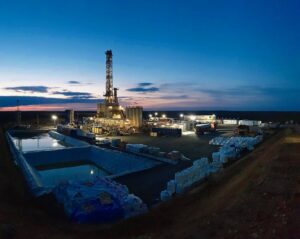
Firstly, as I touched on earlier, after a hiatus in operational activity, we have a rig in the field now that will drill what we call short-term production wells. So, infill drilling, workover wells, that will add barrels in the near term in 2027.
We have a second rig arriving on our third field, Agbami, in 2027. So as we get into 2027, the activity level ramps up with two rigs drilling. So, again, that will sustain our production base.
What it will also do, though, is test some new resource. We’re going to drill a well anytime soon, really before year-end, it’s something called Akpo Far East, which is a near-field exploration target. Again, testing new barrels at low risk, which could be incrementally important to us.
Equally, our second rig, when it comes next year, will appraise a discovery near our main Agbami field that’s a candidate as a tie-back growth project.
So, in terms of operational activity in 12 months, on one hand, we’ve got really important activity adding barrels in a high-price environment and two, we’ve got activity that tests new barrels and matures discovered barrels towards development in the next couple of years.
Operationally, that’s a busy 12 months and pretty exciting for us.
I think the other big area then is in this project maturation. Again, if I talk about Nigeria to start with, we have a big discovery there called Preowei, which is gross about 150 million barrels of recoverable oil. That is a project that ties into the Egina FPSO. It’s a very promising project in the sense that you’ve got a good subsurface resource. It ties back to our existing infrastructure. It’s low capital and lower risk and that’s a project that now we’re moving aggressively in the joint venture forward with.
We won’t see first oil from that in 2027, but what we will see is movement towards an FID decision and therefore a clear way forward to deliver first oil possibly in 2030.
There’s another one of those projects called Egina South, which is a lookalike-type tie-back, again, very good economics, very efficient capital. That’s slightly further behind in maturity, but an appraisal well will be drilled on that in 2027. Again, that will allow that to come as a fast follower, if you like, as another big project.
So, that second bucket I’d characterise as 2027 in the next 12 months is great momentum and milestones in showing that those projects will reach maturity and first production. That will layer on to our strong base cash flow, and it will layer on step changes in growth as we get into two to three years from now.
I think the final big catalyst for us near term is we own a share in Namibia, switching countries so in the Venus project operated by TotalEnergies. We have an indirect stake in that project, and I think I follow the operator’s guidance because they’ve said that it’s very close to FID, it’s in fact final investment decision ready.
That’s something that, as it comes for us, is really important because we have a commercial structure in place there, whereby from a Meren Energy perspective, we don’t have to contribute any capital to deliver first oil. It’s a free ride, if you like, in a capital sense. That project comes on possibly in 2030 or 2031, it’s 25 years of sustained free cash flow for us.
So, again, a longer-term project, but in terms of near-term catalysts, we hope to see major progress in the next period on that project.