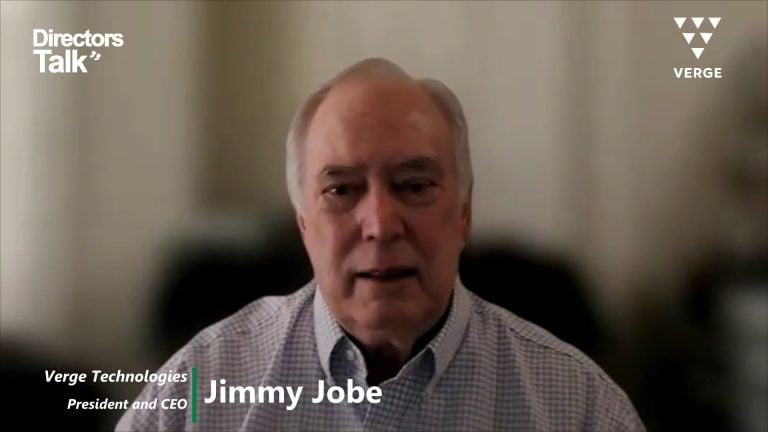
Verge Technologies President and Chief Executive Officer Jimmy Jobe caught up with DirectorsTalk to the growing operational and cost challenges of multi-cloud environments and how SentientDB aims to solve them through AI-driven database management.
Q1: Jimmy, what critical global IT management problem needs resolution today for enterprise rapid growth and operational stability for the next five years?
A1: I think several different things are affecting that, but I’ll go right to the core of what I think it is, and that there is a huge disconnect between the services that most enterprises need and what the cloud service providers are offering today. In other words, the business models are not aligned, let me go into that a little bit more.
Most enterprises today have a distributed footprint because they operate in different cities and states and nations around the world and they use between four and seven different service providers to run their business across that distributed footprint. That requires multi-cloud operations and multi-cloud management.
The problem today is that all of those service providers basically have set up nice little silos where they only make money if you’re in their cloud. So, if you’re in AWS, they’re not managing the IT assets of the enterprise that happen to be in Azure. So, every one of those silos has different proprietary tool sets, they have different SLAs for their cloud silos, different capabilities, different UIs, different management control.
So, if you’re going to run your enterprise across all of those different “silos”, then you need management tools, IT management tools, that can manage not only vertically within that silo, but horizontally to allow your business processes to flow where they need to.
Enterprises don’t run in silos. They run across silos because that’s where their operations are. To me, that is the key element in being able to allow enterprises to not only optimise their business processes, reduce cost and improve resilience, is to be able to operate as if that’s one virtual environment for the enterprise, not seven.
Q2: Why do additional factors increase the urgency to solve this problem?
A2: Well, I think there’s several today. One is the demand for the new AI-focused data centres for data generation and processes. Coupled with the enterprise needs to manage across these new AI centres that are providing data for them to run their organisation, it really increases the urgent need for tools that can manage assets across all of those environments, as if they’re in one virtual data centre.
Additionally, there’s enterprise investments in IT modernisation that’s going on, not only in the government or public sector, but in commercial as well. As we all know, some of the reasons why enterprises didn’t ever get all in cloud was that they had parts of their infrastructure that wouldn’t run in the cloud, the legacy systems, legacy data centres, etc. So there’s a continuing investment in IT modernisation that’s enabling a new round of application and database migrations to cloud environments.
Not only that, what we’re seeing is the reverse of that starting to happen, in that many of the large enterprises are starting to migrate some of their infrastructure back to either proprietary data centres or back to managed service providers. The reason is that they need more control over their assets, and they need more control over cost.
One of the issues today in this multi-cloud environment is really predicting cost and being accountable for cost. CIOs are losing their jobs because they can’t predict the cost on an ongoing basis. It varies. There’s this and there’s that in this cloud and not in this cloud. So, to provide that consistency, people are wanting more control. Will that affect the cost? It may. It may indeed slightly raise the cost of moving back out of that commodity infrastructure and commodity services environment to where you have more control.
I guarantee you if they can control the assets better, and they can control the costs better, the Board and the shareholders are probably going to be very, very appreciative.
So the last thing, of course, that goes along with that is cost containment and budgetary pressures, we’re seeing they are huge right now. Especially we’ve seen these pressures, of course, in the federal government, the public sector side, the tremendous cost pressure. Of course, this has been an issue for years, but we have seen it significantly become more important during the last year.
Reducing budget growth, cutting costs through improving productivity is what we’re hearing across the board and that goes to the core of what’s been needed. Automation. Being able to cut down the touch labour that your operations team is deploying on a daily basis just to keep the train on the tracks, much less develop new capabilities for the future.
Q3: So, what’s the solution to the multi-cloud data management dilemma now and in the future?
A3: Well, I think it’s a couple of things, but definitely I think this is a real sweet spot for artificial intelligence and that is being able to provide intelligent IT management that provides what I’m going to call true cloud convergence.
What I mean by cloud convergence is managing many clouds as one cloud and to be able to do that through what I’m going to call a unified or federated management of all of those critical operational assets and database assets, with an AI-driven automation control and optimised workload performance, regardless of where it’s hosted physically or logically on the globe.
Q4: So how does Verge Technologies provide the solution to solve this data and IT management dilemma?
A4: Verge believes that number one, the future is here today, and we’re committed to building what I’m going to call intelligent or AI-based IT management platforms that remove those borders and boundaries of global IT management.
We talked about all those silos. Well, what if you could have a platform, a set of platforms, that could effectively remove those boundaries and barriers to allow the enterprise to actually optimise its business processes, independent of all those little silos that are out there. They have to operate in and out. That’s where I think it’s the real benefit and value.
Verge has created a database platform as a service called SentientDB that provides the solution, I believe, that is needed for today and the future, providing all capabilities to solve this global dilemma for multi-cloud database management and control out of the box.
Verge Technologies’ SentientDB is a first in market. There’s nothing out there today like that. It’s patented. It’s designed for intelligent and automated multi-cloud management for all database assets across the enterprise footprint.
We talked about before that the enterprise is in four to seven different service providers in order to run their distributed footprint. Imagine a platform that can manage all the database assets that are in your proprietary data centres, that are in your AWS environment, your Azure, your Google environment, and any one of 500 others around the globe.
Imagine that there is a platform that unifies the management and control and optimises the performance of all those database assets, no matter where they’re logically or physically located within and across all those cloud and compute environments and enterprise footprint.
By doing that, you eliminate outages, you provide resilience and fault-tolerant database environments with zero downtime.
Q5: How is SentientDB unique in the market today?
A5: I think one of the primary reasons is that we use AI to predict, prevent, and resolve and mitigate performance and workload issues before they happen. 99.9% of all the platforms and the tools that are out in the market today don’t take any action. They monitor, they alert, and they report. At the end of the day, you still have to get out of your chair and go over there and log in and fix the problem.
What we’re offering is the automated ability, to take action so that you don’t get out of your chair. There’s a policy that’s written that says, if this occurs, do this. Move that database to a larger server, split the workload across three or four servers, scale out on demand, scale back in when the demand ceases. So, being able to automate that environment essentially gives you a self-managing and self-healing, resilient and fault-tolerant data processing environment.
Not only that, we believe that by doing this in an automated manner, we can have 100% transaction consistency with zero downtime. We are a cloud provider agnostic. We’re independent of the machine server layer, and we’re providing those self-managed and self-healing services that actually make zero downtime possible.
We, of course, manage multi-cloud compute environments as one, the cloud convergence, the unified management to manage all enterprise database assets through a single pane of glass, one console in real time. We can optimise the workload performance. This is so important. Optimising workload performance usually says, well, I’m going to take it down, I’m going to tweak this, I’m going to tweak that, I’m going to reboot it, I’m going to start it back up. We do this in real time at runtime, which means that database is processing transactions.
At the same time, we’re making minute changes to its operating environment to ensure that its performance is always optimised. We provide a common management platform across all those environments.
We talked before about four to seven different environments, all with different tools, different SLAs, different everything. What we’re providing is a platform so that you can have consistency in how you want your databases managed across your enterprise, across all of those environments. Common policies, common security, common way of providing that fault-tolerant environment.
We also provide SLA assurance, being able to look at your SLAs and then define the policies to ensure that your SLAs, no matter where they are on the globe, no matter what they are, that you have, we ensure that you can meet them.
We are ready for deployment in your enterprise today.