Switch Metals plc (LON:SWT), the critical metals company focused on tantalum and lithium in Côte d’Ivoire, has announced initial assay results from its maiden reverse circulation drilling programme at its Zraty and Kabore prospects. Both prospects lie within the Badinikro permit on the Company’s Issia Project, in the Birimian terranes of south-western Côte d’Ivoire.
These are the first holes drilled by the Company in the Issia pegmatite district. Initial results confirm lithium mineralisation at depth beneath the Kabore surface discovery, alongside tantalum and niobium mineralisation at both Kabore and Zraty. Mineralisation has been identified in multiple pegmatite bodies, supporting the potential for a broader critical metals system at Issia.
Assays have been received for the first seven of the 34 holes drilled. Results for the remaining 27 holes, 26 for Kabore and one for Zraty, are still to come.
Highlights
Programme
- Assays received for the first 7 RC holes of 34 holes (3,438m): 4 of 30 at Kabore and three of four at Zraty
- Tantalum-niobium mineralisation identified at both Kabore and Zraty, complementing the Company’s existing near-surface tantalum and niobium (coltan) exploration activities at Issia
Kabore: lithium
- 14m at 1.02% Li₂O from 42m, including 7m at 1.75% Li₂O from 43m (ISBRC0024), with a best single metre of 2.63% Li₂O
- 13m at 0.26% Li₂O from 29m, including 1m at 1.42% Li₂O from 32m (ISBRC0009), approximately 200m north-east of ISBRC0024, confirming lithium mineralisation on a second drill section
- Lithium mineralisation confirmed at depth beneath the spodumene discovery, where surface grades reach 2.8% Li₂O
- Significant lithium exploration upside: scout drilling has tested only 500m of more than a 1.3km prospective strike, on fences 50m to 100m apart
Kabore: coltan
- 6m at 130 ppm Ta₂O₅ and 152 ppm Nb₂O₅ from 29m (ISBRC0009), and 2m at 158 ppm Ta₂O₅ and 180 ppm Nb₂O₅ from 34m (ISBRC0023), with coltan (tantalum and niobium) present in all four holes assayed
- The association of tantalum and niobium with lithium is consistent with geochemically fertile Lithium-Caesium-Tantalum (LCT) pegmatite systems
Zraty: tantalum
- 6m at 85 ppm Ta₂O₅ and 134 ppm Nb₂O₅ from 58m (ISBRC0003), the first holes to be drilled at Zraty, with pegmatite intersected in all three holes assayed and tantalum-niobium mineralisation in two of the three holes
- Drill grades are well below surface samples (up to 1,230 ppm Ta₂O₅); further work is needed to test for higher-grade shoots
Looking ahead
- 27 holes still to report: 26 at Kabore and 1 at Zraty. Further updates will be provided as results become available
- Follow-up drilling: full interpretation of the Kabore dataset under way to design the next holes along strike and at depth
- Growing the footprint: geochemical and mapping programme launched to extend Kabore beyond the current 1.3km prospective strike, with soil sampling and scout auger drilling continuing across Issia to generate further targets
Karl Akueson, CEO of Switch Metals commented:
“Although these results have taken a little longer to come through than anticipated, they have been worth the wait. The Issia pegmatite district had never been drill-tested and our first holes at Kabore confirm lithium at depth beneath the spodumene we discovered at surface. We believe Kabore is now a drill-confirmed lithium discovery.
“Maiden drilling at Kabore has confirmed mineralisation beneath the surface discovery and supports the interpretation of Issia as a pegmatite system containing both lithium and coltan (tantalum and niobium).
“The initial drilling results support the potential for lithium mineralisation beneath the lithium-rich spodumene discovery at Kabore, where reported surface grades reach 2.8% Li2O. Drilling returned a best single metre of 2.63% Li2O and a downhole interval of 14m at 1.02% Li2O, including 7m averaging 1.75% Li2O. Further drilling and the outstanding assays will help us assess continuity along strike and at depth.
“In addition, the mineralisation is enriched by intervals of tantalum and niobium helping to explain the widespread surface occurrences observed across the drilling area. At Zraty, our first holes have intersected the pegmatite with tantalum and niobium mineralisation, and further work will test for higher-grade shoots.
“Only four of the thirty Kabore holes have been assayed so far. The pegmatite system is open at depth and along strike and work is ongoing to further extend this target. The remaining results will shape the next phase of drilling.
“Lithium activity is also building in the region. Operators backed by Chinese lithium majors are active around our Tiassalé project, where we have identified seven lithium targets, and with Kabore now drill-confirmed, we have lithium opportunities at both Issia and Tiassalé.
“We have a busy period ahead: the remaining 27 drill holes to report, laboratory assay results from our shallow tantalum programme, and further work to advance our Tantalum Mineral Resource Estimate. We look forward to updating shareholders as these work programmes progress.”
Figure 1: Issia Project. Kabore and Zraty location map with Spodumene and LCT pegmatite, RC drilling area, MRE area.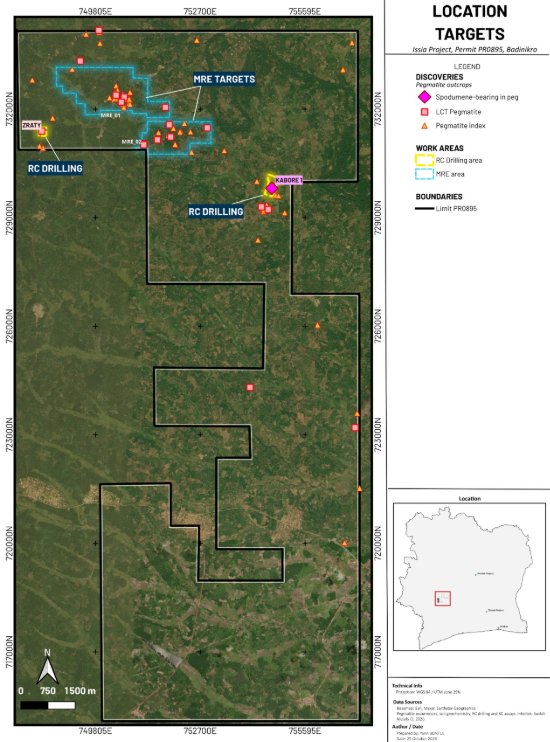
Drilling Programme
Kabore
The completed maiden RC drilling programme comprised 34 holes totalling 3,438m at the Kabore and Zraty prospects within the Issia Project, investigating pegmatite-hosted lithium, tantalum and niobium mineralisation. The programme was initially planned at approximately 2,500m, with the final allocation between prospects subject to drilling results and geological observations (see announcement dated 17 June 2026).
At Kabore, 30 RC holes totalling 3,186m were completed across seven drill fences spaced approximately 50m to 100m apart, testing approximately 500m of strike out of 1.3km.
Drilling at Kabore targeted the down-dip extension of the spodumene-bearing pegmatite discovered at surface in early 2026 with lithium grades of up to 2.8% Li₂O in the discovery trench, and the 1.3 km rubidium soil anomaly that surrounds it (see announcements dated 2 February 2026 and 4 June 2026).
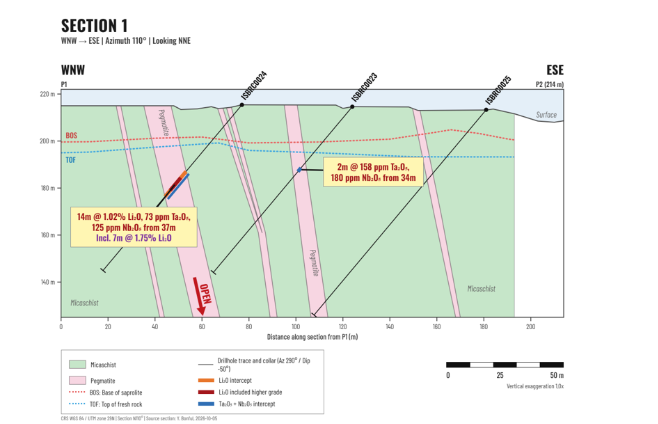
Drilling results show that Kabore is underlain by interbedded mica schist and sandstone. The sequence is moderately to strongly deformed. It is intruded by numerous NE-striking pegmatite dykes. Some dykes are continuous and linear. Others are anastomosing and follow lithological contacts. Alteration comprises sericite, chlorite, silica and hematite, with quartz veining and garnet.
- ISBRC0024 returned 14m at 1.02% Li2O from 42m, including 7m at 1.75% Li2O from 43m. The best single metre assayed 2.63% Li2O. A tantalum and niobium enriched zone of 5m at 97 ppm Ta2O5 and 145 ppm Nb2O5 from 37m lies immediately above the lithium interval.
- ISBRC0009, which lies 200m north-east of ISBRC0024, returned 13m at 0.26% Li2O from 29m including 1m at 1.42% Li2O from 32m. The upper part of the interval is enriched in tantalum and niobium with 6m at 130 ppm Ta2O5 and 152 ppm Nb2O5 from 29m.
- ISBRC0023 and ISBRC0006 intersected pegmatite with no significant lithium. They returned 2m at 158 ppm Ta2O5 and 180 ppm Nb2O5 from 34m and 2m at 143 ppm Ta2O5 and 187 ppm Nb2O5 from 68m, respectively.
These intercepts confirm that lithium, tantalum and niobium mineralisation continues below the surface discovery. The system remains open at depth and to the south-west. Most Kabore results are still pending.
Assay results include the following significant intersections:
Table 1: Significant intersections:
| Hole ID | Prospect | From (m) | To (m) | Interval (m) | Li₂O (%) | Ta₂O₅ (ppm) | Nb₂O₅ (ppm) |
| ISBRC0024 | Kabore | 42 | 56 | 14 | 1.02 | 42 | 78 |
| incl. | 43 | 50 | 7 | 1.75 | 58 | 110 | |
| ISBRC0024 (3) | Kabore | 37 | 42 | 5 | 0.11 | 97 | 145 |
| ISBRC0009 | Kabore | 1 | 2 | 1 | 0.02 | 153 | 169 |
| ISBRC0009 | Kabore | 29 | 42 | 13 | 0.26 | 66 | 78 |
| incl. | 32 | 33 | 1 | 1.42 | 106 | 132 | |
| Incl. | 29 | 35 | 6 | 0.29 | 130 | 152 | |
| ISBRC0023 | Kabore | 34 | 36 | 2 | 0.05 | 158 | 180 |
| ISBRC0006 | Kabore | 68 | 70 | 2 | 0.04 | 143 | 187 |
| ISBRC0003 (3) | Zraty | 58 | 64 | 6 | 85 | 134 | |
| incl. | 61 | 62 | 1 | 112 | 172 | ||
| ISBRC0001 (3) | Zraty | 40 | 42 | 2 | 64 | 87 | |
| ISBRC0002 | Zraty | NSI |
Notes: (1) All intervals are reported as downhole lengths. Kabore holes were drilled at about -50° to -60° towards 290° or 110°, approximately perpendicular to the strike of the NNE-trending pegmatites as mapped at surface. Interpretation on drill sections indicates steeply dipping pegmatites. Estimated true widths are approximately 50% to 70% of downhole lengths. (2) Significant intersections are reported using a lower cut-off of 0.25% Li₂O and/or 100 ppm Ta₂O₅, with a maximum of 4 m of consecutive internal dilution, with flexibility allowing a fair representation of mineralised intervals. Intervals meeting either criterion are reported. No top cut has been applied. Grades are length-weighted averages. No metal equivalents are reported. (3) ISBRC0001, ISBRC0003, ISBRC0024 have been reported below cut-off grade to disclose low-grade mineralisation in Ta₂O₅ and Nb₂O₅. (4) Samples analysed by Intertek, Perth area, Western Australia by sodium peroxide fusion with ICP finish. Lithium assays are reported as Li₂O using a conversion factor of 2.153 (Li × 2.153). Tantalum assays are reported as Ta₂O₅ using a conversion factor of 1.2211 (Ta × 1.2211). Niobium is reported as Nb₂O₅ (Nb × 1.431); values below detection limit are taken as zero. (5) Certified reference materials, blanks and duplicates were inserted at a rate of one additional QC sample for every 9 RC samples. NSI = No Significant Intersection.
Figure 2: Kabore geological map with RC collars, drill sections and significant intercepts. ISBRC0024 lies on Section 1. ISBRC0009 lies about 200m to the north-east.
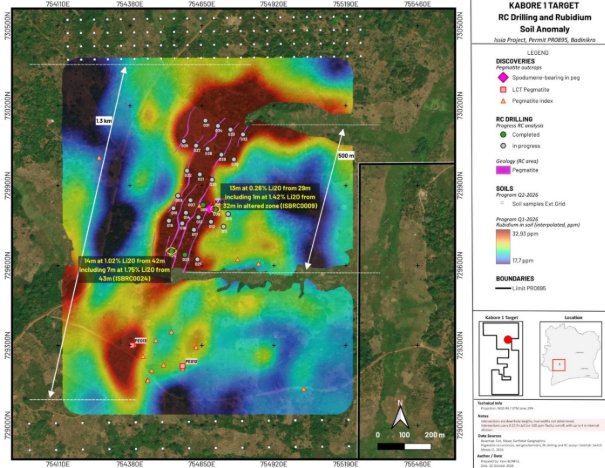
Figure 3: Kabore Section 1 (looking North-North-East) showing ISBRC0024, ISBRC0023 and the interpreted steeply dipping pegmatite dykes. Assays shown as downhole Li, Ta and Nb strips.
Zraty
At Zraty, 4 RC holes totalling 252m were completed to investigate tantalum and niobium-bearing pegmatites previously identified through surface exploration.
Initial assay results have identified tantalum and niobium mineralisation at Zraty.
Four RC holes tested the Zraty tantalum pegmatite on two sections. They are the first holes drilled on this prospect. Assays have been received for three holes. All three intersected a steeply dipping pegmatite in mica schist. The alteration assemblage matches Kabore.
- ISBRC0003: 6m at 85 ppm Ta2O5 and 134 ppm Nb2O5 from 58m including 1m at 112 ppm Ta2O5 and 172 ppm Nb2O5 from 61m.
- ISBRC0001: 2m at 64 ppm Ta2O5 and 87 ppm Nb2O5 from 40m.
- ISBRC0002: no significant intercept.
Whilst drill grades are well below the surface samples (up to 1,230 ppm Ta2O5), the results confirm that the pegmatite continues down dip to the south. Tantalum in pegmatites is often concentrated in discrete shoots. Further work is needed to test for higher-grade zones.
Exploration Potential and Next Steps
The initial scout programme was designed to establish the geometry and mineralisation of the pegmatite system.
The results will be incorporated into the Company’s geological interpretation to refine potential follow-up drilling targets along strike and at depth. Assays for 27 holes remain outstanding and, subject to laboratory turnaround times, are expected by the end of 2026.
Soil sampling, scout auger drilling and geological mapping are ongoing at Issia to investigate north and south strike extensions and identify further drilling targets.