Oriole Resources plc (LON:ORR), the AIM quoted exploration and development company focused on Central and West Africa, has announced an update on its 50% owned Bibemi gold project in north-eastern Cameroon, where the Company is in the process of negotiating an Exploitation Licence for a small-scale open pit gold mine. The Company has now received the results of metallurgical testwork undertaken by ALS Ltd. Australia on bulk oxide and sulphide samples from the Project.
Highlights
· The bulk oxide sample results replicated prior testwork undertaken on smaller samples, confirming that the material is amenable to cyanidation, with >90% gold recovery after 24 hours of leaching.
· Testwork on the two bulk sulphide samples focused on ultra-fine grinding of the flotation concentrate as a route to potentially replacing the pressure oxidation (“POX”) assumed by the current Preliminary Economic Assessment (“PEA”). Results indicate that:
– Flotation of sulphide samples returned approximately 80% Au at a coarse grind size (75 microns, “μm”), therefore similar to previous testwork; and
– Ultra-fine grinding (to 20μm and 10μm) and subsequent leaching of the flotation concentrate has resulted in downstream gold recoveries of between 94 and 98%.
- Overall, gold recovery for the ultra-fine grind flowsheet is broadly comparable with the assumptions in the current PEA, giving a viable alternative that has the following benefits:
– Simplification of the process plant leading to faster project execution, commissioning and ramp-up;
– A reduction in the level of management and supervisory skills required to operate and maintain the plant;
– Elimination of equipment operating at high pressure which reduces safety risk; and
– Elimination of the need for specialised autoclave construction materials that would have been required for the Project given its small size.
Stirling Process Engineering Ltd (“Stirling”) is currently engaged in generating a more detailed understanding of the capital and operating costs in a report related to this flowsheet to enable the production of an updated PEA which will include this alternative process route as an option. This updated PEA is anticipated later this quarter.
Chief Executive Officer of Oriole Resources, Martin Rosser, said: “We welcome the latest Bibemi mineral processing test results as there is now encouraging potential for an improved flowsheet as an alternative to the earlier one developed using pressure oxidation. As such, the provisional indication is that capital and operating costs will likely be comparable, with significant operational benefits, thus confirming ultra-fine grinding as a viable alternative. We look forward to receiving Stirling’s detailed trade-off study.
“Having the option of a processing flowsheet that uses ultra-fine grinding gives processing method flexibility compared to one using POX. Both methods will have pros and cons for the processing of other gold-telluride deposits that may occur in Cameroon, dependent upon the magnitude of plant throughput and ore mineralogy.”
Further Details
At the 177km2 Bibemi orogenic gold project in the North region of Cameroon, the Company’s exploration to date has identified shear-hosted gold mineralisation at four main prospects – Bakassi Zone 1, Bakassi Zone 2, Lawa West and Lawa East – within an approximately 12km long mineralised hydrothermal system at surface.
The Project has a Mineral Resource Estimate (“MRE”) of 6.96Mt at 2.06g/t Au for 460koz contained Au, 100koz Au of which is classified as Indicated, and the remaining classified as Inferred under the JORC Code. The MRE, which is located entirely within the BZ1-MRE zone, is calculated using a 0.40g/t Au cut-off grade and is constrained by a US$2,750/oz gold price pit shell (see announcement dated 15 May 2025). In addition to the MRE, the Company has also reported an Exploration Target across the Bibemi project of between 3.0 and 5.0Mt with an average grade of between 1.50 and 2.50g/t Au, for between 145 and 400koz contained gold.
The Company has submitted an Exploitation Licence Application (“ELA”) for the Project, which is envisaged to be a small-scale, open pit mine that would target an optimised open-pit scenario of 89koz Au, largely centred on the 100koz Au Indicated Resource. As part of the ELA a PEA of this optimised scenario, assuming a 7-year mine life, at ~10koz Au average annual production, was included within the ELA (see announcement dated 16 December 2025), and is considered to be at Scoping Study level.
The PEA also assumed an 85% gold recovery which reflected results from prior metallurgical testwork on sulphide material, at SGS South Africa between 2022 and 2024, that outlined a provisional mineral processing flowsheet to treat the gold-telluride mineralogy, comprising flotation, pressure oxidation of the float concentrate, and leaching of the pressure oxidation residue (see announcement dated 15 May 2025).
The Company today reports that it has recently completed follow-up metallurgical testwork at ALS Perth, using two shallow, near-surface oxide samples, and two sulphide samples. The testwork included initial characterisation of the oxide material and a subsequent, more detailed study on the sulphide material. The latter focused on ultra-fine grinding of the flotation concentrate as a route to potentially replace the existing POX circuit.
The results of this testwork have confirmed that the two oxide samples were amenable to conventional cyanidation with recoveries of more than 90% after 24 hours of leaching using a 75μm grind. Flotation testwork on the two sulphide samples, when subjected to a 75μm grind, returned 81% and 82% Au respectively after 24 hours cyanidation. Both sets of results are comparable with the prior SGS results. Further testwork was then completed on the flotation concentrate, ultrafine grinding it to 20μm and 10μm size fractions with subsequent cyanidation. The downstream gold recoveries were between 94 and 98% after 72 hours (therefore 94-98% of the 81-82%).
Figure 1. Updated provisional Processing Flowsheet for the Bibemi Project
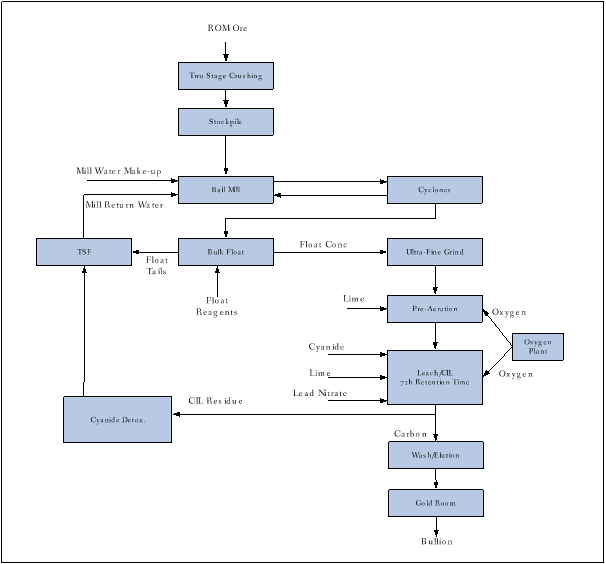
Overall, gold recovery for the ultra-fine grind flowsheet is broadly comparable with the former POX flowsheet. However, it has the following key benefits over the pressure oxidation flowsheet, including:
– Simplification of the process plant leading to faster project execution, commissioning and ramp-up;
– A reduction in the level of management and supervisory skills required to operate and maintain the plant;
– Elimination of equipment operating at high pressure which reduces safety risk; and
– Elimination of the need for specialised autoclave construction materials that would have been required for the project given its small size.
Stirling is now completing a trade-off study for the different options. The provisional indication is that capital and operating costs, which will be included as an option in an updated PEA, will likely be comparable thus confirming ultra-fine grinding as a viable alternative. This updated PEA is anticipated later this quarter.