Giorgio Curti of Ruffer believes the latest oil shock has changed the outlook for investors, central banks and the global economy, with higher energy prices once again threatening to slow growth while keeping inflation under pressure.
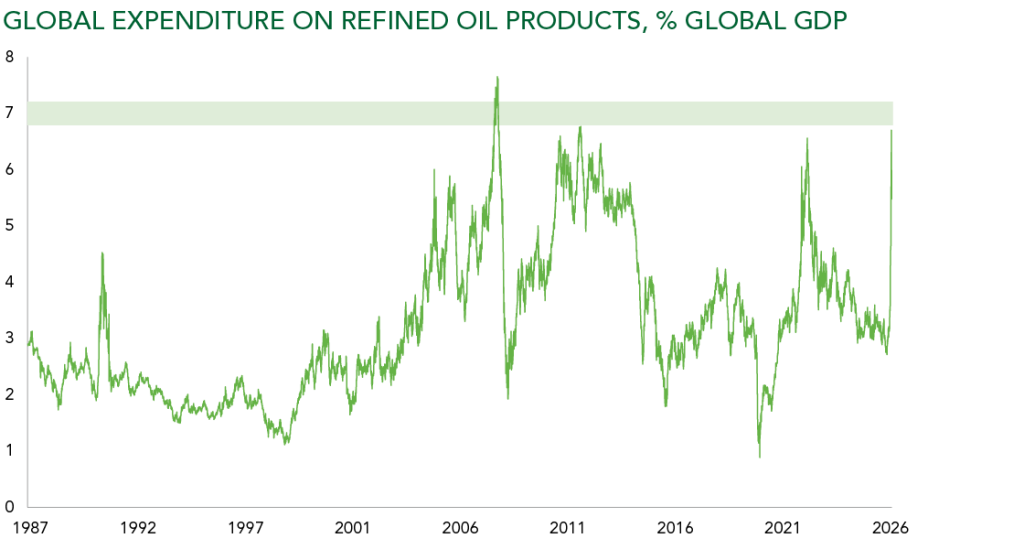
Writing in Ruffer’s April edition of The Green Line, Curti argues that the closure of the Strait of Hormuz is not a marginal event. In his view, it has disrupted a critical share of global oil and gas flows and created the conditions for a fresh stagflationary shock. His assessment is that rising crude prices and higher refining costs could lift global spending on petroleum products sharply, placing added strain on economies already facing an uncertain backdrop.
Curti says the timing is difficult because 2026 had started with some signs that inflation pressures were easing and that growth outside the United States was becoming more broad-based. That picture, he suggests, has now been interrupted by a renewed geopolitical shock which risks pushing energy costs higher just as hopes of a steadier economic period were beginning to build.
A key part of Curti’s argument is that the effects will not be evenly distributed. He points to Asia as one of the more exposed regions because of its reliance on Middle Eastern energy imports and the importance of manufacturing across several major economies. By contrast, he sees the United Kingdom as less directly vulnerable, while the United States is, in his view, in a stronger position thanks to its domestic energy production and reduced dependence on imported oil.
Curti also highlights the difficulty this creates for central banks. He believes policymakers are once again being forced to weigh weaker growth against the risk of another inflation impulse feeding into wider pricing behaviour. His point is that this is not a straightforward demand-led inflation problem that can easily be addressed with higher interest rates. Instead, it is a supply-side shock, which makes the policy response far less clear.
In Curti’s view, the UK may be relatively better placed than some economies to absorb the hit, but that does not remove the challenge for the Bank of England. He suggests the domestic backdrop already looks soft enough to make further rate rises difficult to justify, especially if higher energy costs begin to act as another drag on activity rather than a driver of sustained domestic demand.
Chart source: LSEG, BP Energy Institute, World Bank. Crack spreads are added to each region’s crude oil price