
Gold’s recent behaviour is challenging some long-held assumptions about the metal’s place in a diversified portfolio. Alexander Johnstone, Assistant Fund Manager at Ruffer, believes the renewed relationship between gold and inflation-adjusted interest rates has important implications for asset allocation, risk management and the timing of exposure.
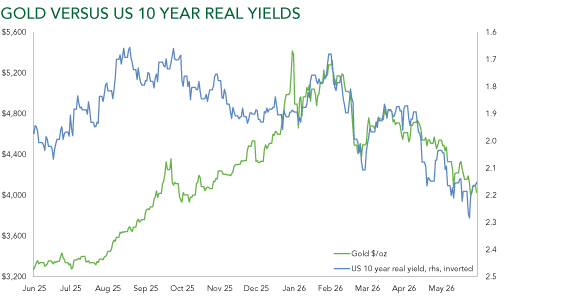
Johnstone notes that gold weakened substantially after reaching its January peak, despite a period of heightened geopolitical uncertainty. The metal has traditionally been regarded as a potential source of protection during political conflict and market stress. Its recent response suggests that geopolitical risk alone may not be sufficient to support prices when other financial forces are moving in the opposite direction.
The central issue identified by Johnstone is the relationship between gold and real yields. Before 2022, gold generally moved in the opposite direction to inflation-adjusted interest rates. Because the metal produces no income, higher real yields tend to increase the relative appeal of interest-bearing assets. Falling real yields, by contrast, reduce the opportunity cost of holding gold.
That relationship became less reliable after Russia’s invasion of Ukraine. Johnstone explains that emerging market central banks, particularly the People’s Bank of China, increased their gold holdings as they sought to reduce dependence on the US dollar and US Treasury securities. These institutions were less sensitive to interest rates than traditional financial buyers, allowing gold to advance even as yields remained elevated.
Official central bank purchases subsequently rose to more than 1,000 tonnes a year, according to the figures discussed by Johnstone, approximately twice the average rate recorded during the previous decade. This sustained demand helped support gold and altered the market dynamics that had previously connected its price more closely to real yields.
More recently, however, that support has become less decisive. Johnstone points to pressure on emerging markets following the oil supply shock associated with the Iran conflict. Turkey’s central bank sold part of its gold reserves in March in an effort to support its currency, before returning as a buyer in April. The episode demonstrated that central banks can become sellers when domestic financial conditions require them to release reserves.
Retail demand also weakened, particularly in India, where tariffs on gold were increased to discourage non-essential imports during the energy crisis. At the institutional level, rising global bond yields encouraged some asset allocators to reduce their gold holdings. Strong US economic data and a firmer stance on inflation from Federal Reserve Chair Kevin Warsh helped keep real yields elevated, while speculative positioning in derivatives markets reversed and added to downward pressure.
Johnstone’s assessment is that the traditional inverse relationship between gold and real yields has reasserted itself. Gold’s sensitivity to US yields has reached a five-year high, while its relationship with equities has strengthened at a time when shares and bonds have also been moving more closely together.
As a result, gold has recently behaved less like an independent defensive asset and more like an additional source of market exposure. Rather than offsetting weakness elsewhere in a portfolio, it has at times increased the effect of the positive correlation between equities and bonds.
Johnstone nevertheless continues to see a structural role for gold. Its status as a real asset outside the conventional fiat currency system may remain valuable if policymakers eventually prioritise financial stability over strict inflation control. The immediate question is therefore not whether gold has a long-term purpose, but how much exposure is appropriate while its diversification characteristics remain less dependable.
Ruffer has responded by reducing its direct gold exposure consistently since spring 2025. At the same time, it has retained an allocation to gold mining equities, which Johnstone says remain highly profitable even if the bullion price falls materially below its current level.
Chart source: Bloomberg, data as at 29 June 2026