
Japan’s recent election result has been interpreted by markets as a decisive signal on the country’s policy direction, with investors responding quickly to the prospect of a more expansionary economic stance. Nicole Wardle, Senior Associate in Private Wealth at Ruffer, notes that the scale of the victory provides the government with the political room needed to pursue its agenda with fewer constraints.
Nicole highlights that the election delivered a commanding mandate for the Liberal Democratic Party under Prime Minister Sanae Takaichi. The outcome not only secured a clear parliamentary majority but also marked a historic moment for Japan with the appointment of the country’s first female prime minister. In her view, the strength of the result immediately reassured markets that policy decisions are likely to progress with greater clarity and speed.
Financial markets reflected that sentiment. Japanese equities reached fresh highs in the aftermath of the vote, while the yen and government bonds also strengthened. Nicole points out that this simultaneous move across asset classes is notable. Historically, periods of fiscal expansion in Japan have tended to favour equities while placing pressure on the currency or bond markets. The fact that all three moved higher suggests that investors interpreted the result as broadly supportive for the country’s economic outlook.
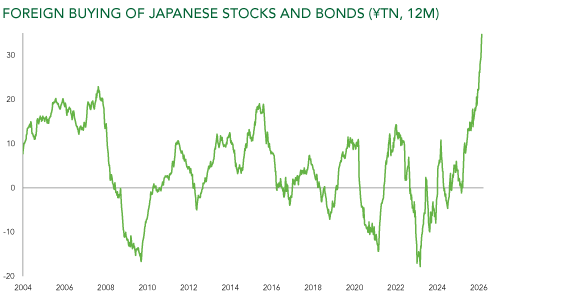
She also draws attention to the behaviour of international investors. Foreign capital had already been flowing into Japanese markets during the past year, but the election outcome accelerated the trend. Global investors appear to see the result as confirmation that Japan may be entering a more constructive economic phase, supported by both political stability and policy ambition.
Central to this shift in sentiment is the economic agenda signalled by Prime Minister Takaichi. The new administration has indicated a willingness to move away from strict fiscal restraint in favour of policies aimed at stimulating domestic growth. Proposed measures include a fiscal stimulus package estimated at around ¥21.3 trillion, representing approximately 3.7% of Japan’s economic output.
Chart source: Bloomberg, data to 27 February 2026