Thor Energy Plc (LON:THR, ASX: THR, OTCQB: THORF) has announced the preliminary results of its Phase-2 soil air geochemistry survey at the Company’s 80.2%-owned HY-Range Project (RSEL 802) in South Australia (Figure 1). The results build upon and validate the Phase-1 survey completed in Q2 2025, recording natural hydrogen readings up to 3% (30,000 ppm) on licence (Figure 2A), whilst successfully validating three of the Company’s highest-priority exploration focus areas (Figure 2B and 2C).
Highlights:
· Elevated Natural Hydrogen Concentrations: Phase-2 recorded highly elevated natural hydrogen readings, reaching a maximum of 3% (approximately 60,000 times background).
· Validation of Focus Areas: Consistently repeated high values, ranging from several hundred to several thousand times background, were recorded and identified across high-grade exploration areas (Mallala, Lochiel, & Crystal) during Phase-1.
· Rigorous Data Integrity: Evolved sampling techniques, in which depth, duration and material variables were tested alongside controls, strongly indicate the presence of highly active natural hydrogen generation. The risk of sampling error or anthropogenic (human-made) contamination has been substantially reduced at the HY-Range Project (RSEL 802).
· Compelling Geological Correlation: Anomalously high surface geochemistry aligns with Thor’s geological models and the crustal-scale basement architecture, faulting, and focusing mechanisms necessary to deliver economic volumes of natural hydrogen.
· Development of Thor’s natural hydrogen and helium exploration methodologies: This survey further refines in-house geochemical sampling methodologies and continues to evolve Thor’s integrated approach to natural hydrogen and helium exploration.
· Imminent 2D Seismic: Thor will shortly announce the award of an exploration 2D seismic acquisition programme across RSEL 802, designed to illuminate the full geological architecture of the Lochiel and Crystal focus areas for the first time, and mature definitive drilling targets.
Andrew Hume, Managing Director of Thor Energy, commented:
“The preliminary results from our Phase-2 geochemistry survey are highly encouraging. Replicating and expanding our Phase-1 results was our primary goal, but returning to the field and recording regionally extensive natural hydrogen readings that locally peaked at 3% is a strong outcome that far exceeded our expectations.
“Equally important is the scientific rigour our team applied to this programme. By evolving techniques, varying sample depths, and running stringent controls, we have substantially reduced the risk of false positives. We now have a robust, reliable dataset that shows compelling relationships between surface anomalies and the interpreted crustal faulting required to focus economic volumes.
“These results provide validity and the confidence to drive forward. We are finalising the award for a major 2D seismic acquisition programme, which will, for the first time, inform the structural architecture of our focus areas. The integration of this upcoming seismic data with our surface geochemistry results is the final step required to mature our targets and set Thor on a definitive path to exploration drilling.”
Phase-2 Survey Objectives and Rigorous Methodology
The Phase-2 geochemistry programme was designed to build on the innovative, first-of-its-kind mobile Gas Chromatography approach pioneered by Thor during Phase-1 in May 2025. The Phase-1 survey identified natural hydrogen concentrations up to 3,000ppm (approximately 6,000x background values, Figure 2B), leading to the designation of four high-grade focus areas chosen for their geochemical signature (Figure 2C), compelling subsurface geology/geophysical properties, exploration potential, and preferential location to future markets and off-takers.
Thor returned to three of these high-grade focus areas for Phase-2 with four primary objectives:
1. Validate and confirm the highly elevated readings obtained in Phase-1.
2. Expand sampling density in specific locations to identify short-distance trends.
3. Repeat sampling to increase scientific rigour and confidence in data validity.
4. Refine geochemistry sampling methodologies to validate and optimise the detection and quantification of natural hydrogen and helium soil/air surface geochemistry, testing and evolving sampling techniques which were developed during the Phase-1 survey.
During Phase-2, Thor further refined its mobile Gas Chromatography approach to practically eliminate risks associated with sample contamination or induced data artefacts. The technical team successfully tested different sample depths, applied long-duration sampling intervals, trialled hole-lining materials, and deployed stringent controls. Consequently, Thor has removed significant sampling uncertainty and continued to refine methodologies for natural hydrogen exploration. Phase-2 operations and results continue to stimulate refinements to techniques and methodologies.
Phase-2 Results and Path to Drilling
The preliminary data from Phase-2 has surpassed the Company’s initial expectations. Not only did the survey corroborate the presence of natural hydrogen flux across all three of the high-priority focus areas targeted in this programme, but it also documented numerous locations where samples far exceeded Phase-1 results. At one standout location, validated samples recorded a maximum of 3% (30,000 ppm) natural hydrogen, several weeks after hole installation, with an adjacent location also peaking at 1.5%. These exceptional concentrations represent tens of thousands of times the typical background values (note: atmospheric hydrogen concentration approximates an average of just 0.5 ppm). The fact that numerous Phase-2 measurements exceed the peak values recorded in Phase-1 is attributed to enhanced sampling techniques, increased sample density and frequency in key anomaly areas, and the impact of temporal and/or seasonal effects.
Critically, Thor has identified compelling relationships between zones of anomalously high surface natural hydrogen and mapped geological architectures, showing a strong correlation to interpreted basement configurations, pervasive faulting, and fluid-focusing mechanisms. These geological elements are vital for the economic viability of natural hydrogen and helium projects.
The enhanced data provides Thor Energy with the confidence to continue the rapid maturation of the HY-Range project. Looking ahead, Thor anticipates announcing the award of a significant 2D seismic acquisition programme across RSEL 802, providing the first extensive and comprehensive dataset of its type across the licence. Thor is fully self-funded to undertake this significant data acquisition, providing meaningful asset maturation without dilution to shareholder interests. These data will serve as the keystone for unifying our insights and illuminating the full geological configuration of the highest-grade focus areas. Combining this seismic data with the Company’s established regional knowledge and natural hydrogen soil geochemistry results will provide a robust, multi-lens dataset to identify new prospects, mature definitive drilling targets, and set the Company on a clear path to exploration drilling.
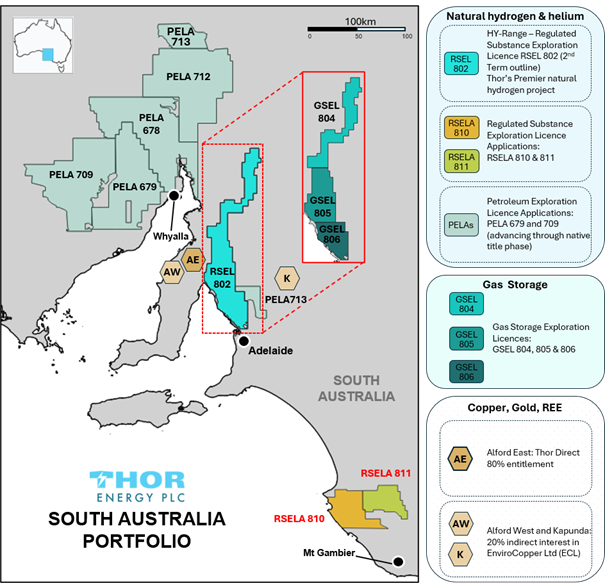
Figure 1: Map displaying Thor Energy’s South Australia portfolio. RSEL 802: HY-Range Project
(2nd term outline shown) is located immediately north of the City of Adelaide.
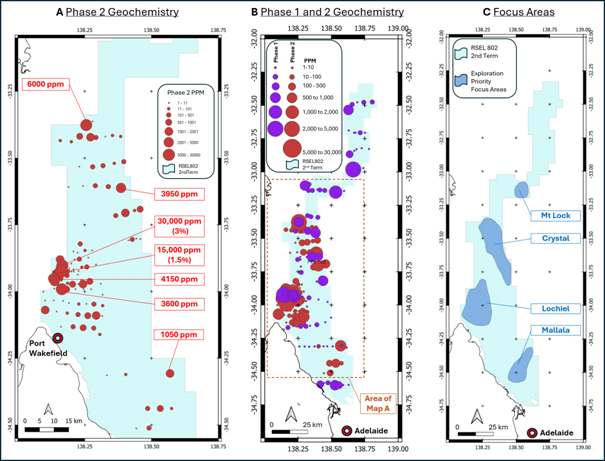
Figure 2: A) Map of Phase-2 geochemical values, expressed in parts per million (ppm). B) Co-rendered Phase-1 and Phase-2 geochemical values and area of Map A. C) HY-Range priority focus areas.