
Nicole Wardle, Manager of Private Wealth at Ruffer Plc, argues that low US stock market volatility is masking significant movements in individual shares, leaving investors exposed to risks that headline market measures may not fully capture.
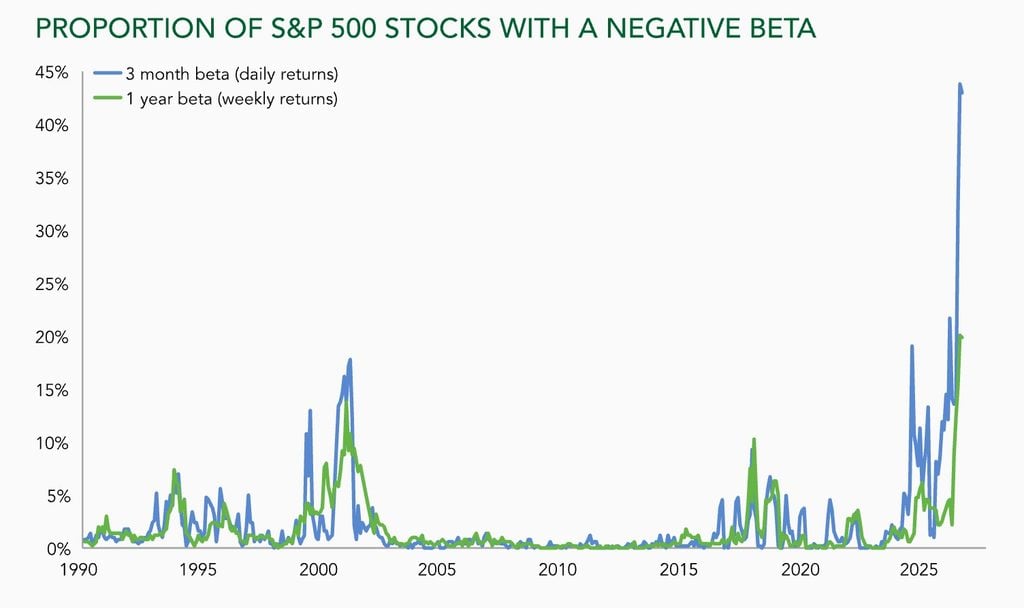
In the October 2026 edition of The Green Line, Wardle examines the unusually low correlations between S&P 500 constituents and explains why this divergence matters. Although the broader index has continued to rise, many individual stocks have fallen, creating a disconnect between index-level stability and the experience of individual companies.
Wardle notes that 2026 is on track to record the lowest stock market correlations on record. She draws comparisons with the period before the dot-com bubble burst in the early 2000s, when similarly low correlations preceded a major market downturn.
Why low volatility may be misleading
Wardle explains that when individual stocks move in different directions, their movements offset one another, reducing the volatility recorded by the wider index. This means the VIX, a measure of expected US stock market volatility, can remain low even when individual shares experience substantial price swings.
Her analysis suggests that if current levels of individual stock volatility were combined with historically average correlations, the VIX would be above 30, compared with an average reading of approximately 18 so far in 2026.
Wardle warns that this divergence could leave markets vulnerable if correlations increase during a sell-off. When investors begin selling stocks more broadly, individual share prices can move in the same direction, potentially triggering a sharp rise in index-level volatility.
AI concentration and stock selection
Wardle identifies the concentration of market performance around a small number of mega-cap technology companies as a key factor behind the current divergence. Investors have increasingly differentiated between businesses expected to benefit from artificial intelligence and those perceived to face disruption.
She argues that this dynamic is contributing to unusually low correlations, with differences in performance extending beyond technology stocks to companies within the same sectors.
Wardle also points to the growth of long/short equity strategies, which involve buying shares expected to rise and shorting those expected to fall. These strategies can amplify movements in individual stocks without necessarily creating equivalent volatility at index level.
Hedge fund capital reached $5.6 trillion in the second quarter of 2026, following its largest quarterly increase on record. Wardle also notes that 2025 recorded the strongest annual hedge fund investor inflows since 2007.
Ruffer’s response to the risks
Wardle sees opportunities for Ruffer to identify companies that have been overlooked as capital concentrates around AI-related investments. If market attention broadens, these businesses could benefit from a more balanced distribution of investor interest.
She also highlights Ruffer’s use of VIX call options as protection against a potential increase in market volatility. These derivatives are designed to gain value when the VIX rises, potentially helping to offset losses elsewhere in the portfolio during a market sell-off.
Wardle notes that low correlations have created opportunities to acquire this protection at attractive prices. The strategy allows Ruffer to maintain exposure to potential investment opportunities while preparing for a change in market conditions.