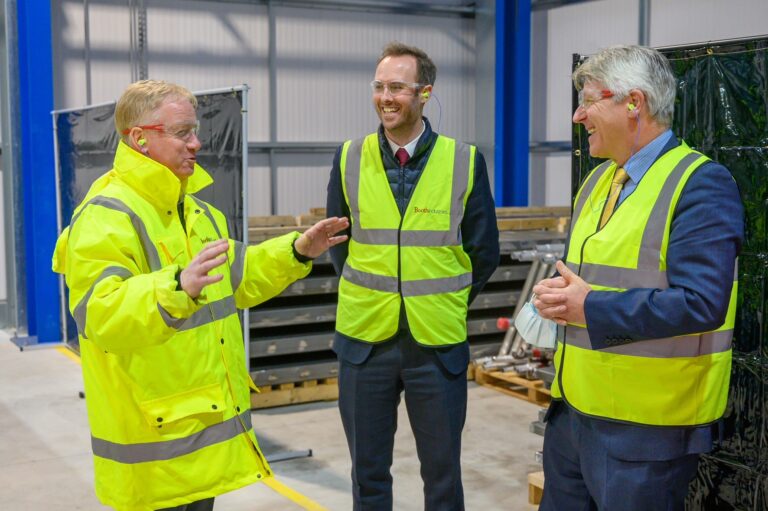
Avingtrans plc (LON:AVG) Chief Executive Officer Steve McQuillan caught up with DirectorsTalk to discuss interim results and growth drivers, including nuclear, AI-driven data centres, and medical imaging.
Q1: Steve, can you just talk us through Avingtrans’ financial highlights from the first half?
A1: We’re pretty pleased with the first half. In most cases, the numbers jumped in the right direction. In terms of gross profit margin, EBITDA, earnings per share etc., they all went in the right direction.
Net debt was stable, which was really pleasing to see because we’re still investing quite a lot of money in medical, which I’m sure we’ll come back to but that’s pleasing that we’ve managed to keep the debt under control. The order book for us for the year is very positive.
So, the only slightly odd thing perhaps for the year that your viewers might want to question is why year on year the revenue stayed pretty flat versus last year.
The reason for that is more about last year than it is about this year. Normally our sales and profits are split roughly 45–55 between the first half and the second half of the year, that’s our normal pattern. Last year was odd in that it went slightly the other way, I think it was 51–49. The first half was slightly bigger than the second half.
That was because of particularly in China, but in other places where we had a very strong original equipment order intake, which enabled us to push ahead in the first half. That calmed down again a bit in the second half and into the new year, not that it’s going backwards particularly, but it was a particularly strong first half last year.
So, as I say, last year was 50–50 more or less, whereas this year we expect it to be the usual 45–55 pattern, which is why we’re happy with what we’re seeing in terms of the remainder of the year, in terms of hitting the city numbers.
Q2: I see the margins and profits have increased strongly. What were the key drivers behind those improvements in profitability?
A2: I think in terms of margins, the big driver there is around the engineering division, the AES, and the fact that we saw more aftermarket sales in the first half. We’re always pushing aftermarket, of course. If you take a broad spread of activity around aftermarket, there’s better margins than original equipment so that was the key driver around the margin improvement, I would say, half and half.
In terms of profitability, as well as that, we’ve got the fact that medical losses, because they’re still in loss as they grow towards commercialisation, but their losses were less than in the previous half years. So, that’s good to see, it’s trending in the right direction. It will still lose money in the second half and maybe even in the next year but it’s trending in the right way. As we grow the medical sales, then obviously that will become less losses as we go forward but we’re happy to see that as a trend overall.
Q3: Now, as you mentioned, the AES division continues to benefit from growth in AI-driven data centres, electrification and new nuclear. How significant have those been in supporting performance and order book visibility?
A3: In terms of each one performance, not that significant yet. There will be a bit of new nuclear build out into the second half, particularly with our customer TerraPower, where we’ve got this larger contract for them to design pumps for new nuclear. Then starting to see orders coming in from other new nuclear players in the second half and then even more particularly into next year and then beyond that as well, it just keeps building.
Certainly, this has all been driven by AI/data centres. They all want to build more nuclear power now. The Americans in particular are driving that very fast versus what we normally see in new nuclear. So, not a huge impact in what we see in the first half, but that will start to build more significantly in the second half. Again, that’s part of what allows us to have a bigger second half than first half is around nuclear. Certainly going forward, nuclear will be a big driver for us over the coming years.
Additionally to that, we’ve got particularly Ormandy in the heating and cooling space and what they’re seeing is more and more orders now for cooling systems for data centres, both in the UK and Europe so far. We might well get into America as well, but certainly at the moment that’s UK/Europe. These systems or subsystems for data centres are to cool the data centre, sometimes it’s primary cooling circuit with cooled water going around. A lot of the times what Ormandy has been required to do is make a backup cooling circuit in case the primary circuit fails. The only way to stop the whole data centre melting is to send all of the cold water around it and keep the temperature down.
So, that’s what Ormandy have been asked to do, that’s a positive surprise for us. We didn’t really see that coming in a big way and we’re just wondering now how big that’s going to be actually, because Ormandy is doing quite nicely anyway. Notwithstanding that opportunity, but how big could that be? We’ll see in the coming years. So, that’s given us a little boost in the first half and again, even more of that in the second half and then we’ll then see how big that can get for Ormandy. That’s looking pretty positive.
So, a number of tailwinds for the business, particularly in AES, as you say, from new nuclear, from existing nuclear, for that matter, from AI and data centres. It’s all good tailwinds for us going forward.
Q4: Just turning to the medical and imaging division. It’s had a busy six months and you’re now entering a key ramp-up period. Steve, can you just tell us more about that?
A4: Yes, so really exciting now for medical. It’s been a frustrating path to get through the regulatory hurdles for both Magnetica and Adaptix. Adaptix finally got there with the US FDA approval just at the tail end of the period, so in November. What that means is we’re busy scurrying ahead to bring on board what are called key opinion leaders in the tech world, which investors will have heard of elsewhere, I’m sure. These are people who are well regarded in their field to start to say how they’re using the system, write papers about it in terms of what they can use it for. That then gradually influences other people who might be looking to buy the systems.
In parallel with that, once we’ve got the 510(k), we’re able to start taking on board distributors in America. So, after period end, Adaptix appointed two new orthopaedic distributors in the US as well as a new non-destructive testing distributor. So, that can let us get ahead now with US sales, which will slowly start to build in the second half and then obviously more of that into the new year.
In parallel with that, we’ve obviously had our first larger scale non-destructive testing sale in post period end and again, although that’s going to be quite slow progress because these are bigger systems with a longer sales cycle but nonetheless, we’re starting to see that build now.
As you’ve seen, we’ve taken on Stuart Gall from January, who’s a very experienced MedTech CEO. He’s joined us to obviously drive the whole of the MedTech business forward. He’s only a few weeks in, but he’s already excited about what he sees and starting to plan out with the teams how we can build that up.
So, yes, very busy period and very busy next 6-12 months with medical as we get these products into the marketplace and start to sell them.
Q5: So, you’ve just covered next half for medical and imaging, but what can investors expect from Avingtrans in the second half elsewhere?
A5: More of the same. Obviously, we’re expecting, as we said, a build-up in the second half to be better than the first half because of the drivers we talked about already in the engineering division and to some extent also in terms of medical.
Into next year, even more so, new nuclear particularly being a big driver for the engineering guys and then the medical imaging, particularly Adaptix, being a big driver for how the medical sales build up next year for the medical and industrial imaging division. Beyond that, actually, both of them will be scaling over the next several years.
So, much more to come in terms of particularly those two big drivers for us, nuclear and medical imaging over the next three to five years as well as the possibility of exits for some of the engineering businesses, of course, which is an ever present possibility these days. Also potential IPO of medical, although we’d say that’s a couple of years out, at least before we’d be ready to actually go for an IPO there.
Certainly looking at all those possibilities and studying all those pots, there’s always a lot happening. We’re never sat on our laurels saying that’s fine then, we’re always looking for what the next thing is to build us up to the next stage.