
Fiona Ker, Fund Manager at Ruffer Plc, argues that software and services companies may now offer a more interesting opportunity after a sharp fall in valuations.
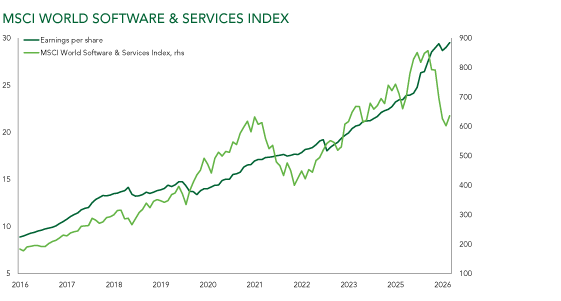
Her view is straightforward. Earnings per share in the sector have continued to grow, but share prices have moved lower as investors worry about the impact of artificial intelligence. That gap between operational performance and market pricing is what has drawn Ruffer’s attention.
AI could change how software is built, sold and used. It may also disrupt parts of the market where companies currently earn attractive margins. Investors are right to question which software businesses can defend their positions and which may struggle.
But Ker also makes clear that enterprise software is not easily replaced. Large companies rely on trusted systems for security, compliance, data management, workflow and customer support. In many cases, switching provider is risky, costly and disruptive. That gives established software companies a stronger position than the current valuation pressure may suggest.
Ruffer had previously avoided much of the sector because valuations were too high and share based compensation was a concern. The recent sell off has changed the calculation. Ker says Ruffer has now taken a small position in a basket of software companies, not because the AI risk has disappeared, but because the price now looks more attractive relative to the risk.
Ker is focused on companies with strong balance sheets, solid cash flow and durable market positions. Higher funding costs expose weaker businesses that relied too heavily on cheap capital after covid.
Her argument is not that software is risk free. It is that the market may have become too negative on parts of the sector.
Source: Bloomberg, data to 30 April 2026