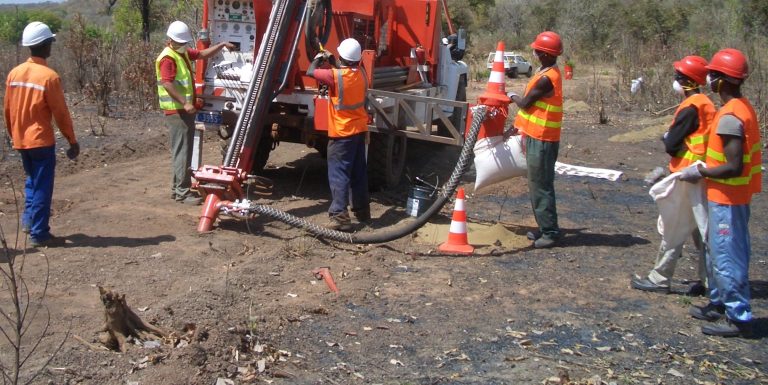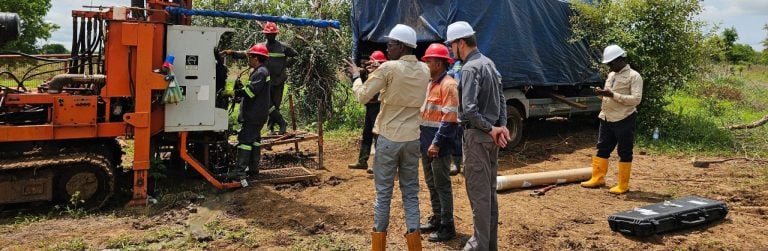
Oriole Resources plc (LON:ORR), the AIM quoted exploration and development company focussed on Central and West Africa, has announced that, further to its announcement on 17 June 2026, a maiden drilling programme is now underway at its 85%-owned Wapouzé limestone project in north-eastern Cameroon.
Highlights
· The Programme is planned for 1,000m in 19 holes, to target steeply-dipping metamorphosed limestone (or “marble”) units in the northeast of the licence that have previously been classified as high-grade carbonate material, potentially suitable for use predominantly within the cement industry in Cameroon.
· Outcrops within three main zones, covering a cumulative strike length of 1.2km, will be tested to vertical depths of up to 40m.
· The first hole, WPDD001, was completed at a depth of 55m and intersected marble units to the end of the hole, supporting a continuation of the package to the northwest. Within the hole, a number of narrow metamorphosed dykes cross-cut the marble although the full width of the package is not yet known.
· Based on an in-field portable X-ray fluorescence (‘pXRF’) pre-screen on the core, it appears to be good quality (i.e. >50% CaO with low magnesium and silica). The core will now be sent for laboratory-based analyses.
· The Company anticipates that the Programme, together with a planned geophysics resistivity survey, will support the estimation of a maiden Mineral Resource Estimate (“MRE”) and/or a JORC Exploration Target for the Property in H2-2026.
· Oriole Resources is continuing its discussions with industrial partners for the potential development of this asset.
Chief Executive Officer of Oriole Resources, Martin Rosser, said:
“We are pleased that drilling is now underway at Wapouzé and that the initial signs are encouraging for the delineation of a limestone resource with commercial potential for use in cement manufacturing. We greatly look forward to the results from the full programme.”
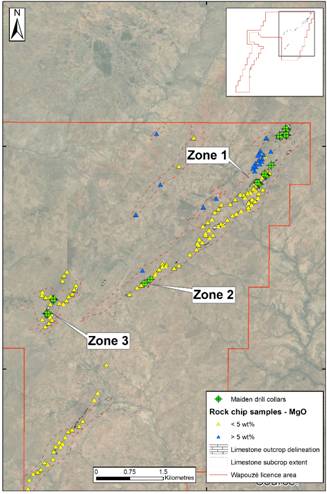
Figure 1. Wapouzé maiden drilling plan to test outcropping metamorphosed limestone units within three zones in the northeast of the licence. Rock-chip sampling results plotted on MAXAR satellite image, with MgO values of less than 5 wt% and more than 50 wt% CaO shown in yellow. Samples with >50 wt% CaO and low MgO are considered to have appropriate carbonate content for use in the cement industry
Further Details
Wapouzé is in north-eastern Cameroon, approximately 100km NE of Garoua and 20km north of the Company’s Bibemi gold project. It was initially an early-stage gold exploration project; however, the Property was deemed less prospective for gold than Bibemi and instead, the Company noted the presence of large quantities of carbonate (predominantly metamorphosed limestone).
In 2022, 14 rock-chip samples were collected for laboratory-based X-ray fluorescence (XRF) analysis to assess the suitability of the carbonate material for industrial use. Out of the 14 samples collected across Wapouzé, 13 samples were classified as high-grade carbonate material, potentially suitable for use in cement production and the Company subsequently proceeded to apply for a change of commodity for the Wapouzé licence, from gold to limestone, which was approved by the Ministry of Mines in September 2023. As part of corporate restructuring in 2024, Oriole Resources has an 85% ownership of the Property (see announcement dated 17 October 2024), with the remaining 15% being held by its Local Partners BEIG3 Sarl and Roxane Minerals Limited.
During 2025, a further 139 samples (not including QAQC) were analysed and further confirmed the material’s high-grade carbonate limestone (>50% CaO with low magnesium and silica) classification that would make it potentially suitable for use in the cement industry (see announcement dated 21 April 2026).
Oriole Resources today reports that it has commenced a planned 1,000m diamond drilling programme in 19 holes at Wapouzé to provide a better understanding of the depth continuity of these outcropping limestone units, which dip steeply (60-80 degrees) to the southeast. All holes have been planned towards an azimuth of 320 degrees and will be drilled at an inclination of 50 degrees.
The first hole, WPDD001, was completed at its planned depth of 55m and intersected a package of marble units, cross-cut by narrow metamorphosed dykes, from 1.30m downhole. The hole ended in limestone, supporting a continuation of the package to the northwest although its full width is not yet known.
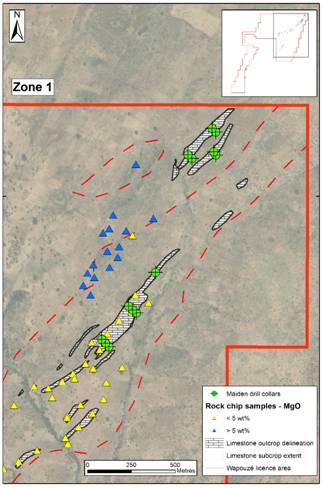
Figure 2. Planned drill holes over Zone 1, on MAXAR satellite image with mapped geology and MgO (wt%) data for all limestone rock chip samples collected to date at Wapouzé, where CaO content is greater than 50%. Samples with a minimum 50% CaO are considered to have appropriate carbonate content for use in the cement industry
Direct geochemical measurements on the core using a handheld pXRF unit shows it to be of good quality (i.e. >50% CaO with low magnesium and silica). The core will now be sampled more formally and sent for laboratory-based X-ray fluorescence (XRF) analysis.
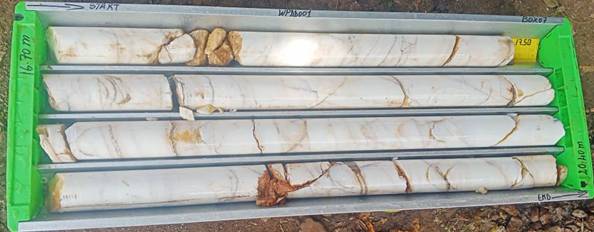
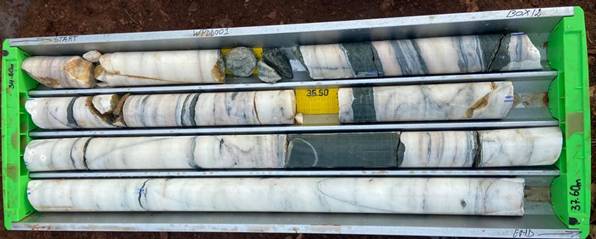
Figure 3. Examples of metamorphosed limestone units intersected in hole WPDD001. Top: massive, metamorphosed limestone. Bottom: Marble crosscut by metamorphosed dykes with a schistose texture
The Company also plans to complete a geophysical resistivity survey which, together with the drilling, the Company anticipates will support the estimation of a maiden MRE and/or a JORC Exploration Target for the Property in H2-2026.
Commercially, a significant limestone deposit at Wapouzé could be highly suitable for use within Cameroon’s cement industry, which is believed to be worth several hundred million pounds per year, largely supported by expensive imports of required clinker material. The Company believes that there is a significant demand for cement (for concrete) within Cameroon and neighbouring Chad (with its capital, N’Djamena, located approximately 250km NNE of Wapouzé). Furthermore, Cameroon has seen substantial foreign investment made into expanding its cement manufacturing capacity, with neighbouring plants to Wapouzé producing cement from similar material, and the government is keen to see its reliance on imported clinker reduce significantly.
Oriole Resources is continuing its discussions with potential industry partners that could advance Wapouzé towards development and exploitation on an expedited basis. The Company is ultimately looking to achieve royalty-based income from a commercial scale quarrying operation, likely to be based upon the volume of material extracted, which would provide valuable in-country revenue that could be used for funding its gold-based exploration work in Cameroon.